Categories
Showcase 2022

Women’s House: A Oneself Community

Women’s House: A Oneself Community

Mr. Waris Sinsuebpol

Introduction

“Kaira Looro Architecture Competition 2021: Women’s House” took place to eliminate all forms of discrimination and to promote gender equality and female empowerment in Africa. The challenge of the competition is to design a women’s house that aims to promote gender equality as a key factor in rural development. The structure must be a space dedicated to hosting activities which focus on education, raising awareness, and developing the village in the name of equality.

I decided to enter this competition as an experiment in architecture design in May 2021 with the hypothetical objective of designing the architecture that can help lifting a quality of human’s life.

According to the information provided along with the additional research, there can be seen that the problem of gender equality can be divided into 2 aspects; First is the physical problems while the latter is something to deal with mentality. The physical problems as we knew, it could be described as a limitation of the accessibility in education and the lack of facilities in many countries in Africa. However, the mental problems are yet to be considered too, to lift the expectation in solving this problem. Mentality issues could be involved in these subjects, such as the lack of self-esteem, some issues in their believe, and their cultures, etc.

The project tended to focus on not only women alone, but also men. Even though the main subject is a women’s house, but arguably, when gender is mentioned, that means people is still being categorized and that might still be questioned about an equality. Therefore, hypothetically, if an equality is the main idea, neither women nor men should not be mentioned, but a focal point of the project would rather be shifted to see more on “humanity” and could consider this project to be “a oneself community”. consequently, the programs, space, facilities, of this project have been carefully thought and designed for everyone.

Furthermore, the project approach was not only to design a conceptual architecture, but also required to think more about the possibility to build and be inspired by local traditions as well as to use as much local material as possible. Therefore the area of study such as, the gender equality problems, local traditions, topography, climates, religion, local building material, and local architecture, are the subjects that had been studied through.

Conclusion

In conclusion, this project could expectedly become another experimental project to prove one of the aspects of architecture that; Architecture could be a medium to help people to improve their quality of life, as well as could provide the space that can encourage people to be able to lift to their potential. The result of the project was not only the conceptual and preliminary design drawing, but the project was also required to be able to build by the local builders and under the certain budget, therefore the conclusion of this project is also to declare further on the cost estimate as well. And another part of the project conclusion is as follows.

Objectives Aims or Purposes

To design the architecture that could help to encourage women to gain more self-esteem and more potential to be ready to live in the society with confidence as well as to provide the place that men can learn to be open-minded and to see what women are capable of so they can learn how to treat women equally.

Process or Methods

DESIGN
A problematic Issues
From the information provided, with additional research, it can be seen that the problem of gender equality can be divided into 2 aspects; First is physical problems while another is to deal with mentality. The physical problems as we knew, it could be described as a limitation of the accessibility in education and the lack of facilities in many countries in Africa. However, the mental problems are yet to be considered too to improve the progress. Mentality issues could be involved in these subjects such as the lack of self-esteem, some believe, and some cultures, etc.

A oneself community
When we say word “equality” that means we’ve valued them as an essential condition of being human. However, in this project, we might possibly need to think from different angle, mindset on this project would rather be shifted to reflect more on “humanity” and could instead consider using the word “oneself”. To achieve knowing oneself, a self-esteem is the core feature be considered.

It is very important that women must know and believe in themselves before others do. To do so, they must be encouraged what they are good at, what they are capable of, what their potential are and how to achieve that, and more importantly, to make them be proud of who they are and what they do. Once they can come across that, so they will be prepared and ready to improve their education and skills. On the other hand, to achieve this community means that every everyone in this community needs to learn about themselves and others. So, men will also
be a key in this circle, and both women and men must understand each other. They need to learn what women are capable of as well as to believe that women can also do things as good as men. And then there will probably be no more “equality” as they are now at the same level, a human.

The Programming
Programming is considered with both the design brief and the aforementioned problems. This project will be comprised of management area for 8-10 people, storage, meeting room, first-aid room, and multi-purpose room for education and library. Not only that, but the project also comprises a middle open courtyard as a central gathering space with an amphitheatre to be utilized in a winter and summer time

Conceptual idea and strategy
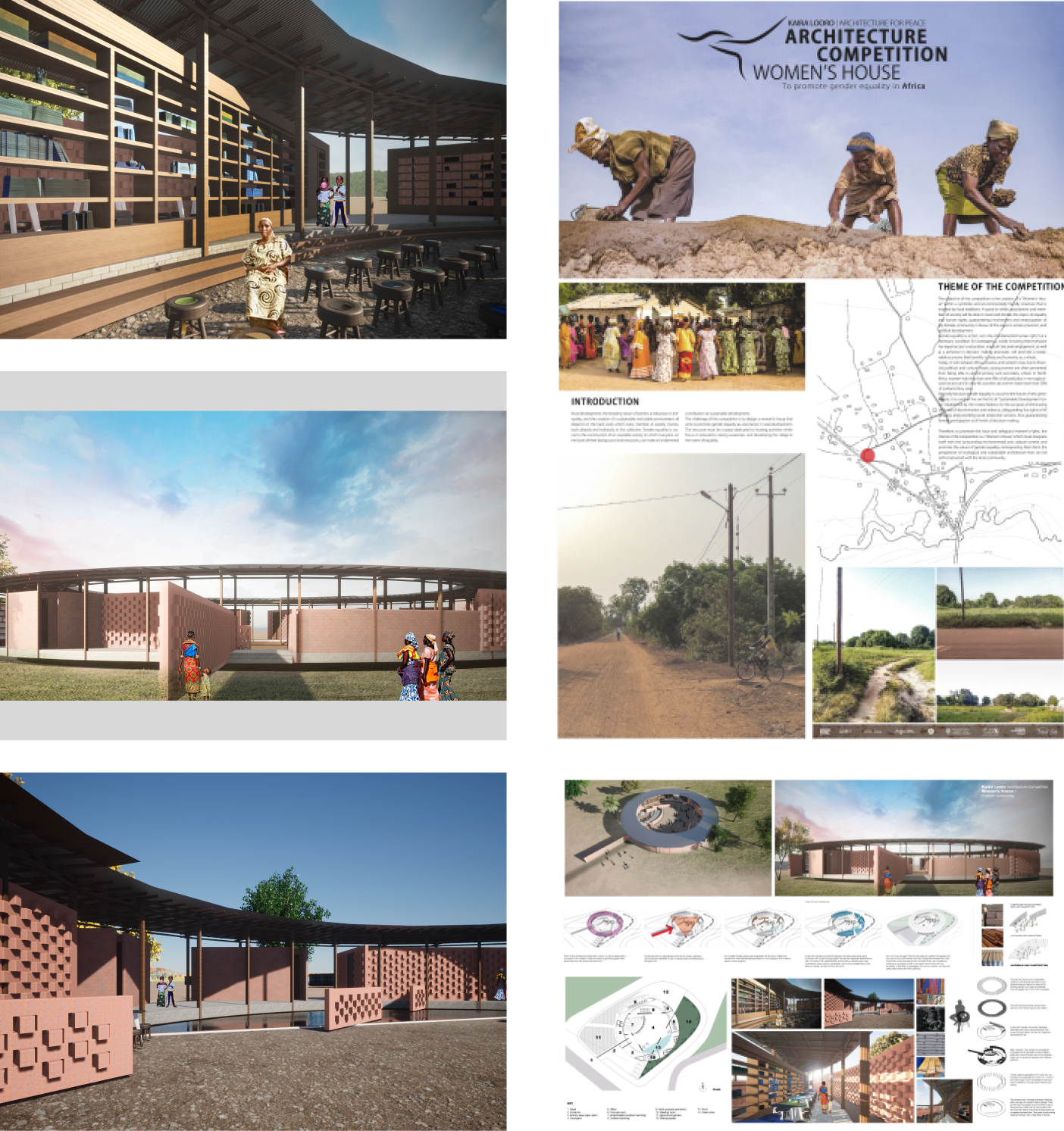
Centralize the decentralized – community. The idea is to generate the sequence of the activities. Firstly, to centralize the community by gathering everyone in through one entrance, no priority, no hierarchy, no gender, only one way in and out. Encouraging their focus to one direction using the wall panels to lead their vision, and once they got in, a sense of direction will continue leading people to the destination.

However, once this journey is completed, the program will now be decentralized, and people will start a new one with their own choice. No pressure, no manipulation, they can freely select their own activities if it’s available. To do that, the architecture is designed to have an open plan so they can see all the activities all at once. The enclosures are limited to where necessary such as bathroom, office, etc.

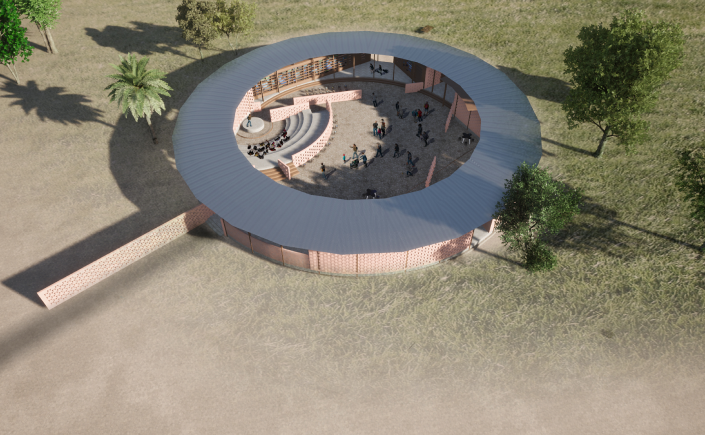
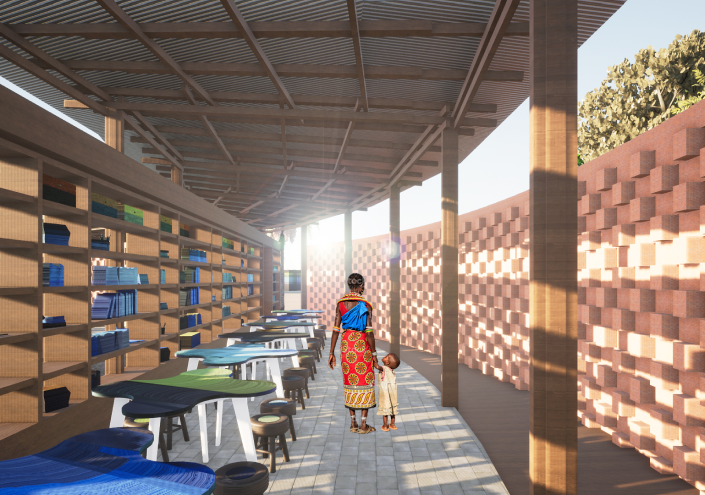
Therefore, a form of the architecture starts with a circle in a donut shape with a courtyard in the middle to create a gathering space while preventing from the external environment, then it’s pierced with an approached entrance to create a pathway.

To layout the programs, the connection between 3 main functions were considered as a triangular link. An invisible triangle shape was integrated into the donut. Solid wall panels then were deliberately generated on that triangular line to define where the open space and where the 200 sq.m.- enclosed space will be. All sceneries are carefully thought and selected what to be seen and what needs to be hidden in each program.

Then the functions will be considered along with the form. A wall with visually connection between activities were done using brickwork with a see-through pattern as well as integrated bookshelves wall. A function that needs partially privacy like a meeting room was considered using a pond to physically control the accessibility but still allowed to visually connect to the main court.

All in all, it can be seen that the core idea is to gather the people into this community, both women and men, fading themselves from their former life, and encouraging them to restart their new mindset by creating an architecture with a new open environment with no boundary in activities, knowledges, and communication, so later, they can presumably leave with their new potential.

Techniques and materials

MATERIALS & PROPOSED METHOD OF CONSTRUCˇION
Main material in this project is earth brick because it could create a solid wall, a see-through wall, and a breezed black wall. It could be versatile with different patterns. It is also easy to find, it’s local and not expensive. In terms of the looks and feel, it’s raw and don’t need much of maintenance so it could show its true beauty even when the time has passed.

The main structure from the ground still needs to be concrete for the building’s floor with Clay Brick finished. The courtyard in the middle can still be earth. The roof structure will be using timber columns with timber beams and rafters. The roof will have to be a lightweight material, and because we need a very shallow slope to keep the mass of the building as light and clear as possible, the corrugated roof is the main candidate. Some of furniture were also proposed using a tire with a wooden top covered with a local fabric for internal use, and with a raw timber finished for the outside furniture.

The construction is very straight forward. Starting with a survey and locate a donut shape. Then do the main foundation and find other lines of triangular axis walls and do the support with the one that need it. Forming the formworks for a casted concrete floor. Then start the plumbing. Casting the floor with a Clay Brick finished. Next is to work on the columns, as it can be seen from the lists of material, a timber post is very thin, so the idea is to assemble 4 of them for 1 column with bolt to gain more compression load and leave a rebate on the top to joint beams and rafters and adjusting the level of the rafters in order to get a right slope for the roof.

About the wall, study the brickwork and calculate the bricks before start. When it comes to the door frame, the concrete column and lintel need to be casted before installing the door frame. After finishing the wall, install the roof to prevent the building form the weather. Installing doors and windows and the sanitary wares. Then after the whole construction process, we gave some idea to use a used tyre to make some furnitures. Its top could also be covered with local fabric to add some gimmick to the project as well.

Size or Mins.

–
Categories
Showcase 2022

Interior Design of the Siri Khoa Yai Resort Project

Interior Design of the Siri Khoa Yai Resort Project

Ms. Kalunyoo Sipiyauk

Introduction

Khao Yai is Thailand’s third-largest and one of the most visited national parks that blessed with a lush, mountainous landscape, with fertile valleys, pounding waterfalls and rich biodiversity. Due to Khao Yai being a year-round getaway destination just three hours’ drive from Bangkok, It is a popular destination for both foreigners and Thai tourists.

The owner, khun Siriluck Manakijsombul’s desired to run a business about destination place for travelers by turning her own fallow land to be a luxurious private resort with the idea of “Nature friendly” and “Cozy feeling”. As a discussion with all design parties includes of architects, interior designers and landscape designers, every team should run through every process together from the beginning.

Regarding the owner’s aim to make this place be like a private resort, public areas are allocated in compacted space that can be supported no more than 20 guests for each area. On the other hand, guestrooms are more priority. There are 4 room types contained with a room size that larger than the standard resorts and proper functions suite to various target groups such as couple, newbie parents and family group.

To relate with the owner’s first approach, the interior concept would talk about “Wardian Case” which is symbolized of plants container. But during the design process, an architect team has changed the design form resort style to be modern style because of the owner’s preferring. However, the interior concept has to still remain about plant container but it has changed from “Wardian Case” to be “Glasshouse” which shown feeling of “Nature within Space” by using 3 ideas. First concept is “Terrarium” which shows of plant, followed by “Riparium” which shows of water and rocks and the last one is ” Vivarium” which shows of life. All the interior concepts about nature feeling have to be blended into modern style architecture.

Finally, due to the designer teamwork, all design processes are successfully completed. At the present, the Siri resort is in the process of construction which will be completed in a mid of 2023 and hope that it will become a destination for all tourists who visit Khao Yai.

Conclusion

Lastly, although the conceptual “Nature Friendly” is the main concept of project design, the final architectural design was too expose and dissonant from nature, Due to the owner’s concept change. Nevertheless, the interior design strives to maintain the core idea about nature follows the concept : Terrarium, Riparium and Vivarium as much possible while still has to blend the design to architecture style. Then focus on the development of functions that can serve various target groups which are hoped that if the project is completed, it will become a destination for all tourists who visit Khao Yai.

Objectives Aims or Purposes

1. To create a brand identity that conveys the harmony between human and nature following the owner intention.
2. To create resort’s function and design to suited to customer’s behavior and requirement especially couple and newbie parents.
3. To experiment the alternative guestroom types for various behavior of target groups.

Process or Methods

1. Survey and Information Analysis
The process started with site surveying and competitive strategy analysis followed by gathering information from the owner then making a discussion with all designer parties for determining an overall initial conceptual design.
2. Conceptual and Preliminary Designs
After architectural drawings were issued by the architect team, interior design process continued with alternative furniture layout plans, initial design sketching, 3D perspective rendering, and presentation
3. Proposal Approval
A meeting with the owner would hold for conceptual presentation and taking the owner’s comments for further development.
4. Design Development
When the preliminary designs were approved by the owner, the interior design team would take all feedback from the owner and continued the Tender drawing for contractor bidding.
5. Construction Drawing and Specification Document
Construction drawing packages would be started after Value Engineering (VE) process.

Techniques and materials

– Hand sketch
– AutoCAD
– SketchUp
– 3D Max
– Photoshop
– 4 of A2 Presentation Boards

Size or Mins.

–

Categories
Showcase 2022

Conformal Elimination

Conformal Elimination

Mr.Wantawee Simchomphu

Introduction

The confrontation with changing situations, it was found that the way human can survive change is to “adaptation”. In psychology, “adaptation” is a type of behavior that is used to modify a behavior to a given situation. It’s the type of behavior that helps humans survive in changing situations. The effective adaptation must be based on creativity and reasonable. The human who confront of a problematic situation must be a systematic thought process there is a clear set of goals for adaptation. This will lead to “Conformal” behavior or harmonious behavior.

When humans are faced with problematic situations human beings will learn what are the obstacle and what is the goal. Then the process of adaptation is carried out through self-defense mechanisms such as suppression , the blame to others (Projection), rationalization of oneself. (Rationalization), regression, reaction Formation, Daydreaming (Fantasy), Isolation (Isolation), venting anger (Displacement) even Imitation (Identification).The outcome of the adaptation depend on the method choices of the individual expression.

Therefore, human are able to survive in the changing situation is to maintain a balance between ourselves and the environment changing, according to the events and situations encountered.

Conclusion

When humans are faced with problematic situations human beings will learn what are the obstacle and what is the goal. Then the process of adaptation is carried out through self-defense mechanisms such as suppression , the blame to others (Projection), rationalization of oneself. (Rationalization), regression, reaction Formation, Daydreaming (Fantasy), Isolation (Isolation), venting anger (Displacement) even Imitation (Identification).The outcome of the adaptation depend on the method choices of the individual expression.

Objectives Aims or Purposes

Demonstrating to the confrontation with changing situations, it was found that the way human can survive change is to “adaptation”. In psychology, “adaptation” is a type of behavior that is used to modify a behavior to a given situation. It’s the type of behavior that helps humans survive in changing situations. The effective adaptation must be based on creativity and reasonable. The human who confront of a problematic situation must be a systematic thought process there is a clear set of goals for adaptation. This will lead to Conformal behavior or harmonious behavior.

Process or Methods

1. Pencils sketch on paper line with a black ink pen.
2. Imported sketch images into the computer for customization vector and digital paint
3. Editing and customization vector software in Adobe Illustrator and digital paint in Adobe Photoshop.
4. Bring color and color scheme.
5. Manage the detail of the works.
6. Test print process.
7. Artworks Printout.

Techniques and materials

Adobe Photoshop, Bitmap/Raster Digital Printing. / Tools
– Selection Tool / -Brush Tool / -Move Tool /- Adjustment / -Colour / -Layer etc.,

Adobe Illustrator, Vector / Tools
-Selection Tool/ -Pen Tool / -Pencil Tool / -Blend Tool / -Colour / -Swatches / -Gradient Tool etc.,

Size or Mins.

Print on paper size 20X30 inch

Categories
Showcase 2022

Cross Dimension

Cross Dimension

Mr. Akarapon Kritruenonwong

Introduction

In today’s society, designers with multidisciplinary design are in high demand.
Designers, on the other hand, are usually interested in their own preferences, such as 2D or 3D works, and begin learning design work from that medium.

“Cross dimension” refers to a design that has a connection with multiple dimensions.
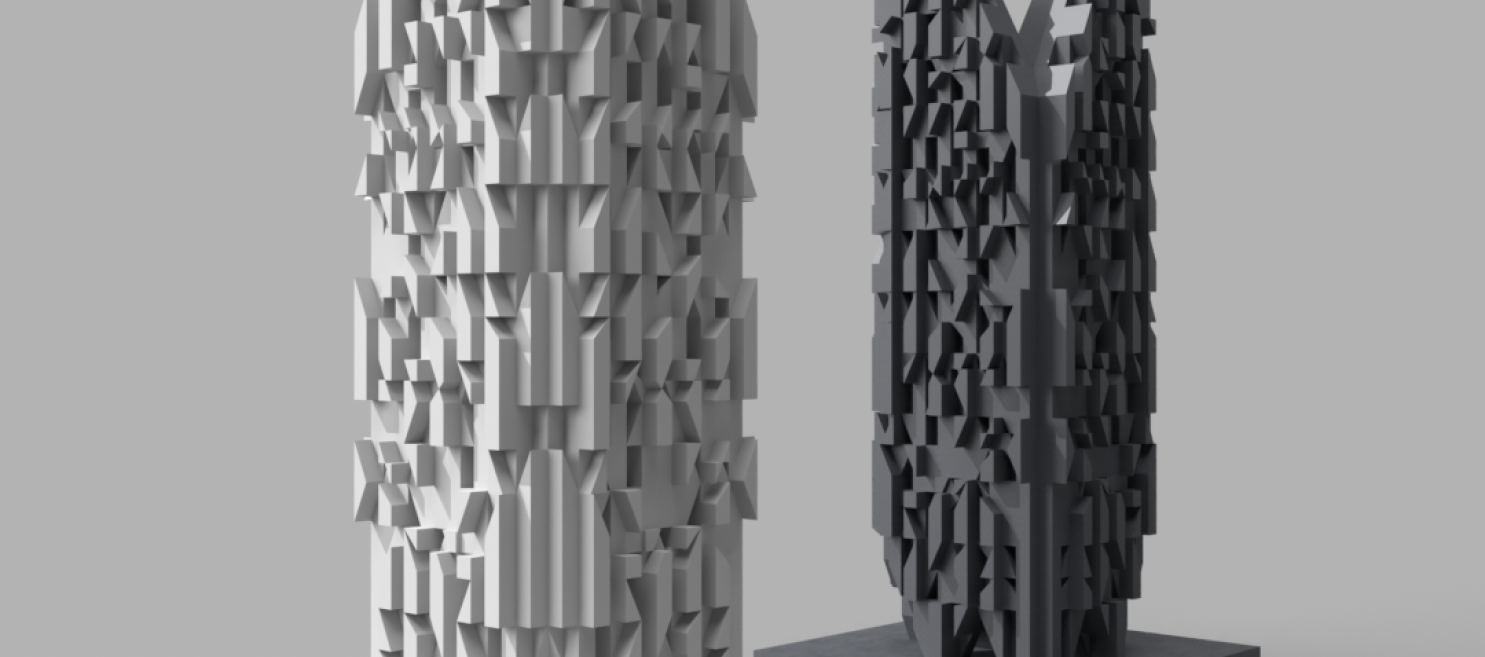
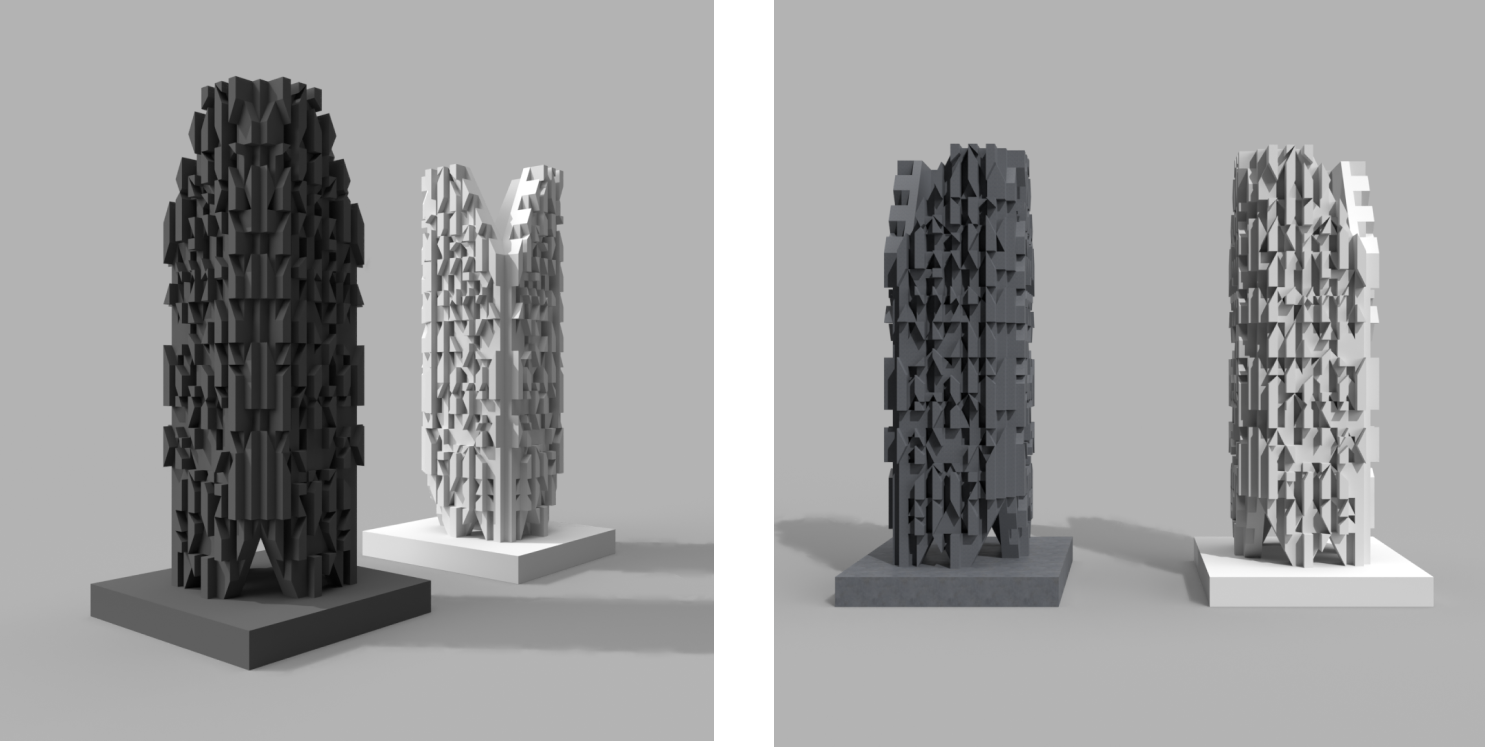
I’ve noticed The relationship. The link between 2D and 3D designs will broaden the designer’s vision and improve the 2D or 3D knowledge of design. As a result, this design work conveys the link between 2D and 3D designs. The relationship between the results of altering the dimensions and the other dimension will have an impact on the other dimension. It can also display the opportunity to design by the understanding of multiple dimensions.

This work has developed from an experimental study of Thai ornament grids to applying modern designs from that grid to 2D design the typeface design and illustrations to 3D design. in the form of a digital model to study and improve in order to see the relationship of design in numerous dimensions in the previous year’s works. The goal of the project is to show the outcomes of the 2D design one works that have been developed into a 3D design. One can create a 2D design with a large number of works by understanding the connection of dimensions. In the context of both space and time.

Conclusion

Building a body of knowledge on the relationship of dimensions in design through study and development so that it may be used empirically. It also represents an opportunity to create designs in the context of space and time.

Objectives Aims or Purposes

1. Research and develop the transmission of the relationship between 2D and 3D design.
2. Display the outcomes of the work’s design based on the knowledge of the relationship of dimensions in the design.

Process or Methods

1 Graphic design using a Thai ornament grid in the composition of art
2 Create 3D models from 2D design.
3 Experiment and develop concepts with a 3D design program.
4. Determine the light and shadow at different times of the day and year using the 3D model.
5. Summary of Design for Design Presentation.

Techniques and materials

Mix media, Graphic Design, Visual Communication Design

Size or Mins.

–

Categories
Showcase 2022

Islamic Art with image of Thai identity

Islamic Art with image of Thai identity

Dr.Danu Phumalee

Introduction

The Qur’an never directly mentions the art. But it ever refers to the beauty which God
created. The essential of Al-Qur’an was related to the way of life and mind in good. The
Goodness was symbolized with all beauty and created things. Muslims were applying it to lead a
valuable life with intelligence and faith. Value, function, systematic and reason are priority for
Islamic designers to represent beauty within the mosques, to symbolize their life style.

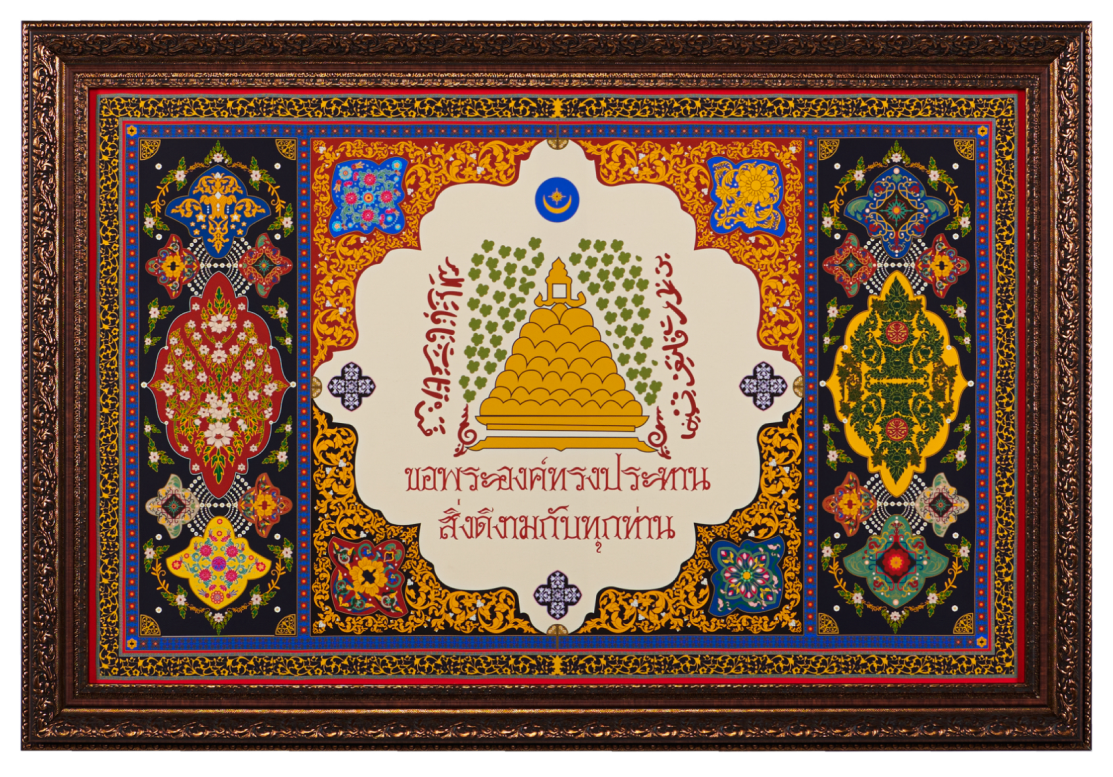
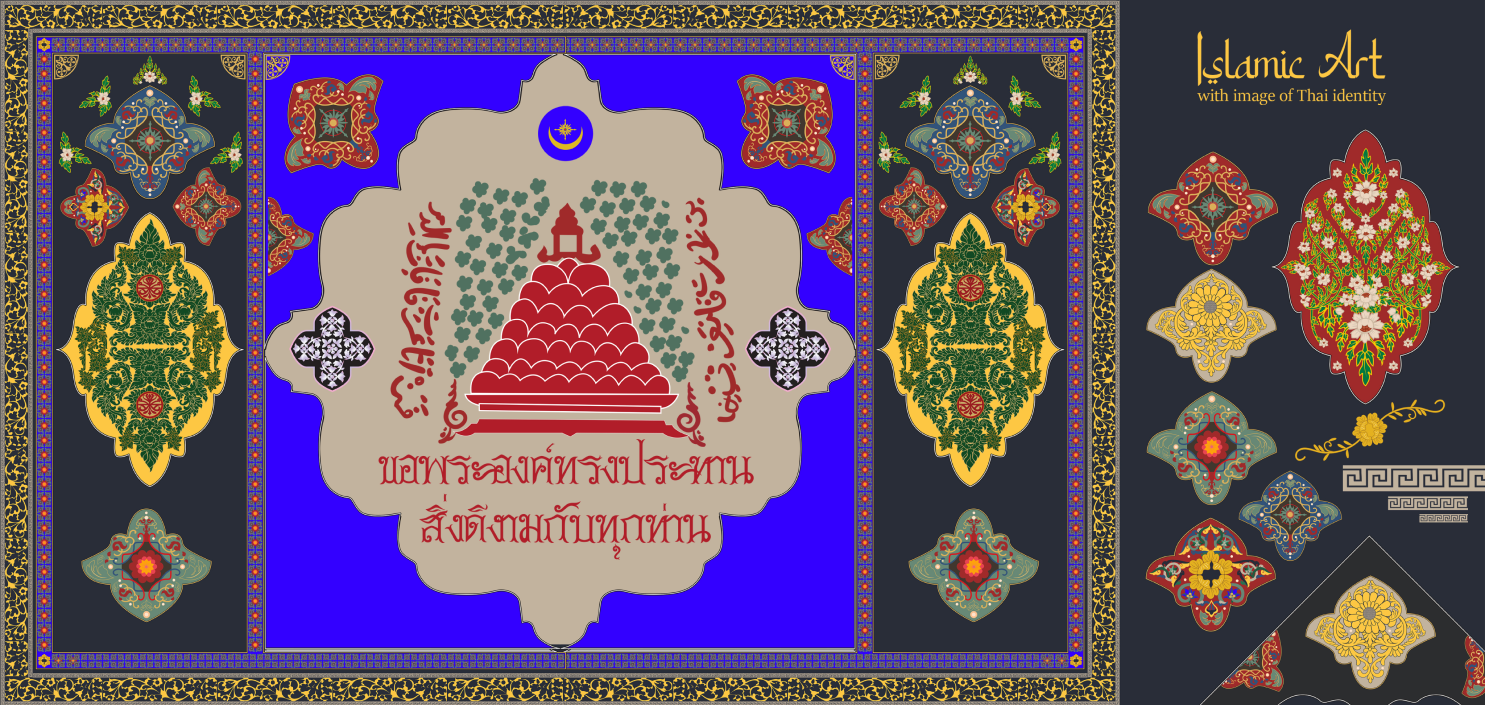
The Muslim identity is represented by three main structures of design such as Arabesque,
Geometric Form and Arabic Calligraphy.

The main factors of Islamic art identity in Thai mosques include of image of Thainess, image of traditional ethnic identity of Asian Muslims in Thailand, image of conservative Islamic and Arab identities, image of Modern/Post Modern and Deconstruction art.

The elements of Thai mosques consist of the principles of Islam, related to the meaning of
Holy Qur’an in the mosques structure such as Unity, Respect, Knowledge, Balance, Modesty,
and Remembrance. The Muslim life and culture in Thailand, related to local material and the
process of traditional art and the sign recognition of all Muslims in the world, related to the rule of Islamic art.

Conclusion

Overall, the findings of this research reveal that Islamic art in Thai Mosques were built under the a lot of method according to the circumstance of society. Since the late Ayutthaya period to early Rattanakosin period, the Mosque was under the patronage from the government. Thai traditional art was selected during this period. Then the Muslims from around Thailand
immigrated to Bangkok and brought their local art and blended it to Thai style. After the end of
Islamic Empire in the Middle East, the Arabian styles have been evident to Thai Mosque. The last
is the way that Muslims maintain their identity with the adjustment design to the new world.

Objectives Aims or Purposes

– To study the graphic design process that can reflect the personality and identity of Thai
Muslims.
– To create a design direction that can enhance communication in visual communication design to reflect the identity of Muslims in Thailand.
– To develop graphic to reflect identity of Thai Muslim.

Process or Methods

This design research intends to identify the differences and similarities of Islamic art in Thai Mosques. Identify the concepts behind their image, what are the factors of their differences and similarities image, and how are they using the elements of Islamic art? The research methodologies are Thai Muslims with dynamic roles in Islamic culture were interviewed. In addition, a field survey a lot of mosques in Thailand. Data analysis was
based on the concepts behind their image by local lifestyle, culture, construction material and the characteristics of each period.

The Framework of this Design research was based on 2 keywords – Islamization: the principles of Islam, the beauty of God.
– Localization: the life and culture in Thailand, the environmental effect.

The elements of Thai Islamic Art consist of the principles .of Islam, related to the meaning of Holy Qur’an in the Islamic : Art nity, Respect, Knowledge, Balance, Modesty, and Remembrance.


Techniques and materials

Graphic / illustration and Digital print on canvas

Size or Mins.

–

Categories
Showcase 2022

1.1 REAL or FAKE No.1 1.1 REAL or FAKE No.2

<span data-metadata=""><span data-buffer="">1.1 REAL or FAKE No.1
1.1 REAL or FAKE No.2

Asst.Prof. Vichai Mekkerdchoo

Introduction

Nowadays, the internet plays an important role in the daily life of every class, profession and all ages. To attract consumers or the target audience is interested in the content they want to present, Words or Images must be used that will instantly grab attention, eye-catching, and arouse curiosity. This makes it sometimes presenting content that is exaggerated and distorted, misleading consumers. Leading to the wrong message either by forwarding the message or telling until it becomes a neglect of the truth in the content until there is nothing left of the truth outline Which is a trigger that causes communication problems as in today’s news.

It is also a source for disseminating information immediately. Sharing information is sometimes both real or difficult to investigate or find the root cause. Someone may intentionally create false information for a specific purpose. Some people took it and accidentally shared the wrong content.

When it comes to fake news, it doesn’t just mean fake news. But also includes information that is not true. Therefore, if we want to understand the process of forwarding or sharing information that is not true. There should be a need to understand the types of misinformation, people’s motivation and content that has been prepared and spread.

Fake news was originally defined in many ways. But from the European Commission and in the political context of the United States, it can be concluded that “fake news” means news that contains untrue, deceptive, or creating situational news, including covertly support news writing, according to a 2017 LSE Media Policy Project report by Tambini.

Fake News can be categorized into six groups based on characteristics of their content delivery:

Conclusion

In short, Fake News is false information presented as news, information for the purpose of misusing individuals to cause damage to a person or organization in order to gain benefits in any way

As for my works, want to present ideas, consider and make observations before believing or sharing any information to avoid causing damage to the person or any agency


Objectives Aims or Purposes

Problematic information circulating in the system and try to categorize Fake News ranging from fake news, to comedy, satire, for fun. The recipient knows that it’s not true, but wants to read and share it for fun. If the person or group of people being teased or ridiculed is not laughing, embarrassed, insulted, humiliated, or hated, it becomes Cyberbullying or Hate Speeches.

Another category is misleading content. This may be done intentionally or unintentionally. Sometimes, famous or credible people are impersonated to say or endorse it. There is also a variety of information to be linked, although in reality they may not be related at all.

For example, irrelevant research is linked to certain products or for the purpose of selling more products; Bringing old photos or images of other events into the same event, misleading the recipient that it is the same story or the same event.

The worst is the content that is intended to be edited. Whether it’s text, images, sound clips, video clips, whether it’s done for fun. Build faith or for various benefits is considered false information that has an impact on an individual, group of people or society as a whole. It is also an illegal act.

So before believing or share any information should be considered by observing the following methods.

1. Consider the credibility of the published website. If you find an online news site with only a few pages that not specify address or contact information for the author, it could also be a website created to spread fake news.
2. Check if there are other websites or news sources that publish the same news. If there is only one news source, it may be that the news is unreliable.
3. Observe the image by bringing that image to search from image search sites such as TinEye, Google Reverse Image Search, to know the source of the image, credibility or related to the news read
4. Check by bringing news titles or the content of the news to search in search results, users may find websites warning them that the news is fake. Or see the release date of the news that you may find that the news is real, but it was published in the past.
5. May consider asking for help from other people for consideration by inquiring on the web board or contact a reliable news agency to help verify

Process or Methods

Based on the concept laid out, the creator considers the meaning of the image for the work creation that will communicate and convey the story to the audiences towards work, bringing
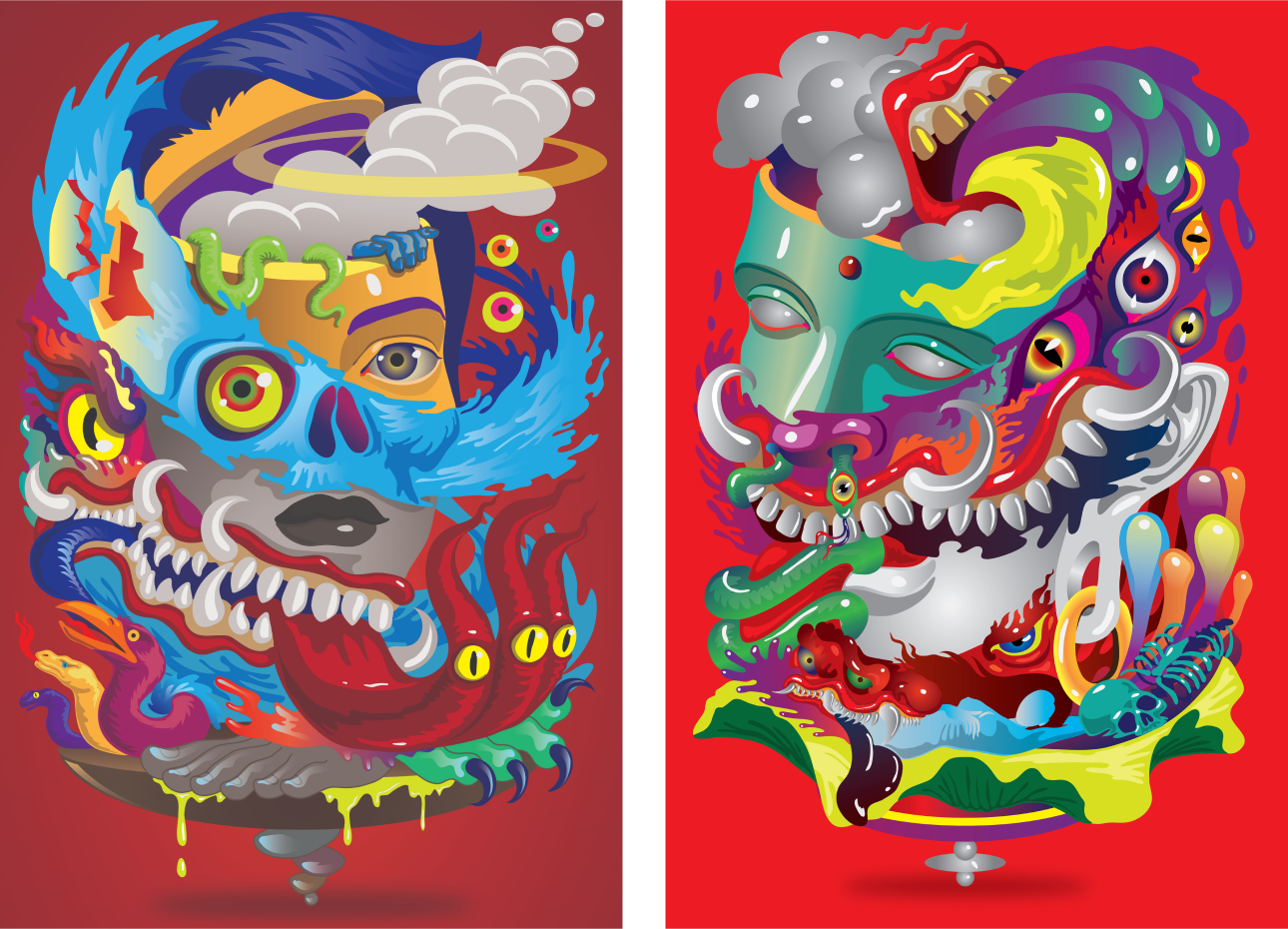
Confused feelings, looking for what is true and what is an illusion, wherein the picture, the truth and the illusion overlap
Here, the creator chooses to use images of common people, both men and women that look good and represent life. That overlaps with the skeleton that represents death, which is the opposite overlapping. Another tool for viewing and interacting with the creator’s work is a blue and red transparent acrylic sheet for viewing. In principle, when looking through a blue acrylic sheet at the work, the blue part in the picture will be invisible, leaving the part of the picture in another color. Same as, Red acrylic to see work, the red portion of the image will be rendered invisible, leaving the portion of the image in the other color. Here, the colored acrylic sheet that looks through the work will be like a tool for examining truth and lies.

Techniques and materials

From this concept, the creator takes Photos & Retouching technique that could be respond such concept.

Size or Mins.

1. REAL or FAKE No.1 : 60 cm. X 120 cm.
1. REAL or FAKE No.2 : 60 cm. X 120 cm.

Categories
Showcase 2022

Happy to Live Like a Kid Again

Happy to Live Like a Kid Again

Mrs. Achara Narklada

Introduction

 “Happiness” might be a thing that everyone can have. However, the current situation
forces us and the people around us to be distanced from happiness. A person who defines oneself as a happy person tends to get fewer health issues. He/she is also less likely to get ฃdepression and has a longer life span.

When we are tired or disheartened, it is undeniable that we sometimes miss our past and
would like to turn back time to be a kid once again. This is because our childhood life was so
beautiful, had the freedom to dream and were full of happiness, smiles, and laughter.

Even though we cannot turn back time to be a kid anymore, we can always reminisce
about our childhood and bring childhood happiness back to life. This is because each one of us has an inner child.

Conclusion

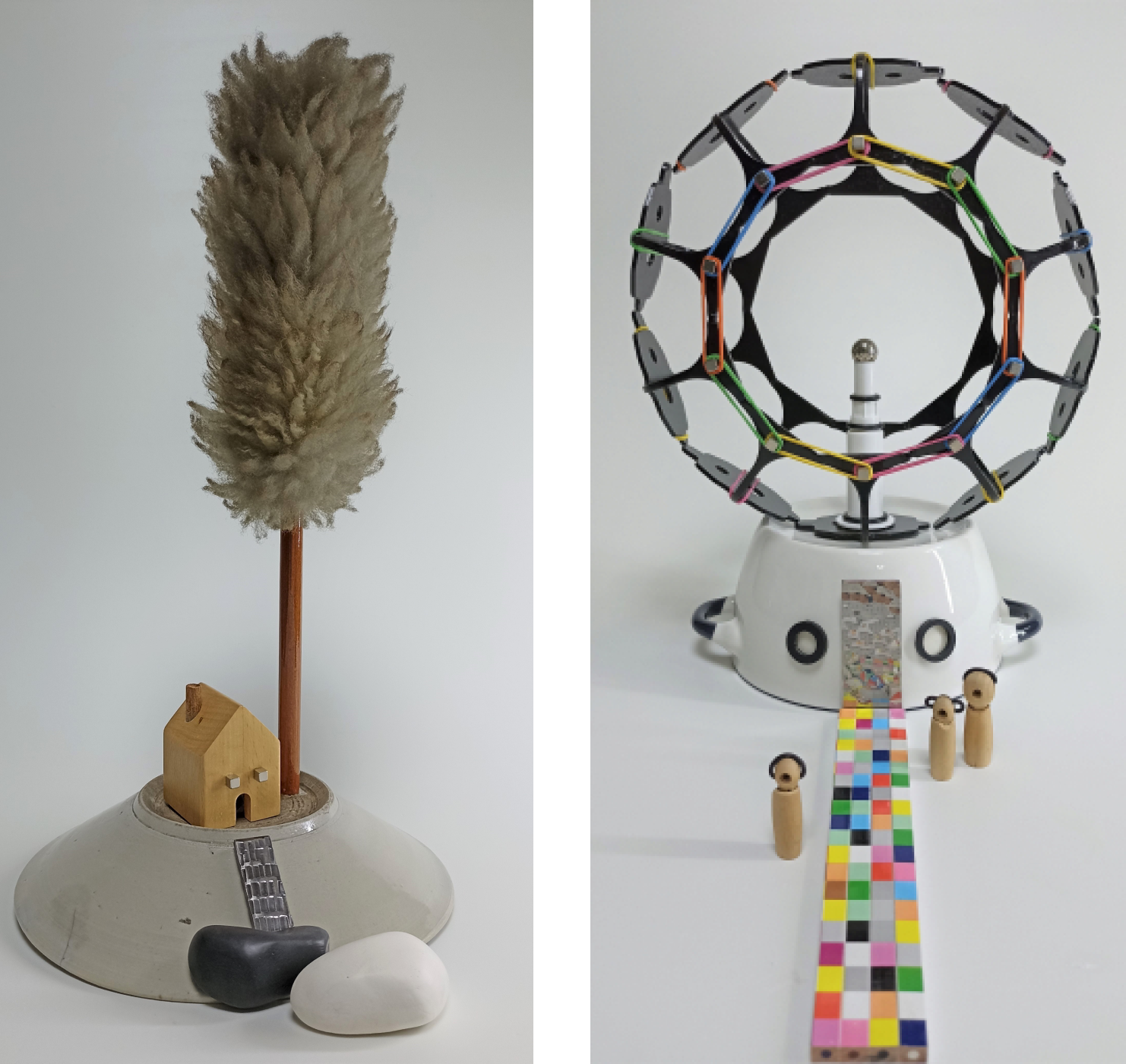
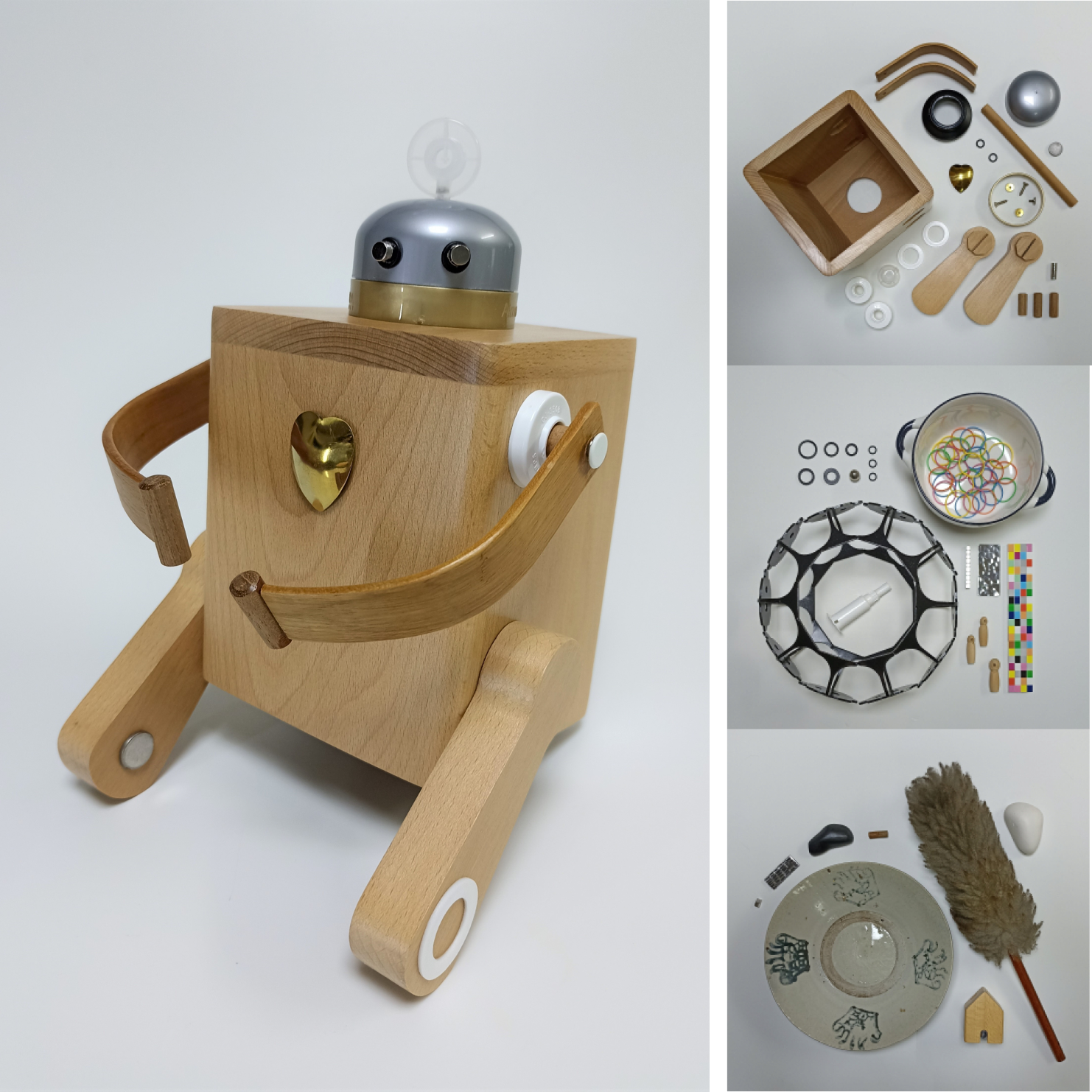
Old items when they have already been used, it would be thrown out as trash. However, if we bring these used items and combined them with other suitable stuff, it can create artwork that has beauty in another dimension. The point is when we create artworks we search for the bright side and beautifulness of ourselves and our surroundings, especially from the happiness in our childhood. We turn that positivity into energy to live the current life.

Objectives Aims or Purposes

1. To reminisce and review our childhood, and bring our childhood happiness back to
life.
2. To create an artwork that demonstrates the aspect and feeling of happiness derived
from the freedom to dream and play.
3. To create artwork that values the promotion of happiness by finding the optimism and
beauty inside our life and things surrounding us.
4. To reduce waste by converting the items that are no longer in use into artwork. Less
waste, less burden to the earth.

Process or Methods

1. Select the items that are no longer in use or left over from work.
2. Arrange and match the items without modifying the items.
3. Avoid adding any new materials in the artwork unless it is necessary

Techniques and materials

1. Ready-made objects.
2. Composition and arrangement.

Size or Mins.

0.60 X 2.00 X 0.45 m.

Categories
Showcase 2022

Work-Light Balance Series

Work-Light Balance Series

Assist.Prof.Tippaluk Komolvanij

Introduction

The work of “Work-Light Balance Series” had been compared between the words “Work-Life Balance” and “Work-Light Balance” to point out that the designer put a lot of effort to find the balance between timing, space and exposure in order to get reflecting images and efforts to find Life -Balance both in personal and work life during the Covid-19 era. So far all works and personal life had been all at home, which caused the balance of life to be imbalance, lacked of quantity although life according to the theory should be equal to 50 : 50 both work and life.

In each images, the designer set images placement and graphics to strongly contrast by giving the part of colors instead of personal life and nine graphic lines instead of workload to show the hard works of today’s people, which each had the goods in life, wanted to be progress in every efforts (Nine means successful in Thai), but they neglected to take care of their private lives, which caused of imbalances. However if people can set their timetable of each activity accordingly, life will have more pleasure and enjoy both work and living.

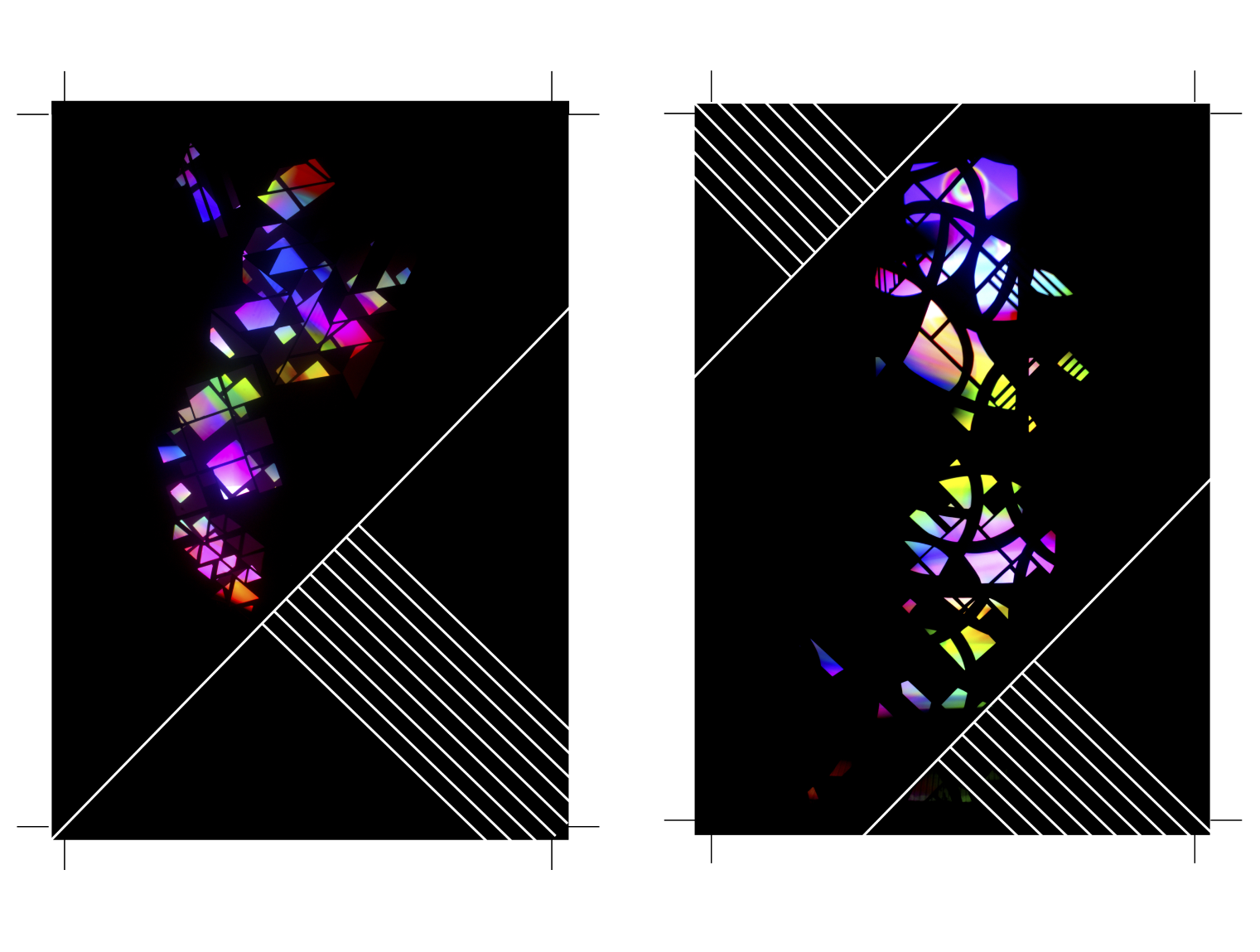
For the process of photography, the designer got inspired by the work of Hanna Huhtamo – Finnish Artist, who said “Darkness is my canvas and light is my brush” so experiments with long exposure photography using lights source from an Android application instead and used cutting papers into shapes both geometric and free form together to stack on top of each other as in random manner as well as used the lights from Disco Lights application to shine behind the paper and its result been created by lights, by the time the Disco Light application changed the light colors continuously, an alternating colors light all the time and the light still switch through only some of the paper resulting in new shapes, became new strange and unique shapes with pretty bright colors. The visual style will not be the same every time the light is on and the papers can switch to and from to get more beautiful images.

Conclusion

From the selection experiments for application to be the light, found that the nature of the colored light depends on the used application. Some will have a light switch setting and
strong enough, which made photography in form light-painting but the light results was not beautiful or not appeared on images.

The work of photography in this series reflects both the balance in the camera settings and the balance of light from the mobile application, it also reflects the life being that there must be a balance between work and personal life as well. When life’s balanced, happiness in life will follow

Objectives Aims or Purposes

1) To experiment with creating works by using long exposure together with paper cutting and Mobile phone
2) To bring the results that have been created to be further uses

Process or Methods

1) Form shapes, physical outlines : geometric shapes and other free forms on A 2 paper randomly arrange the elements.
2) Cut the paper as the shape been set.
3) Placed the cut-paper on the steel frame, put the patterned cut-paper on another sheet of paper by allowing each to be spaced 1 inch apart.
4) Set up the camera by using a phot method Long exposure photography to be set speed at 15 sec. open F-stop 22 and used ISO 100 to take photo together with tripod and mobile-phone.
5) Download Appliction Disco Light (Androids) to be used as a light camera shine over through the back of the patterned paper when shooting.
6) Bring images to be decorated with additional graphics in the program Adobe Illustrator.
7) Bring the resulting images without further editing to retouch for making shirts and bags to further the creative works to be used in other ways.

Techniques and materials

Long Exposure Photography and Photographic Technique called “Light Painting”

Size or Mins.

–

Categories
Showcase 2022

A Creation of Textile Design through Thai Cultural DNA for Millennial in part of Fulfilling

A Creation of Textile Design through Thai Cultural DNA for Millennial in part of Fulfilling

Assist. Prof. Dr. Thanotai Mongkolsin

Introduction

From an interview with Dr. Suwit Maesinsee (2016) on the government’s policy on Thailand 4.0 in terms of Creative, Culture & High Value Service, he talked about the elements of Thai Cultural DNA. The cultural DNA meaning is the cultural information
transmission from generation to generation. It comes from two sciences, they are organisation field and biological field (Min & Lee, 2017). Cultural DNA is like a cultural identity that can be passed on from generation to generation which differs from country to country. Sasin Institute,

Chulalongkorn University and Kellogg School of Management, Northwestern University have previously studied that “Thai Cultural DNA” consists of 5 Fs: Fun, Flexible, Friendly, Flavouring and Fulfilling. In this research, the researcher selected one of five Thai cultural DNA to design a loincloth pattern. It is “Fulfilling”, which corresponds to the Outdoorsy style. It refers to the researcher’s previous research (Mongkolsin, 2019). Outdoorsy Style is associated with outdoor activities lover (Merriam Webster, 2018). It is a style that combines functional and stylish together such as camping etc. Outdoorsy people dress depending on the environment and weather conditions, for example, if the weather is rainy, they tend to wear a rain parka and rubber boots (Hine, 2017). From the research, the Millennial generation was born in 1981-1995 (U.S. Census and Bureau, 2014). Nowadays, there are approximately 20.6 million people in Thailand. They have high purchasing power (Marketeer, 2015) with lifestyles that emphasise fun, entertainment, fashion, interest in charitable activities and like to do activities with a group of friends. They have freedom of thought and plan their future lives (Jitpraphai, 2007).In addition, the Millennial Generation is the first generation to receive training from schools with the eco-friendly and sustainable concept. It led this generation to focus on this idea (Rogers, 2013)

which is consistent with the research idea. The researcher wants to design a new loincloth pattern to develop loincloth patterns and exchange knowledge of weaving wisdom with villagers in Ban Suan Por women’s group, Roi Et province through two sustainable fashion and textile approaches: 1) “Recreate” is to creatively rework from the existing design concept by designing from local wisdom and local craft labour mixed with the knowledge of Thai cultural DNA and fashion design for providing local people with income and careers, and 2) “Longer Lasting Fashion” is to design using high quality materials and craftsmanship. Design and tailoring make the pieces come out beautiful, precious and durable, as well as create a more emotional bond with consumers than just the utility alone (Fletcher & Grose, 2012). This process is used through the theory of Fashion & Textile Design elements. It consists of four key elements: Colour, Silhouette, Detail & Technique, and Material (Seivewright, 2012). The research methodology consists of four steps: 1) Literature review, 2) Expert interview, 3) Consumer questionnaire, and 4) Design and conclusion. The research result is a loincloth pattern that corresponds to the research topic for continuing to create clothes with an outdoorsy style, consistent with Thai cultural DNA and the Millennials to generate income in the local community sustainably.

Conclusion

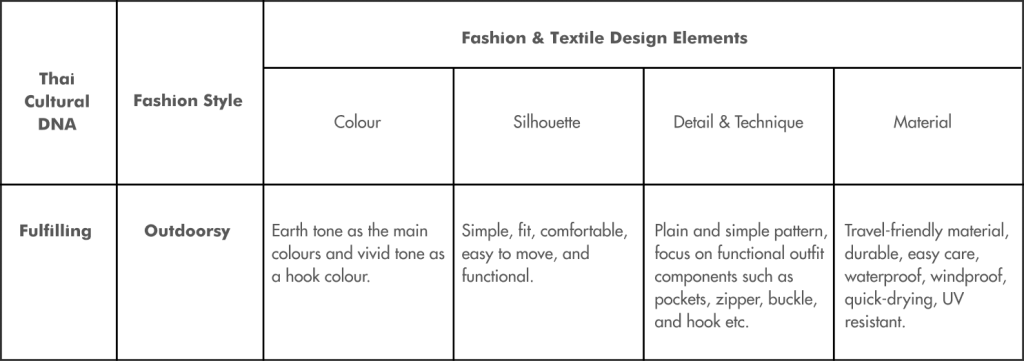
The researcher received information about Thai cultural DNA in the part of the word “Fulfilling” that corresponds to Outdoorsy style, which is a form of fashion style, to use as a reference for finding a loincloth pattern design for this research. After collecting research data from expert interviews and target group questionnaires, the researcher used the above information to analyse the results as the following research results. The table shows the results of the analysis of data collected from expert interviews and target group questionnaires to be used in the loincloth pattern design for this research.

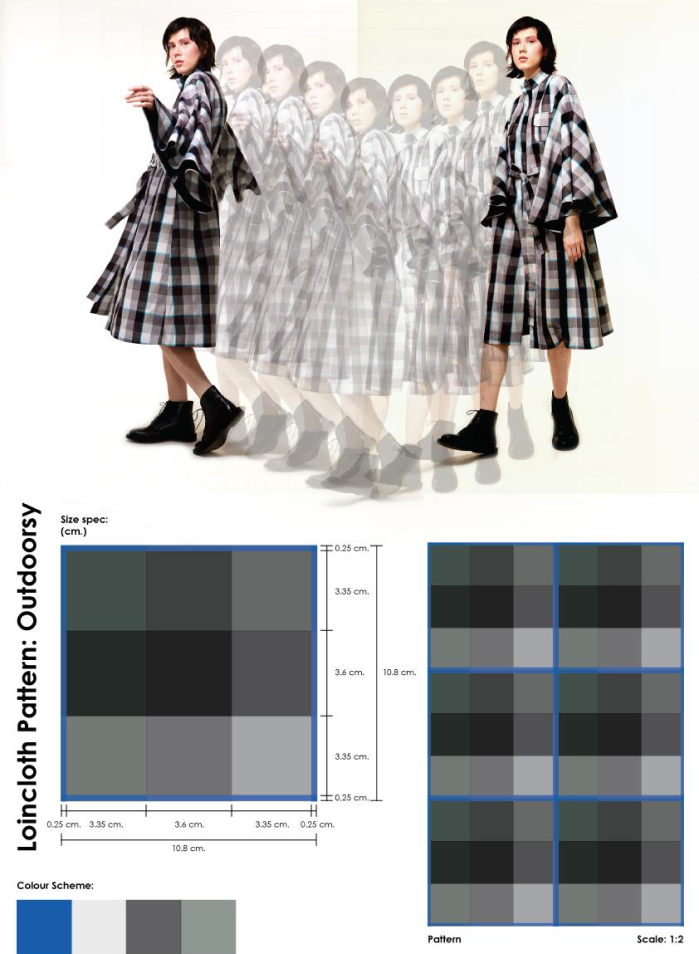
After receiving the analysis data, the researcher used this information as a guideline for designing a loincloth pattern that was consistent with the research topic. The researcher has summarised the result of the loincloth pattern design. The loincloth pattern is designed with a 3 x 3 grid motif, each of which measures 3.6 x 3.6 centimetres. It is white, grey and black in 9 different compartments and has blue lines, 0.25 centimetres wide, to be projected into the frame of the motif grid. (As shown in the picture), the researcher then asked the villagers to weave the loincloth pattern into a piece of cloth with recycled plastic bottle fibre. The cloth size is 80 centimetres wide and 10 metres long for the villagers to sew the sample dress in the outdoorsy style.

Objectives Aims or Purposes

  1. To extend knowledge of Thai Cultural DNA with fashion style to design textile pattern (Pha Kao Ma)
  2. To develop a Pha Kao Ma pattern, local textile, to be more contemporary
  3. To exchange knowledge of textile design and local wisdom with locals to lead to new fabric pattern designs

Process or Methods

A Creation of Textile Design through Thai Cultural DNA for Millennial in part of Fulfilling is a mixed methodology which is quantitative and qualitative research along with the creation of works. It uses a quantitative research method to collect information about Millennials lifestyle and personality traits, and a qualitative research method to collect information about the concept of Thai cultural DNA, fashion styles and design elements of fashion and textiles to know the approach of a research method. It can be divided into 4 parts as follows:

1. Literature review
2. Expert interview
3. Consumer questionnaire
4. Design and conclusion

1. Literature review
In order to know a creation of textile design through Thai Cultural DNA for Millennial in part of Fulfilling, the steps are as follows:
1.1 To study the concepts and theories about Thai Cultural DNA by studying the meaning, background and development of Thai textile design from secondary sources, including documents, books, textbooks, electronic media and related research by selecting “Fulfilling”, 1 word from 5 words of Thai Cultural DNA to be used in the design for this research.

2. Expert interview
At this stage, the research process will be qualitative research with the Delphi technique for collecting data from experts to lead the creative design process further by seeking opinions from a group of experts in the relevant fields that the researcher would like to study to find a unified conclusion (Wadecharoen, Lertnaisat, & Teekasub, 2017) in this research topic.
2.1 Data storage framework: From the study of information about fashion style in accordance with Thai cultural DNA in part of Fulfilling from the relevant documents, it was found that the fashion style that corresponds to Thai cultural DNA is Outdoorsy style. The researcher needs to obtain a framework of pattern design and loincloth weaving to guide the creation of a pattern prototype of the research and draw the conclusions of the fashion and textiles design elements from the experts appropriately.
2.2 Expert designation: By Delphi technique, the researcher must select a person who has knowledge and ability to conduct research studies (Wadecharoen, W. et al., 2017), therefore, the researcher determines the qualifications and sizes of the experts as follows:
2.2.1 To determine the expert’s qualification: The researcher has selected experts with knowledge and competence in fabric pattern design and loincloth weaving.
2.2.2 To determine the expert’s size: After defining the expert’s qualification, the researcher determined the expert’s size at 5 with a deviation of 1.20-0.70 and a net change of 0.50 (Silcharu, T., 2008).

3. Consumer questionnaire
It is a quantitative research process involving Millennials, the target group to find information about lifestyle, fashion and textile needs, and personality. This will be a guideline for the loincloth pattern design that is suitable for the target group’s needs. The steps are as follows.

3.1 Research tool creation
3.1.1 Creating a questionnaire
1) The questionnaire was interviewed with a representative of fashion style icons corresponding to Fulfilling, which is 1 in 5 Thai cultural DNA. She is a Millennial generation and has an urban lifestyle. The researcher selected her as a fashion style icon from a sample of target consumers for knowing the lifestyle and style of dress according to the elements of fashion and textile design to be used as a guideline of a research concept and the questionnaire structure.
2) Preparing the research conceptual framework.
3) Defining the questionnaire structure.
4) Creating a questionnaire for the target group.
5) Finding out the questionnaire tool quality.
6) Improving the questionnaire.

3.2 Targeting: In this research, the main target population were Millennials, living or studying or working in Bangkok, born between 1981 and 1995.
3.3 Data Collection: The researcher collected data from 100 questionnaires in 10 days.
3.4 Data Analysis and Presentation: The data analysis from the Millennial questionnaires was shown with frequency distribution, percentage, arithmetic mean and the standard deviation through presentations in tabular form with essays explaining the various issues as determined by the researcher.

4. Design and conclusion
During this research process period, the researcher designed the pattern prototypes to be a guideline in this research with Delphi technique data collection. The researcher divided the pattern prototype process and summarised the research results as follows.

4.1 Creating a pattern prototype process
4.1.1 Drafting the loincloth pattern then bringing the fabric pattern to an expert for examination and selection to find the most suitable fabric pattern.
4.1.2 Experimenting to weave the designed pattern to see the possibilities and weaknesses before proceeding with the improvement.
4.1.3 Weaving loincloth with the designed pattern.

4.2 Summary and discussion including suggestions for further research
Satisfaction was assessed through bringing this loincloth pattern prototype to sell in civil state stores (Pracharat stores) and to issue a booth on behalf of the Ban Suan Por women’s group, Roi Et province. Both the loincloth fabric and the loincloth clothing were made according to the outdoorsy style to be summarised and discussed including suggestions for further research.

Techniques and materials

Media Design Research, Analysis, Context, Photo, Format, Typography, ColourLocal wisdom weaving / Recycled plastic bottle fibre

Size or Mins.

–

Categories
Showcase 2022

Application of Wabi-Sabi Philosophy in creative fashion design entitled “Nature: Impermanence”

Application of Wabi-Sabi Philosophy in creative fashion design entitled “Nature: Impermanence”

Assist. Prof. Supreeya Suthamtarikul

Introduction

Wabi-Sabi philosophy is one part of the Japanese aesthetic which is derived from the relationship of feeling and spirituality. It is also found from life experience and nature, including Buddhist insights. Shortly, “Wabi” means simplicity while “Sabi” means the appreciation of uncontrollable decay including imperfect and unfinished. Symbolism is one of important techniques, was used in poetry and literature during the early pursuit of aesthetics. The concept “Impermanence” storytelling and symbolism techniques are mainly used. Wabi-Sabi philosophy history from Muromachi period to Edo period was told.


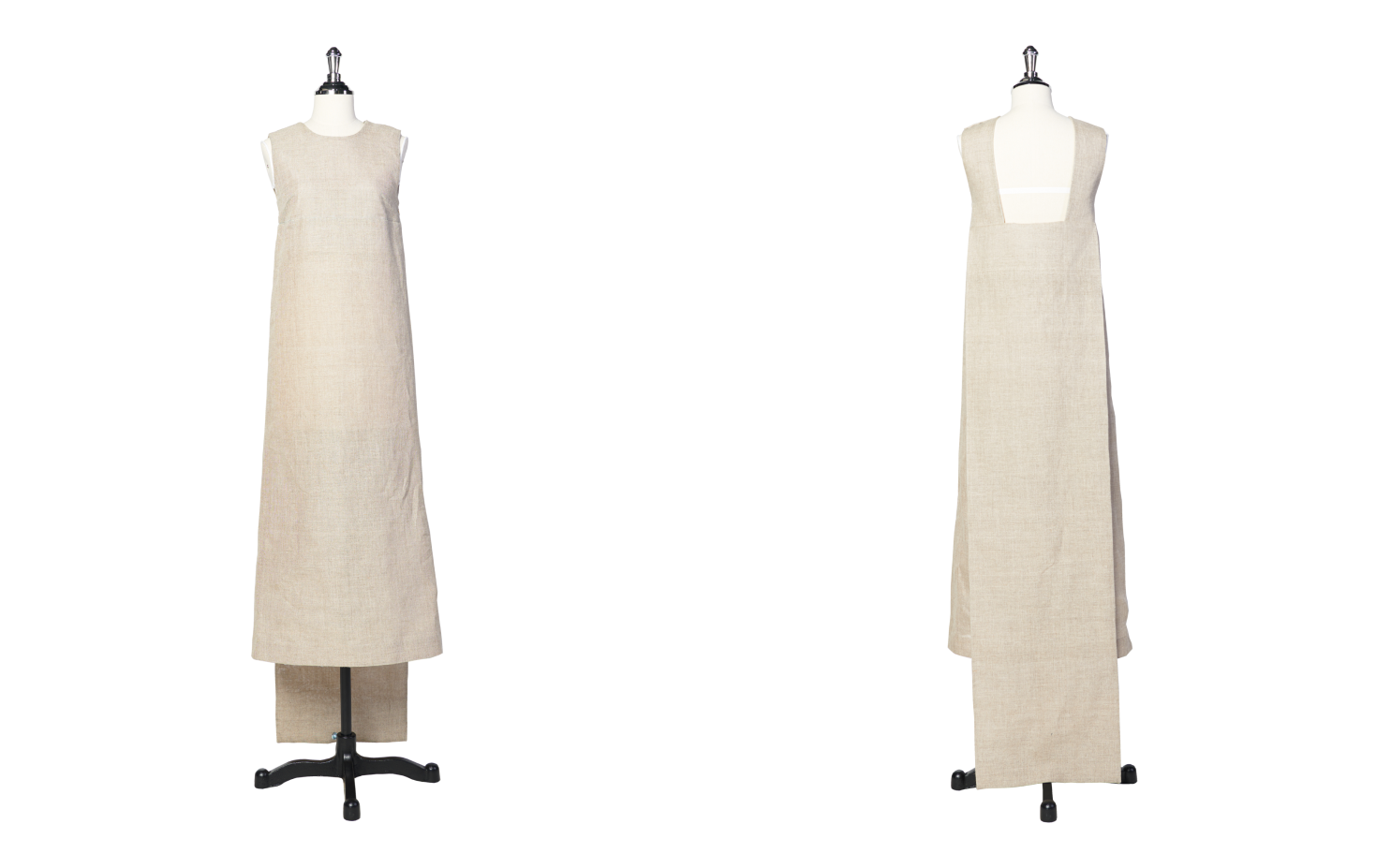
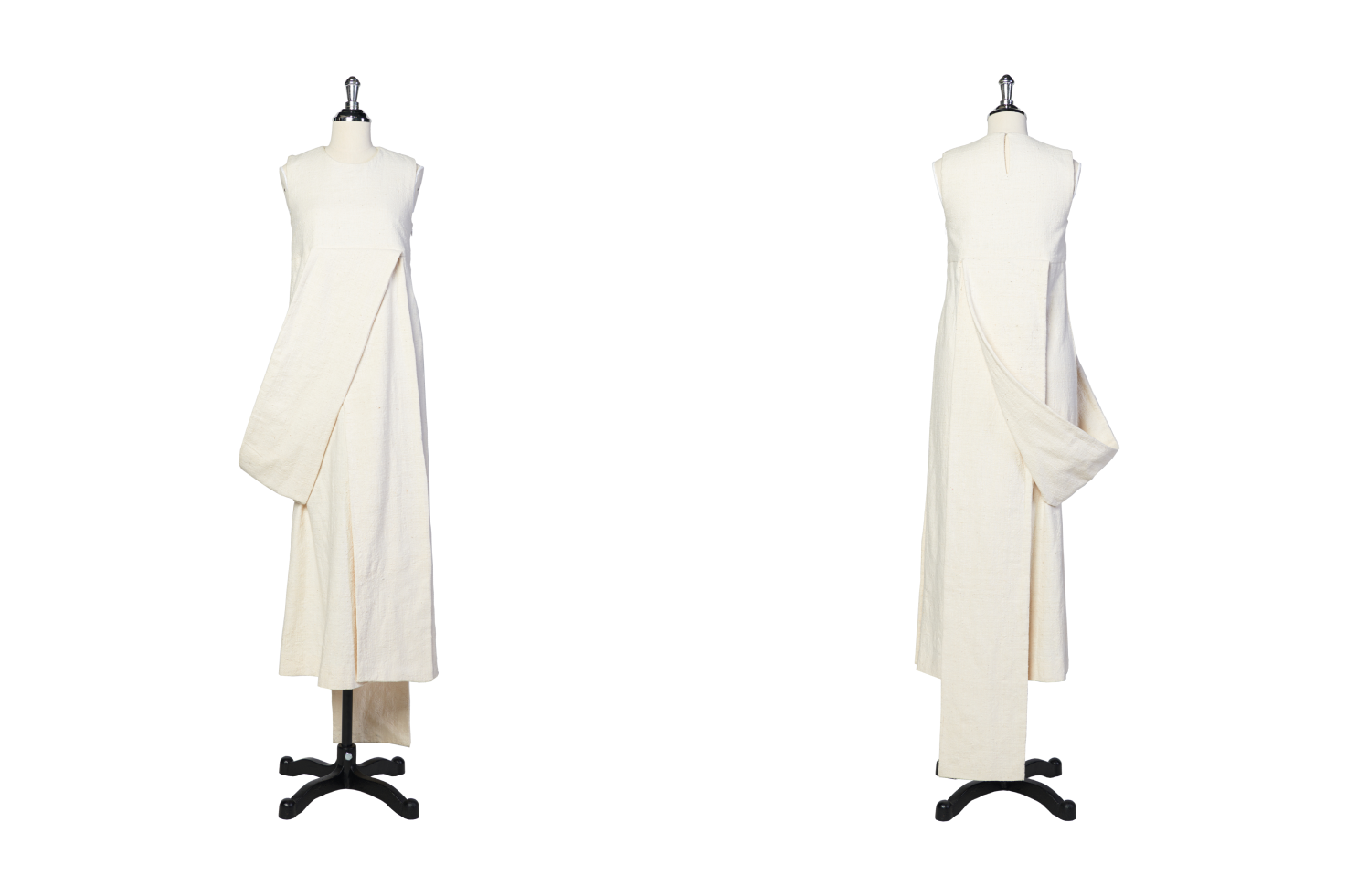
1. “Contradictions of thought” and expressed asymmetry, incompleteness in nature, is symbolized with long dress and skirts of different lengths, the long dress and short overcoat are represented wealthy people. The short skirt is represented the humble group of people, or “wabi-sabi” group.
2. The concept of “Shibusa” or naturalness are represented asymmetry and incompleteness with the 2 pieces long dress combination. One is reduced and cut some part off, then put together by stitching over each other.
3. “Confusion” concept is symbolized as a long piece of clothes folded alternately, and assembled on a long dress and also represented simplicity with confusion of life.
4. “Simplicity” based concept is symbolized as a single piece of long cloth using the “Kiri” technique or cutting out the unnecessary things to a minimum as “wabi”.
5. “Emergence” concept is symbolized with a simple square shape nested behind a long plain dress, using 2 long pieces of fabric attached to the back of the plain dress that is patched with different colored of fabrics at the back. The Kintsugi technique was used. It is a technique for fixing pottery showing imperfections.

Square shape behind the body come from the concept of changing style to new attitude, called “Iki” in Edo period. Rikyu’s teacup concept is simple and homegrown, using local woven clothes, which is a natural color, naturally dyed indigo and ebony. They are pineapple fiber fabric, cotton fabric, hemp fabric and linen fabric to represent “Wabi (simplicity) -Sabi(home grown)”.

The use of natural fiber hand woven technique for High Fashion is only average. High fashion and design are fairy good. Symbolism technique and possibilities in design simplicity should be worked in progress.

Conclusion

  1. Researcher gains knowledge in research and analyzed the evolution of the philosophy “Wabi-Sabi” to a certain extent, using historical data, telling stories and finding examples in its design. which has been applied to fashion design experiment The results were satisfactory to a certain extent.
  2. In designing by applying the philosophy “Wabi-Sabi”, this collection has been focused on the issue “Simplicity” in view of “Wabi”. The researcher used techniques of symbolism in design as the main guide. It also has been focused more on structural design. The issue of antiquity and traces of decay or the concept of “Sabi” is likely to be the next stage of research. However, the researcher used hand-spun woven fabrics instead of the old ones to represent “Sabi”. and also used the concept of repairing pottery “Kintsugi” technique using two types of fabric to represent the mood of home grown.
  3. Surface experiments has also been conducted in this research has been cut off. Simplicity issue as well as the structural design and symbolism were used. Due to the beauty of the
    fiber and hand weaving showing the indigenous and humility are clearly seen, in addition to highlighting simplicity and nature.
  4. In the part of sewing, considering the design output, there may have seen some limitations in tailoring by using natural fibers fabric. The successful results may be missed the creative needs. Handwoven fabrics from natural fibers in Thailand may be find difficult to used for High Fashion. It looks beautiful and valuable, however it is too expensive to use for ready to wear. Budget was found obstacle in creative experiments.
  5. Handwoven fabrics from natural fibers in Thailand may be found the non-tight problem in weaving, so it made the work unstable shape. They are expensive and faced a budget obstacle in creative experiments. However, they are so valuable that no one can deny.
  6. The use of natural fiber hand woven technique for High Fashion is only average. High fashion and design are fairy good. Symbolism technique and possibilities in design simplicity should be worked in progress.

Objectives Aims or Purposes

  1. To study Wabi-Sabi philosophy and analyze their concepts.
  2. To analyze the work of designers who probably applied “Wabi-Sabi” philosophy in their
    design.
  3. To apply the concept of Wabi-Sabi philosophy in creating fashion design titled “Nature: Impermanence” by creating form and structure and experiment surface design.
  4. To experiment by using woven fabrics from natural fibers in Thailand for fashion apparel.

Process or Methods

  1. Primary Research
    1. Collect natural fiber woven fabrics such as cotton woven fabrics, bananas, pineapples, etc.
    2. Experimental surface design (Embroidery or other methods) A4 size also form and structure design experiments by making pattern and sewing with calico
    3. Applied techniques for using symbols or signs in design.
    4. Applied techniques for experimenting forms and structures and surface design with the decaying (sabi)
    5. Design of 5 real works and sewing
    6. Evaluation of high fashion design by organizing a focus group and collecting assessment data.
    7. Evaluation of Creative Design at the College of Design International Symposium International Symposium Working in Progress: Green Design
  2. Secondary research
    1. Revew and Analyze concepts of “Wabi-Sabi” philosophy in history of aesthetic from books, journals, pictures, research and websites. Apply “wabi-sabi” which reviewed history of aesthetic from Heian to Edo period. Find some concepts to design a collection.

Techniques and materials

Symbolism technique is applied in fashion design. Experiment of symbolism technique with storytelling by representing forms and structures, using homegrown natural fiber woven; hemp, cotton, linen which are hand woven fabric for fashion apparel.

Size or Mins.

–