The Clown's Dogma
College of Design, Rangsit University, Thailand
Suporn Shoosongdej
Abstract :
The Clown’s Dogma is a single-channel vertical video (9:16, Full HD, stereo, 3 minutes 33 seconds) that brings together the artist’s own 1998 short film, shot on 16mm colour film and later transferred to PAL video (.AVI), with images generated by artificial intelligence. It starts from something most of us know from the daily flow of news, speeches and social media: violence, and the signs of it, are reproduced so often that we stop seeing them as events. They become a grammar, and eventually we speak it ourselves, above all in the belief that peace has to be won by force.
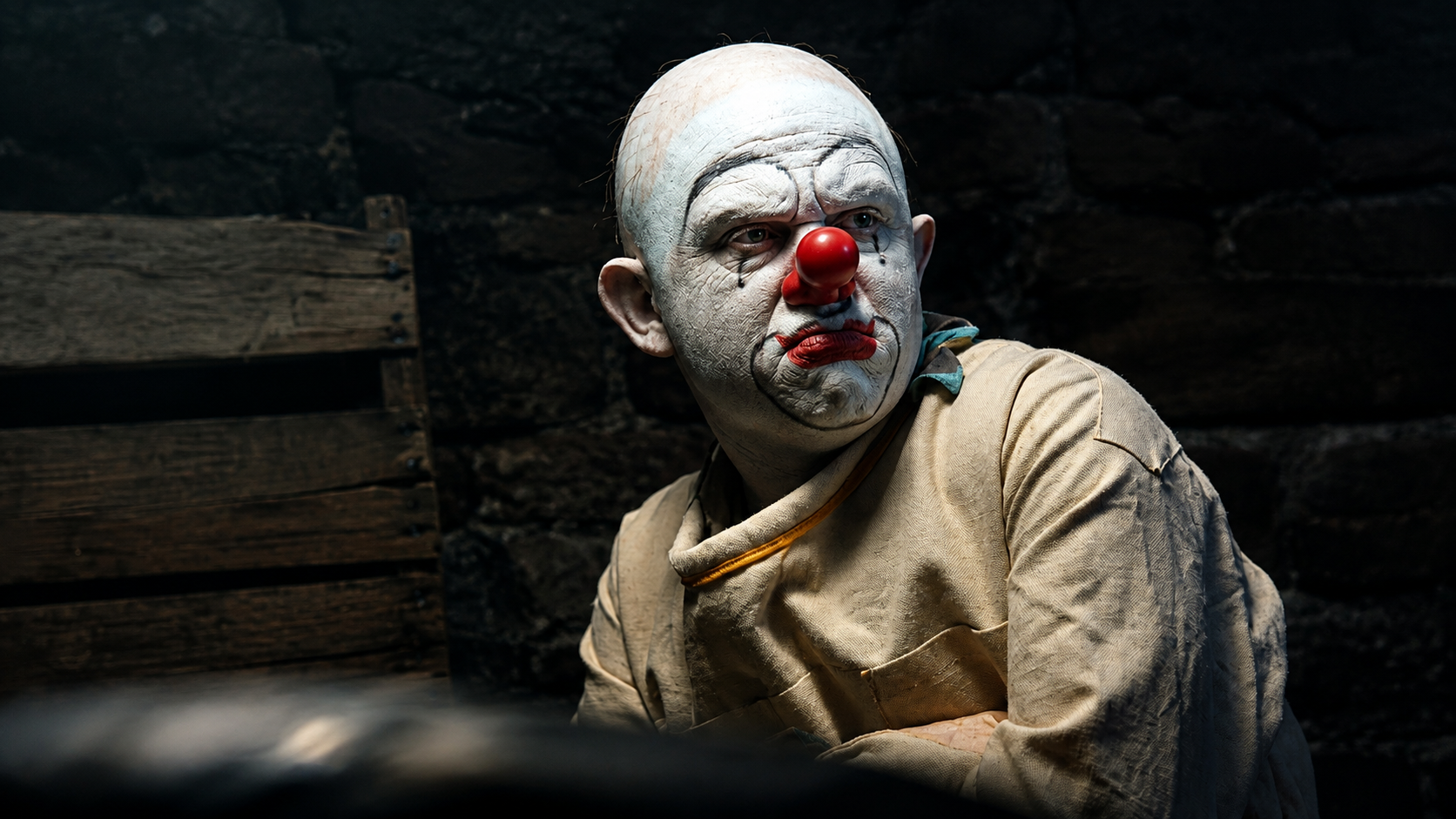
The work hands this belief to one figure: a bald clown with cracked white makeup, bound in a stained straitjacket and sitting alone in a dark room. He first appeared in the 1998 film and has been rebuilt here with AI. He speaks two texts that mean the same thing. One is the well-known closing passage of Franklin D. Roosevelt’s address after the attack on Pearl Harbor in December 1941, which led a nation into war. The other is Little Red Riding Hood, told twice: from the wolf’s side, ending in his death, and from the girl’s side, where she kills him herself. The telling is split into two clear parts. One is built from AI images that re-imagine frames of the old film; the other uses the colour-shifted 16mm footage itself. The two surfaces are two ways of perceiving violence under the same belief.
Read through the theme of postmemory, the texts and the footage are treated as inheritances. The speech and the fairy tale reach us with their morals already in place. The 1998 film has become a memory that even its maker can now reach only through copies. The AI images are synthesised from what has already been seen. Each layer repeats the one before, and each time the logic of justified killing comes through intact. The straitjacket holds the paradox at the centre of the work: the man society calls unreasonable is the one who says, most plainly, what society calls reason.
Objectives :
The project has four connected objectives.
1. To show how repetition turns violence into something normal. The work does not depict violent acts. It isolates the language that comes before them and makes them acceptable. Setting a wartime presidential address beside a children’s story lets viewers see the same rhetorical structure in two places usually kept apart, politics and the bedtime story, without the work having to claim they are the same.
2. To extend Marianne Hirsch’s idea of postmemory beyond family trauma. Hirsch describes how a later generation relates to experiences it did not live, passed down so strongly that they feel like its own memories. Here the idea is applied to stories of justified violence, learned through school, media and retelling, which shape how later generations understand force and peace.
3. To return to a question the artist-researcher first worked on in 1998: how the discourse of using violence to create peace is reproduced. The clown in the straitjacket was made then as a compound figure. The clown has long been allowed to say what others cannot; the straitjacket marks a body judged mad and restrained for other people’s safety. Together, he recites the logic of control while being controlled himself. The aim is to keep this figure open, so that it does not harden into a fixed symbol.
4. To set archival image and sound against AI-generated image and sound within one work. The 16mm footage carries the trace of a real moment; the AI material is assembled from vast inherited datasets. Placing them side by side asks which of the two looks more like memory. It also records how the artist-researcher directs, selects and rejects machine output while keeping authorship of concept, text, sequence and sound.
Together, these objectives frame the work as practice-based research in which the finished video and the documented process are both outcomes.
Conceptual Framework :
The work rests on three lines of thought.
The first is Galtung’s cultural violence: the parts of culture, such as ideology, language and art, that make direct and structural violence look right, or at least not wrong. A call to war for peace and a fairy tale in which killing restores safety both work this way. Neither commits violence; each makes it legitimate and repeatable. Zipes shows that Little Red Riding Hood has been rewritten for centuries to instruct its listeners, and Butler argues that framing decides which lives count as grievable. Telling the tale twice moves the frame, and the viewer sees that the violence does not move with it.
The second is Hirsch’s postmemory, applied here to inherited stories rather than inherited trauma. In Thailand, the memory of October gives this a closer meaning. Thongchai Winichakul describes the 6 October 1976 massacre as neither fully remembered nor forgotten, but held in an “unforgetting” shaped by silence. Chaiwat Satha-Anand shows how violence is managed through official truths that decide what later generations may know. The grammar the clown recites is therefore not foreign; it is how many societies pass on their violence.
The third concerns the figure and the medium. The clown is a licensed speaker with a confined body, so his words are allowed and discredited at once. The 16mm footage and its AI doubles carry this condition into the image: each is a copy of something no longer present, and none can claim to be the original memory.
Process / Methodology :
The work was developed in four stages.
1. Text. The artist-researcher took the famous closing passage of Roosevelt’s post-Pearl Harbor address and wrote two mirrored versions of Little Red Riding Hood, both ending in a killing framed as resolution.
2. Character. Frames of the clown captured from the 1998 film served as the identity reference for a character sheet generated in Google Gemini, specifying makeup, costume, turnaround, six expressions and a lighting key. The sheet then anchored the clown’s moving shots, generated in Google Flow.
3. Archive and regeneration. The 16mm footage of the girl in the red coat and the figure in the wolf mask was reframed from 4:3 to 9:16 and colour-graded. Selected frames were used to generate new images in Gemini, giving each archival image a synthetic double.
4. Sound and editing. The work was edited in Vegas Pro. The clown’s mouth was timed to the original recording of Roosevelt’s speech, the sound was mixed in stereo, and AI material was composited with the old footage in a vertical frame. Every AI output was reviewed, altered or discarded by the artist-researcher.
Techniques and Materials :
Tools: Claude (Anthropic), Google Gemini, Google Flow. Editing and compositing in Vegas Pro were done by the artist-researcher without AI.
1. Character sheet: the clown in the straitjacket, main character of the artist’s 1998 short film, was defined in Gemini using frames captured from that film as reference (prompt below).
2. Storyboard: Claude was used to develop a storyboard and shot prompts, built around the wording of Roosevelt’s address.
3. Generation: the prompts were run in both Gemini and Flow, and the resulting image, sound and mood were compared and revised over many rounds until they matched the artist’s intention.
Prompt — character reference sheet (used with frames from the 1998 film):
Using the attached image as the exact identity reference, create a professional character reference sheet for film pre-production. Keep the same person, the same face structure, and the same makeup design in every view.
CHARACTER: “The Bound Clown” — a slim middle-aged man, melancholic silent-clown type.
– Head: smooth bald cap, pale white-blue, no hair visible
– Face makeup: full white base; thin black eyebrows painted high and arched above the real brows; small black teardrop lines under both eyes; black outline around the mouth drawn in a downturned sad shape with a small red lip in the center; round glossy red clown nose
– Ears: natural skin tone, unpainted (keep this contrast)
– Costume: worn, stained off-white canvas straitjacket, arms crossed and bound across the chest, long canvas straps and buckles, ribbed mustard-yellow knit trim at the neckline, a grey hood or collar bunched underneath, dark trousers
– Mood: quiet, sorrowful, restrained, never grotesque or horror-like
LAYOUT (16:9, clean neutral mid-grey background, even soft studio lighting): Row 1 — full-body turnaround: front, three-quarter front, side profile, three-quarter back, back view (show strap and buckle arrangement on the back of the jacket). Row 2 — six head close-ups showing expressions: neutral melancholy, sideways glance, silent laugh, fear, resigned eyes closed, holding back tears. Row 3 — detail callouts: makeup design front and profile, red nose, yellow collar trim, buckle and strap construction, fabric texture and stains. Small corner panel — lighting key: the character lit by a single hard cool blue-white top-side spotlight against a pure black void, as in the reference.
Consistent proportions across all views, thin label text under each panel, photorealistic cinematic style, film still quality.
Result / Conclusion :
The project produced a completed 3-minute-33-second vertical video. The outcome works on two levels.
In the artwork, the doubled story works through recognition rather than argument. In the second telling, sympathy passes from the wolf to the girl while the killing stays the same. Beside the language of war for peace, this shows legitimacy being assigned by the frame, not by the act. The clown keeps that recognition unsteady: the viewer can neither dismiss him as mad nor accept him as the voice of reason.
In the process, two things emerged. First, the AI clown drifted from the slim figure in the character sheet towards a heavier, older face with makeup cracked like dry clay. The prompt never asked for that weariness; the drift is a reminder that generation repeats with variation rather than copying. Second, the sharp AI images look more alive than the blurred 16mm frames they came from. The synthetic copy looks more real than its source, which is close to how postmemory works: the inherited image can outweigh the event. For the artist-researcher, meeting a character from 1998 again through a machine made this more than a theory.
As work in progress, the project leaves two questions for the next stage: how the piece behaves on vertical screens in a gallery, and how audiences from different cultures read the fairy tale and the speech.
References :
Butler, J. (2009). Frames of war: When is life grievable? Verso.
Chaiwat Satha-Anand. (2006). The silence of the bullet monument: Violence and “truth” management, Dusun-nyiur 1948, and Kru-ze 2004. Critical Asian Studies, 38(1), 11–37. https://doi.org/10.1080/14672710600556411
Galtung, J. (1990). Cultural violence. Journal of Peace Research, 27(3), 291–305. https://doi.org/10.1177/0022343390027003005
Hirsch, M. (2012). The generation of postmemory: Writing and visual culture after the Holocaust. Columbia University Press.
Roosevelt, F. D. (1941, December 8). Address to Congress requesting a declaration of war with Japan [Speech audio recording].
Thongchai Winichakul. (2020). Moments of silence: The unforgetting of the October 6, 1976, massacre in Bangkok. University of Hawai’i Press.
Zipes, J. (1993). The trials and tribulations of Little Red Riding Hood (2nd ed.). Routledge.
Share :
Facebook
Twitter
LinkedIn
WhatsApp
Email
Print