Mind Governance Controller 2026
College of Design, Rangsit University, Thailand
Wantawee Simchomphu
Abstract :
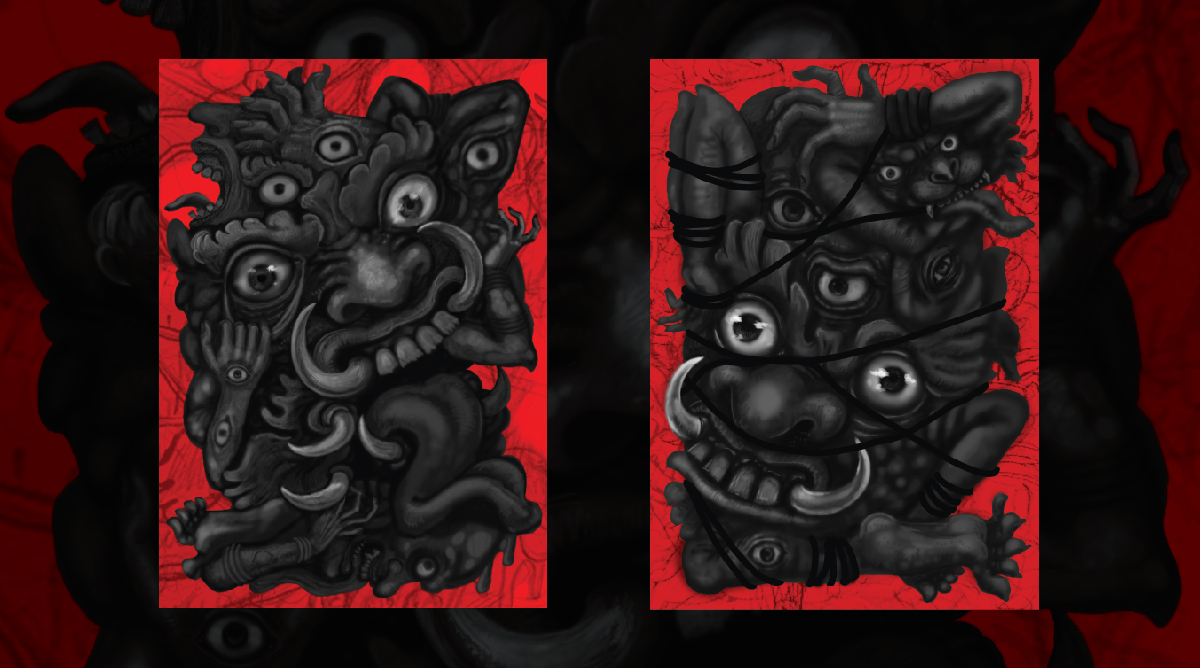
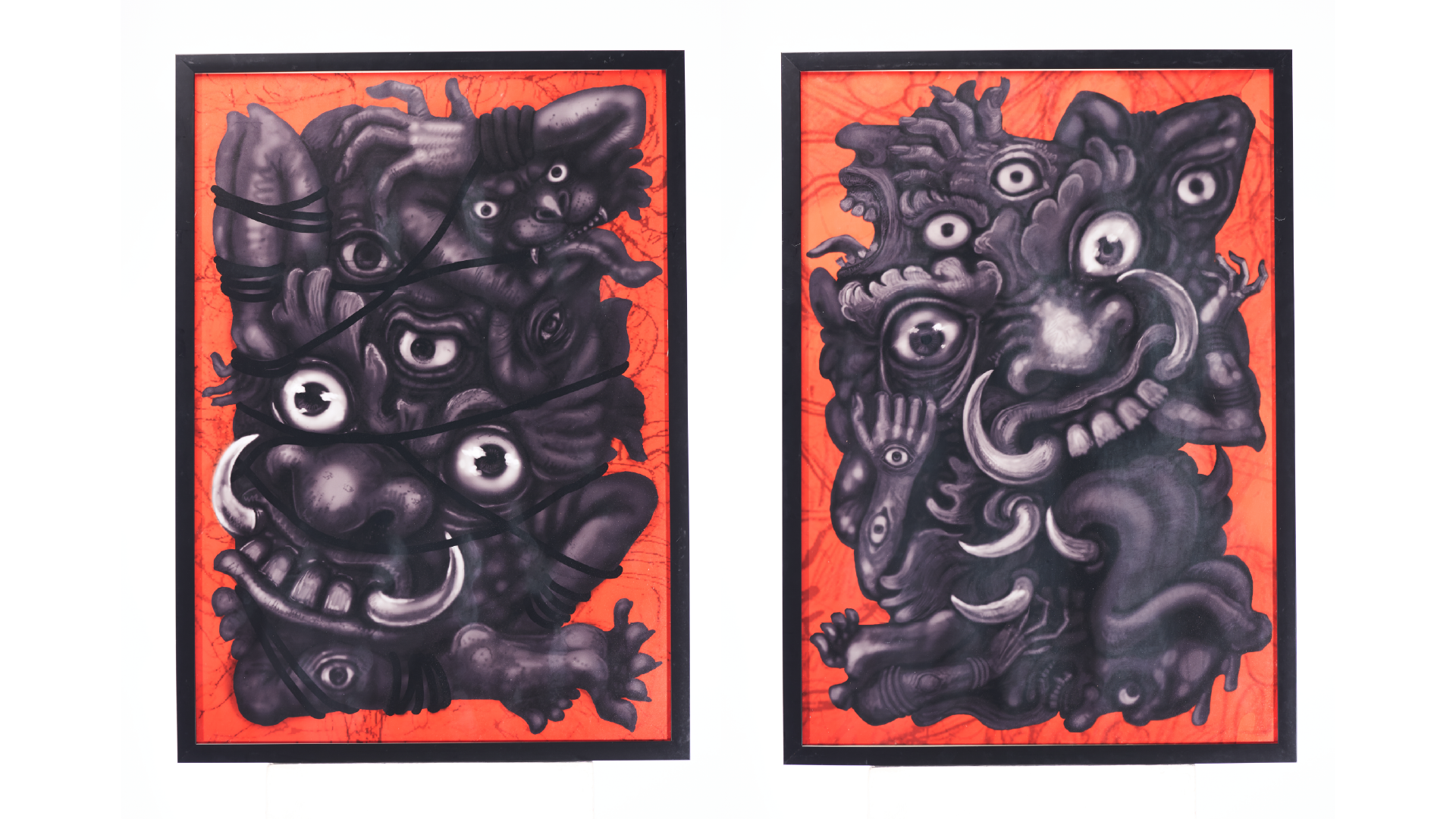
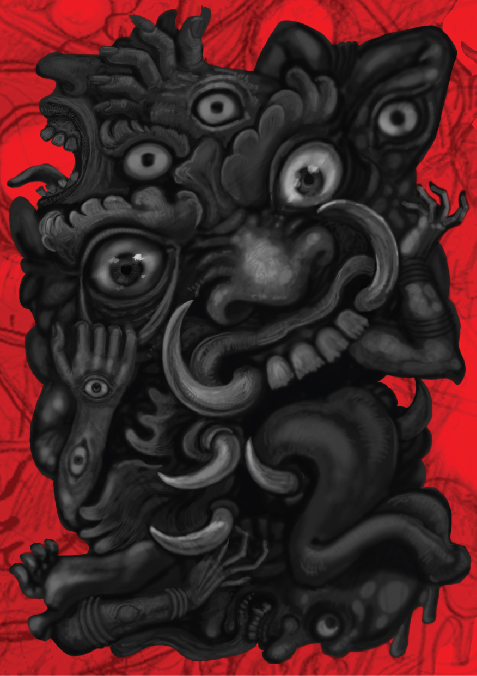
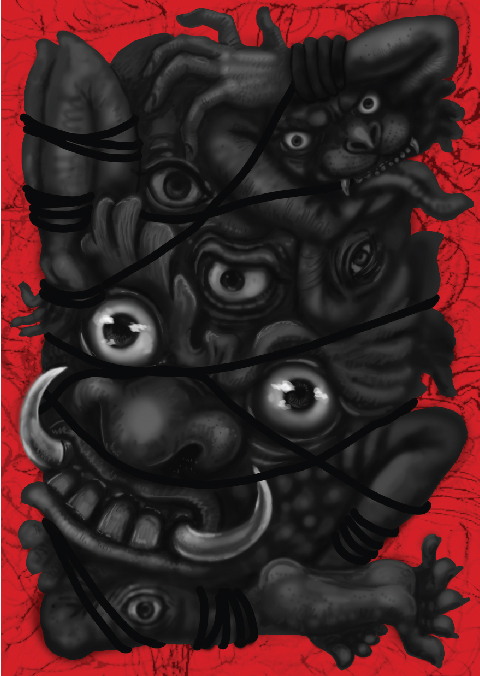
This creative work aims to present the creative process behind two digital illustrations, whose central concept is rooted in understanding the “dark side of the human mind” the foundation of the win-lose framework, or Zero-Sum Mindset, an attitude that views resources, value, or success as limited, such that one party’s gain always means another party’s loss.
The researcher has applied Buddhist teachings, particularly the concepts of the Three Characteristics of Existence (Trilakkhana), defilements (Kilesa), craving (Tanha), attachment (Upadana), and the Four Noble Truths, as tools for analyzing and resolving internal mental conflict, leading to the emergence of true “wisdom” meaning a genuine understanding of oneself and a transition from a divisive win-lose (Zero-Sum) mindset to a mutually beneficial (Non-Zero-Sum) mindset. Both illustrations were created using digital art techniques at A1 size (59.5 x 84 cm), using Adobe Illustrator for vector graphic structuring and Adobe Photoshop for creating atmosphere, light and shadow, and texture to convey emotional feeling.
The results demonstrate that illustration can serve as a medium for translating abstract intellectual/wisdom processes into concrete, easily understood forms, and can effectively encourage viewers to reflect on their own minds in accordance with Buddhist principles.
Objectives :
1. To study the connection between the Zero-Sum Mindset concept and Buddhist teachings, as a tool for understanding the nature of the dark side of the human mind.
2. To create two digital illustrations, sized A1, that convey the process of mental transition from a state dominated by a win-lose framework to a state of wisdom according to Buddhist principles.
3. To present the design process using Digital Art techniques through Adobe Illustrator and Adobe Photoshop programs, as a guideline for those interested in conceptual illustration design.
4. To communicate the concept of wisdom and self-understanding to viewers of the work, through visual language that is easy to understand, and to encourage self-reflection.
Conceptual Framework :
Every human being has a dark side hidden within the mind, arising from three fundamental defilements lobha (greed), dosa (anger/aversion), and moha (delusion). These defilements are the root of the Zero-Sum mindset, which views the world such that if others gain, one must lose, and if one is to gain, others must lose. This perspective leads to conflict, suspicion, and suffering at both the individual and societal levels. The creator therefore conceived the idea of bringing this “dark side” into consideration not to deny or suppress it, but to understand it as it truly is, in accordance with Buddhist principles that teach one to be aware of mental states rather than to flee from them.
The Zero-Sum Mindset is a concept that views relationships between individuals or situations as a fixed-sum outcome that is the sum of what is gained and lost within the system always equals zero. This concept often leads to competitive behavior, rivalry, and viewing others as competitors rather than allies. Psychologically, this framework is closely linked to anxiety, distrust, and a mental state that blocks compassion and loving-kindness. The creator has used this concept as the central axis for explaining the human “dark mind” through illustration.
Considering these teachings together with an understanding of the dark mind gives rise to wisdom which in Buddhism means true insight into the nature of reality, leading to the release from the Zero-Sum mindset.
Process / Methodology :
1. Research and Data Collection
The creator studied Buddhist teachings related to defilements (kilesa), craving (tanha), and wisdom (panna), alongside studying Zero-Sum Mindset theory from psychology and behavioral economics sources.
2. Concept Sketching
Rough concept sketches were drawn by hand or with sketching software to establish the composition and determine the main symbols for each image.
3. Mood & Tone Determination
Planning the color palette.
Creation Process with Adobe Illustrator
-
Vector Outlining — Using the Pen Tool and Shape Builder Tool to create the main shape outlines, such as human figures, circles, curved lines, and the lotus symbol, to achieve sharp lines that can be resized without loss of quality.
-
Composition Arrangement — Using the Rule of Thirds and Golden Ratio principles to position the focal points of the image, guiding the viewer’s eye to the key point: the transition between darkness and wisdom.
-
Layer Organization — Organizing layers separately by element, such as background, main structure, symbols, and fine details, for ease of transferring files to Adobe Photoshop.
-
File Export — Exporting files in high-resolution .PSD or .AI format, with document size set to the actual dimensions of 59.5 x 84 centimeters at 300 dpi resolution to support printing.
Creation Process with Adobe Photoshop
-
Creating Atmosphere and Light/Shadow : Using the Brush Tool, Dodge Tool, and Burn Tool to blend light and shadow to create depth.
-
Digital Painting : Using Layer Blending Modes such as Multiply, Screen, and Overlay to blend colors and create effects of contrast between light and shadow.
-
Texture Creation : Adding texture to enhance the emotional dimension of the image.
-
Overall Color Tone Adjustment : Using Adjustment Layers such as Curves, Color Balance, and Gradient Map to adjust the image tone to align with the desired emotion conveyed in each image.
-
Review and Detail Refinement : Checking sharpness, proportion, and overall harmony of the image before proceeding with final resolution adjustments.
-
Final File Export : Exporting files in high-resolution (.TIFF and .JPEG format), ready for printing and display at actual size.
Techniques and Materials :
Adobe Photoshop, Adobe Illustrator, Digital painting, Print on 240 gms semi gross paper, Sizes A1 (23.4 x 33.1 inches)
Result / Conclusion :
The creation of this digital illustration series demonstrates that the artistic process can serve as an effective medium for translating abstract philosophical and religious concepts into concrete forms that are easy to understand and that directly reach viewers’ emotions. Applying the Zero-Sum Mindset framework in analysis alongside Buddhist teachings reveals a connection between modern psychological and Western philosophical science and ancient Buddhist principles both of which point to the root causes of conflict within the human mind and offer paths to resolution through deep self-understanding.
The two illustrations, created using Digital Art techniques through Adobe Illustrator and Adobe Photoshop, are able to convey the developmental stages of the human mind in sequence from a state dominated by defilements and a win-lose mindset, to a state of wisdom and inner balance, which is the ultimate goal of the Buddhist path. This creative research is therefore an example of integrating design disciplines with religious and psychological studies, to produce work that holds value not only aesthetically, but also in terms of the mental/spiritual development of the viewer.
For further study, those interested may expand this research into creating a larger series of illustrations, or apply it in the form of motion graphics, to broaden the scope of communicating the concepts of wisdom and self-understanding even further.
References :
Andrews, M. (2013). The psychology of zero-sum thinking: How scarcity mindsets shape human behavior. New York, NY: Routledge.
Meyer, J. (2010). Digital illustration: A comprehensive guide to creative digital art. London: Laurence King Publishing.
Share :
Facebook
Twitter
LinkedIn
WhatsApp
Email
Print