Tell Your Story to Making Flowers
College of Design, Rangsit University
Tanaporn Ngamjit
Abstract :
Tell Your Story to Making Flowers explores how the artist’s own voice can become a material for visual creation within an interactive art project. Beginning with the question of how an image might be made without drawing by hand, the work treats storytelling as a vocal gesture whose acoustic variations contribute to a digital floral composition. Artificial intelligence assisted application development, while the artist supplied the voice used to generate the imagery. This distinction locates AI within the production workflow and identifies vocal expression and programmed transformation as the principal means of image making.
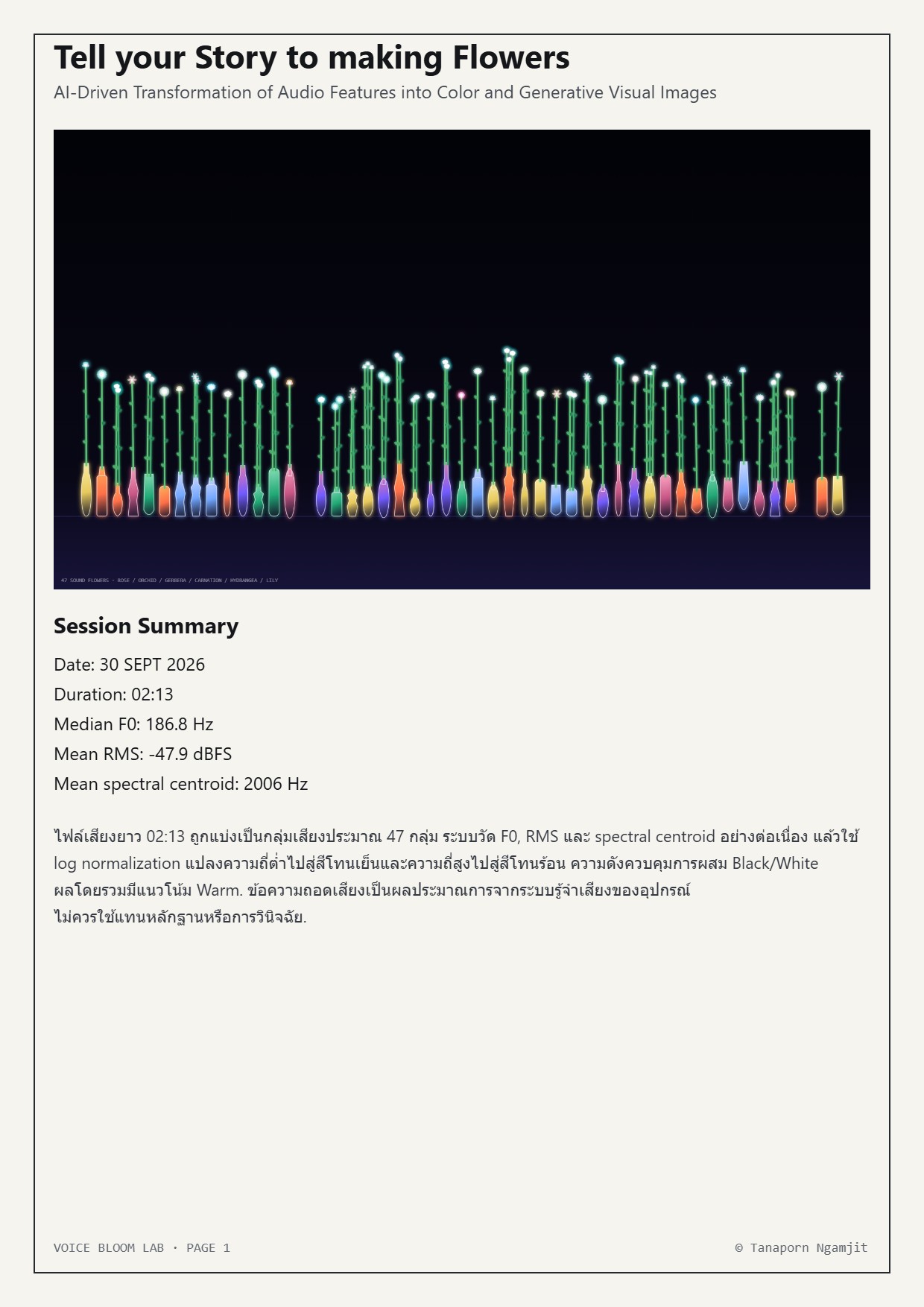
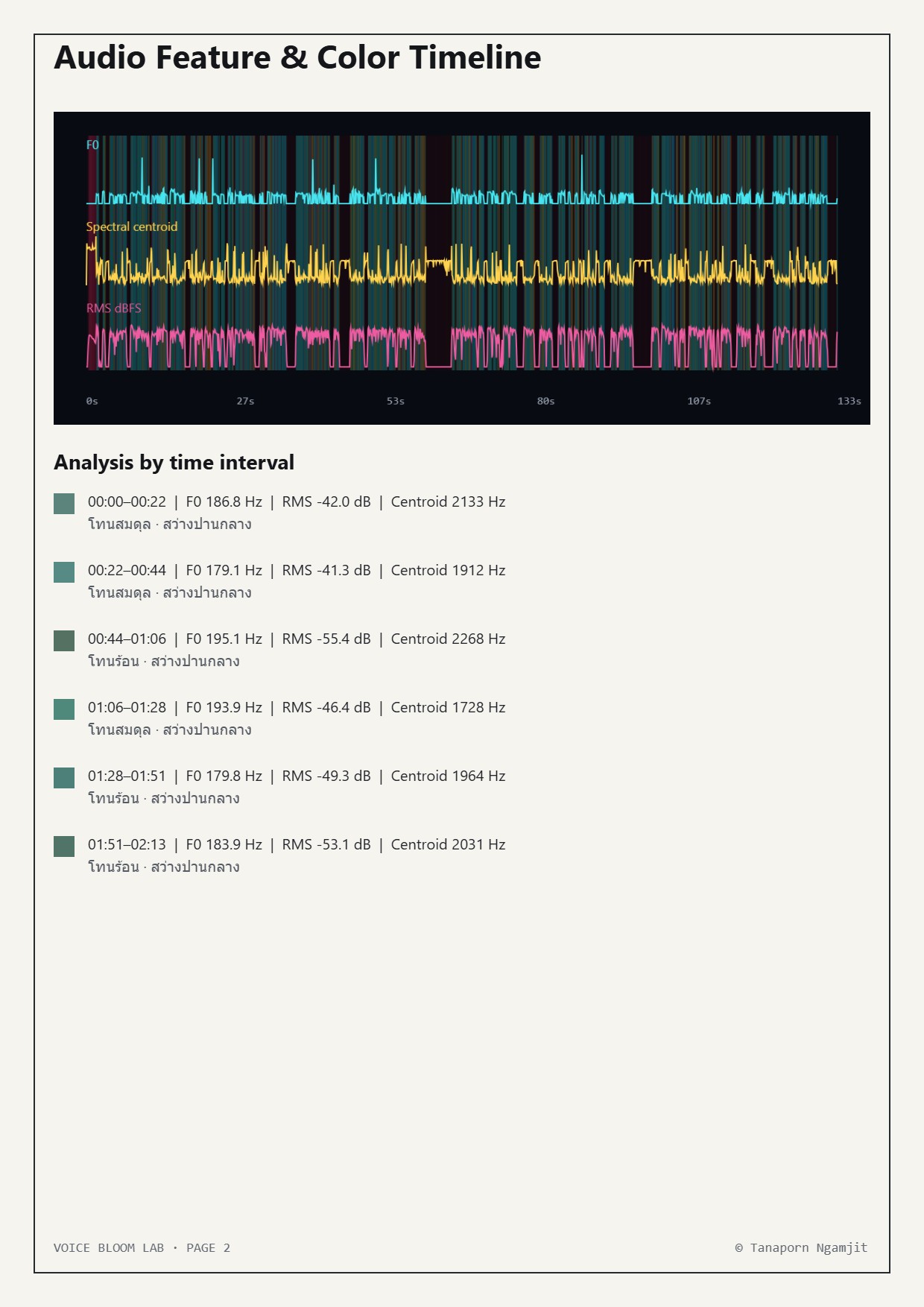
The paper presents a practice based case analysis of the project report, visual documentation, and the artist’s clarification of the creative process. Its theoretical framework brings together practice based research, generative art, and interaction as an artistic concern. The documented recording lasts 133 seconds and is divided into approximately 47 sound groups. The report records a median fundamental frequency of 186.8 Hz, a mean root mean square level of −47.9 dBFS, and a mean spectral centroid of 2,006 Hz. It describes logarithmic normalization, associations between lower and higher frequencies and cooler and warmer colours, and intensity mappings that influence darkness and brightness.
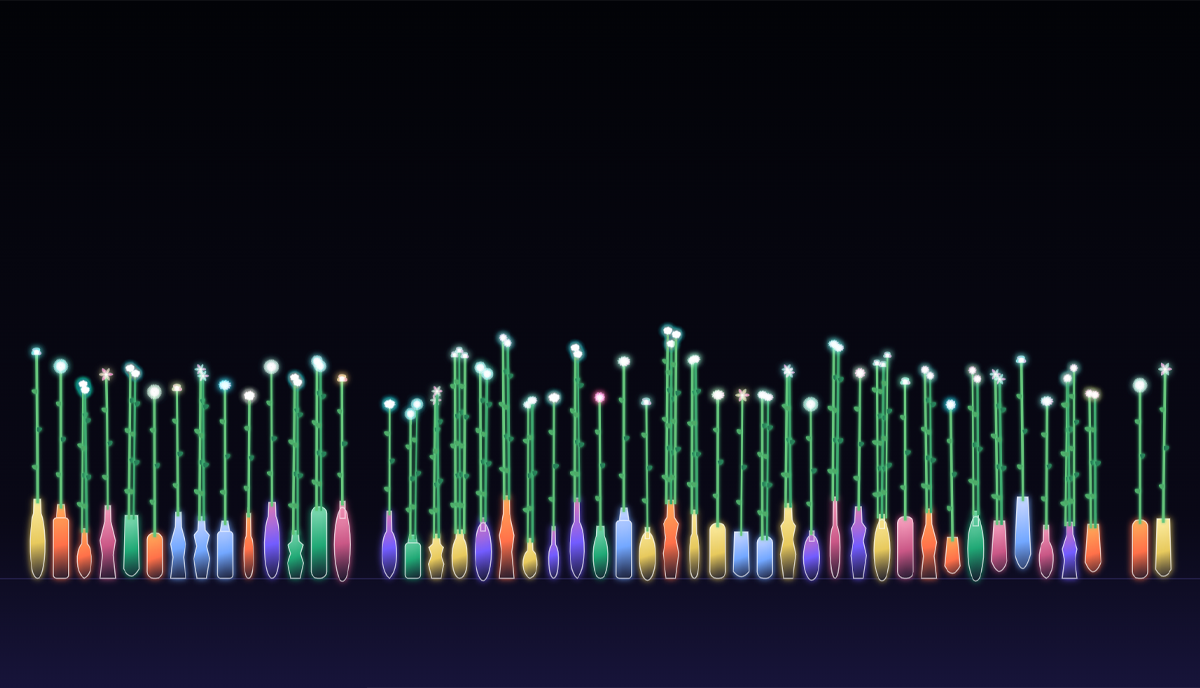
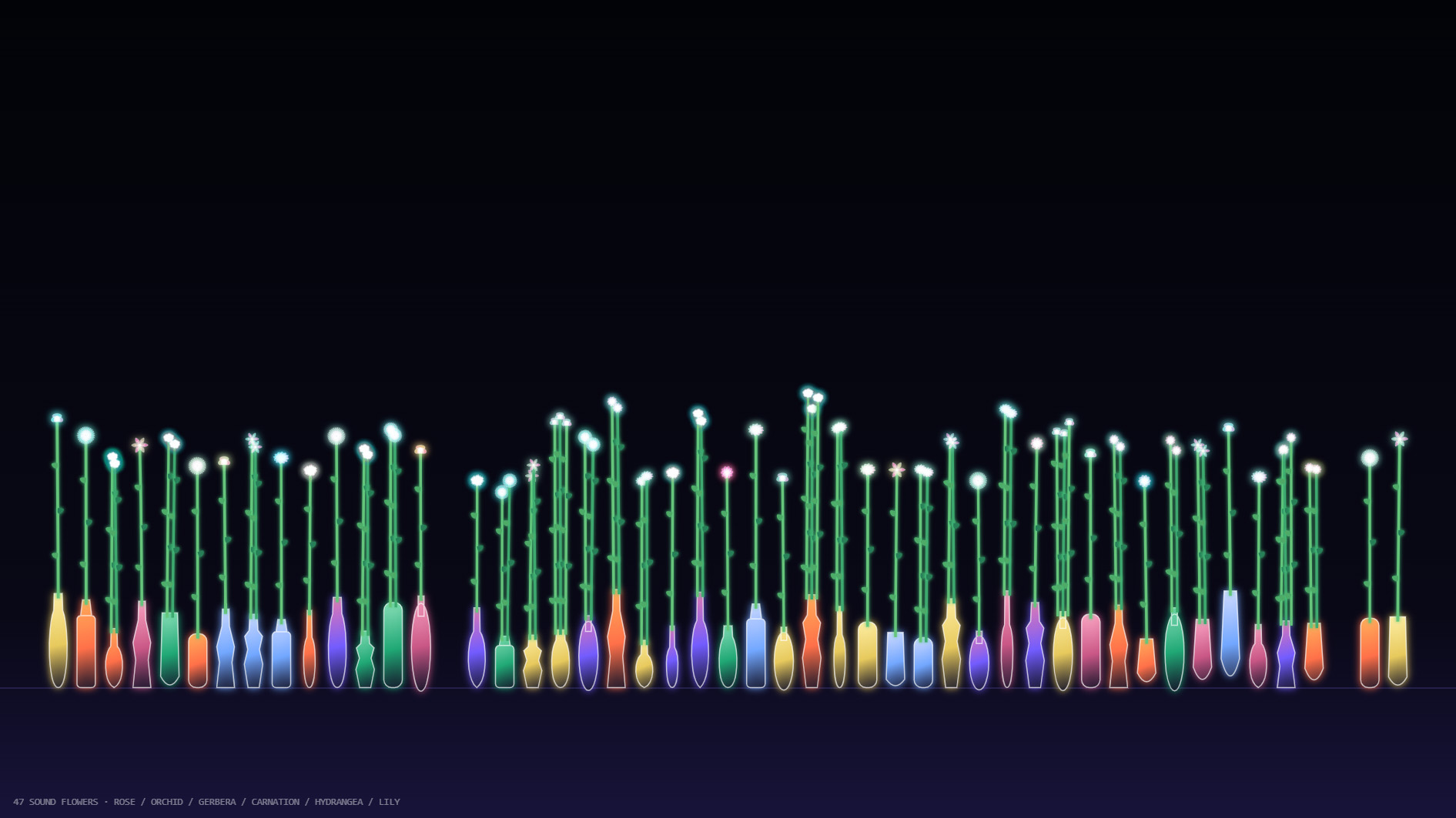
The resulting composition presents luminous flowers, green stems, and varied coloured vessels against a dark background. The floral field is interpreted as a visual trace of the artist’s temporal expression, while the invitation to tell positive stories provides a metaphorical association between speech, growth, and care. The contribution is an account of how artistic intention, embodied input, and computational rules meet in the production of an image. The available documentation supports analysis of the generated composition but does not establish audience responses or the performance of a live interaction loop. Future exhibition research should examine whether participants perceive a relationship between their vocal actions and visual changes. The project therefore offers a grounded starting point for studying voice as a creative interface in interactive art.
Objectives :
The primary objective is to investigate how the artist’s own voice can function as a material for image-making within Tell Your Story to Making Flowers. The research asks how vocal expression can extend drawing beyond hand movement and how a spoken event can acquire a visible presence. It approaches pitch variation, signal intensity, and pauses as temporal qualities through which the artist contributes to a generated composition.
The second objective is to clarify the relationship between artistic intention and computational transformation. The study examines the report’s account of acoustic measurement and its mappings to color and brightness. It also distinguishes documented mappings from visual characteristics whose generation rules remain unspecified, including flower type, stem height, and vessel shape. This supports a precise discussion of the work without treating every visible difference as a verified acoustic correspondence.
The third objective is to situate the project within relevant approaches to generative and interactive art. The study considers how the artist establishes a visual vocabulary and procedural conditions, while the voice supplies variable input. It examines the proposed relationship between action and response as an artistic question, with particular attention to the evidence needed to establish participants’ understanding of their influence on an image.
The fourth objective is to articulate the role of AI in the creative workflow. AI assistance in developing the application is distinguished from the artist’s vocal contribution and the application’s programmed image generation. This distinction supports an account of authorship that recognizes the artist’s conceptual decisions, expressive contribution, and responsibility for the resulting work.
Finally, the research aims to interpret flowering as a metaphor for the visible emergence of a story and to establish priorities for further investigation. These include documenting the complete mapping rules, observing interaction during exhibition, and gathering voluntary participant reflections. The intention is to connect the artwork’s aesthetic proposition with a transparent research account, while distinguishing artistic interpretation from claims about emotional recognition, therapeutic benefit, or demonstrated audience engagement.
Conceptual Framework :
Tell Your Story to Making Flowers adopts a framework for translating acoustic features into visual elements.
Storytelling is understood as both artistic expression and measurable input. The conceptual sequence is voice input → audio feature extraction → normalization → colour and visual mapping → digital floral imagery.
Voice thereby becomes a means of producing visible traces beyond direct hand drawing.
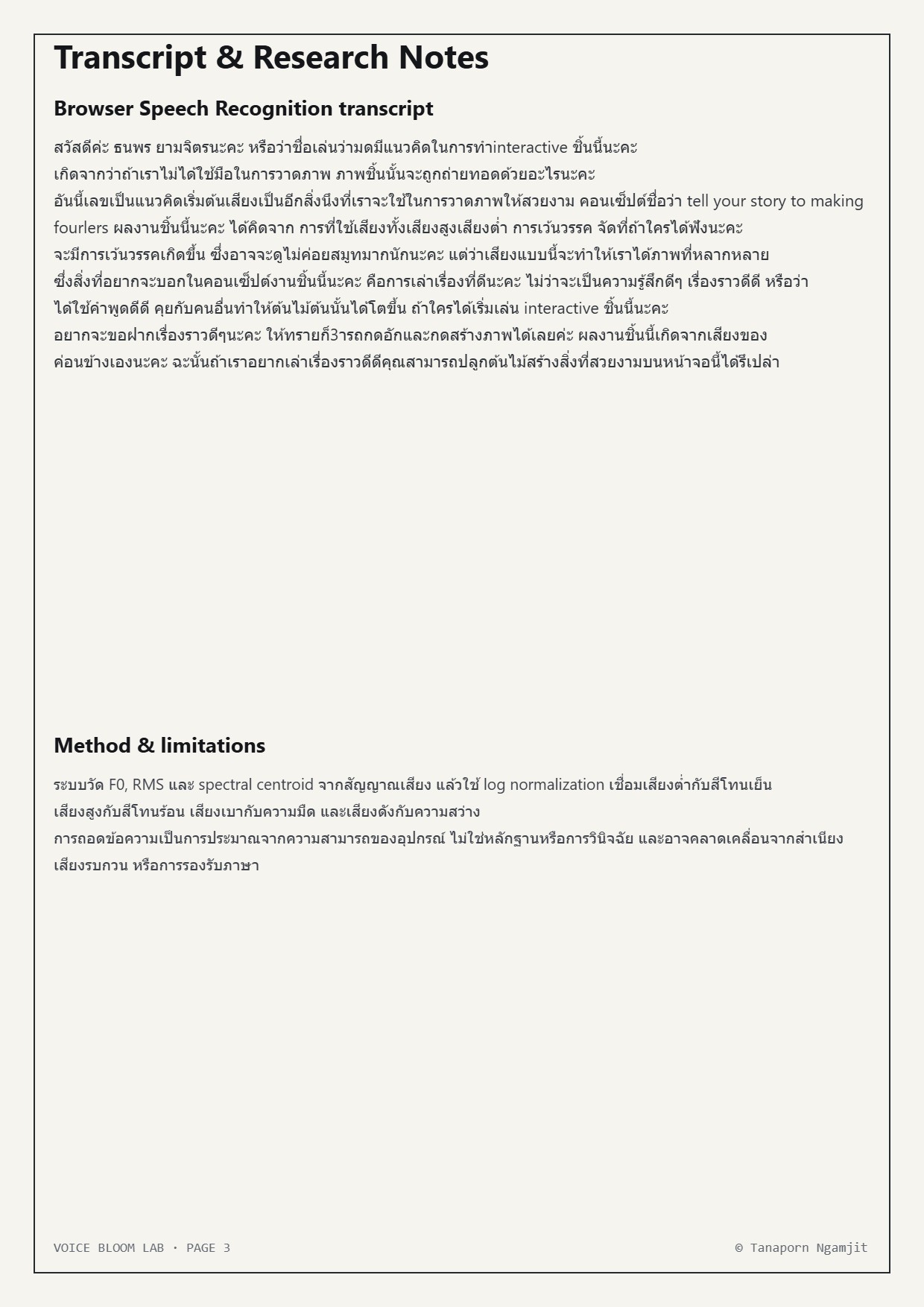
The acoustic descriptors include fundamental frequency, RMS signal level, and spectral centroid. These describe different aspects of the signal and are not treated as interchangeable. The colour mapping associates lower pitches with cooler colours and higher pitches with warmer colours, using normalized values to determine CMYK components before conversion to RGB for screen display.
This relationship is an artistic convention established for the project, rather than a universal law of sound–colour perception. Signal level relates to darkness and brightness, while rhythm and silence offer directions for further mapping to repetition and negative space.
Process / Methodology :
First, the artistic question is identified how can a spoken story produce an image without direct hand drawing? Second, the technical description is examined.
The report documents a 133 second recording divided into approximately 47 sound groups, with fundamental frequency, root mean square level, and spectral centroid measured over time. It describes logarithmic normalization and frequency mappings toward cooler or warmer colours, alongside intensity mappings toward darker or brighter results. The precise contribution of each descriptor to all visual parameters remains unspecified.
Third, the still images are examined for colour, repetition, spatial arrangement, and contrast. These observations are interpreted alongside the artist’s intention, rather than treated as proof of particular algorithmic relationships. The numerical values are reported from the existing documentation and have not been independently recalculated.
Finally, the findings are considered through the conceptual framework. Proposed further evaluation would record the live action and response sequence and gather voluntary reflections on perceived influence, visual meaning, and participation. These activities are future research steps, not completed procedures.
Techniques and Materials :
AI assisted the development of the application. The artist’s own voice provided the input for image-making, with acoustic features transformed into visual elements through programmed mappings. AI assistance in development is therefore distinguished from the role of the voice in producing the imagery.
Result / Conclusion :
The documented outcome is a floral composition labelled “47 sound flowers,” associated with a recording containing approximately 47 sound groups. Luminous blossoms, elongated green stems, and varied vessels establish a repeated visual vocabulary with differentiated forms and colours. The report records a median fundamental frequency of 186.8 Hz, a mean RMS level of −47.9 dBFS, and a mean spectral centroid of 2,006 Hz, and describes an overall warm colour tendency.
The principal artistic finding is an interpretation of voice as a means of producing a visible trace through programmed transformation. The artist contributes both the expressive source and the conceptual conditions of the work. AI assists the development of the application, while the documented image making process is understood through acoustic input and computational mappings. The flower metaphor connects the emergence of visual form with the invitation to share a story.
The contribution to interactive art research is therefore a documented creative proposition and a framework for examining its future encounters with participants. The present materials establish a visual outcome, but do not establish audience engagement, emotional recognition, or therapeutic effects. They also leave the details of live feedback and several visual mappings unresolved.
Further research should make these rules explicit and investigate how participants perceive and negotiate their influence on the image. This would extend the current artistic account into an evidenced study of interaction.
References :
Candy, L., & Edmonds, E. (2018). Practice-based research in the creative arts: Foundations and futures from the front line. Leonardo, 51(1), 63–69. https://doi.org/10.1162/LEON_a_01471
Edmonds, E. (2010). The art of interaction. Digital Creativity, 21(4), 257–264. https://doi.org/10.1080/14626268.2010.556347
Galanter, P. (2003). What is generative art? Complexity theory as a context for art theory [Conference paper]. 6th Generative Art Conference, Milan, Italy. https://www.philipgalanter.com/downloads/ga2003_paper.pdf
Share :
Facebook
Twitter
LinkedIn
WhatsApp
Email
Print