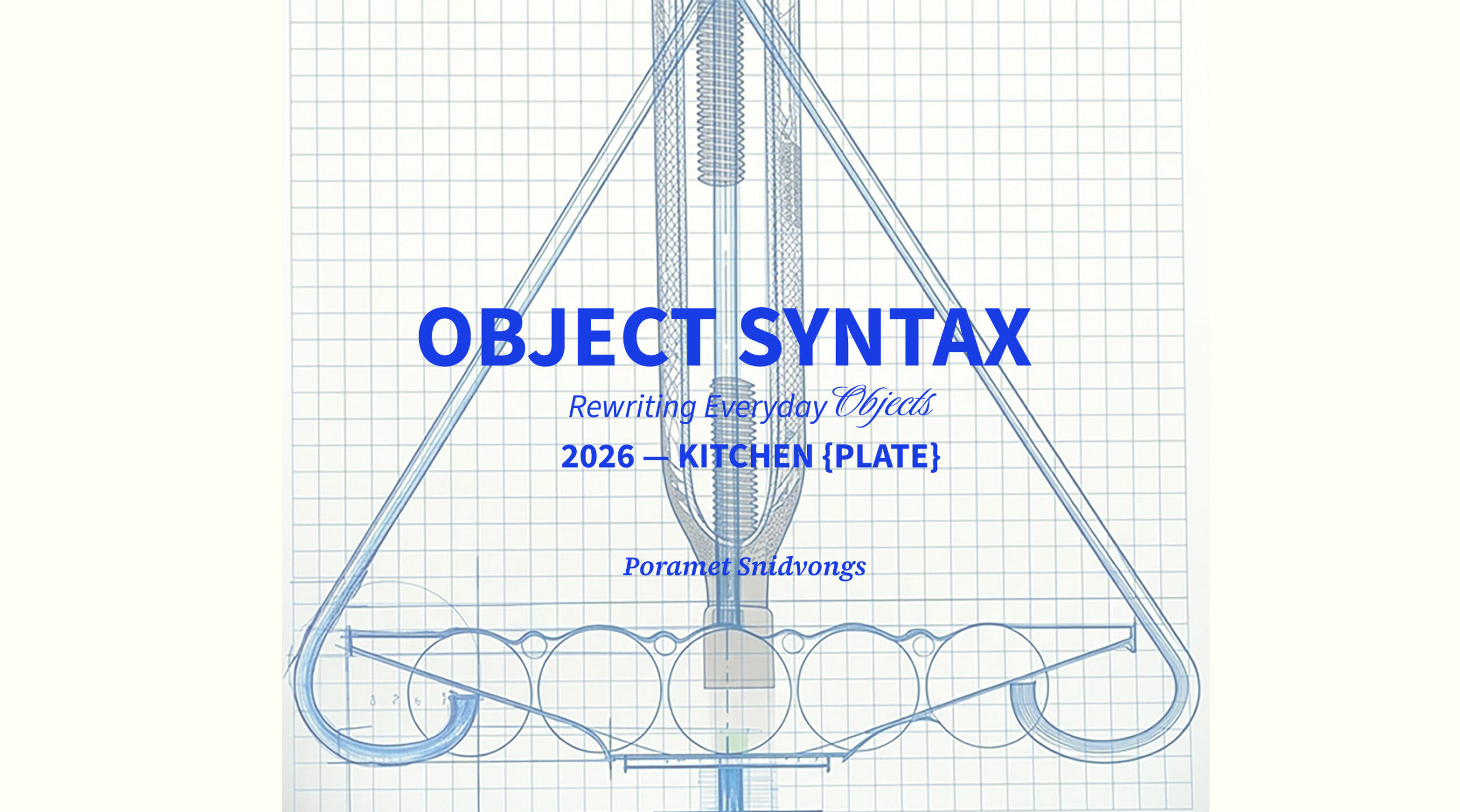
OBJECT SYNTAX
Rewriting Everyday Objects
2026 — KITCHEN {PLATE}
College of Design, Rangsit University, Thailand
Poramet Snidvongs
Abstract :
OBJECT SYNTAX*: Rewriting Everyday Objects* investigates how the meaning and function of everyday objects can be reconsidered through changes in context, materiality, configuration, and relationships. The project begins with a simple question: If context defines function, can changing the context rewrite the object? Rather than treating an object as a fixed entity with a predetermined purpose, the research proposes that objects can be understood as flexible systems of formal, material, functional, and contextual relationships.
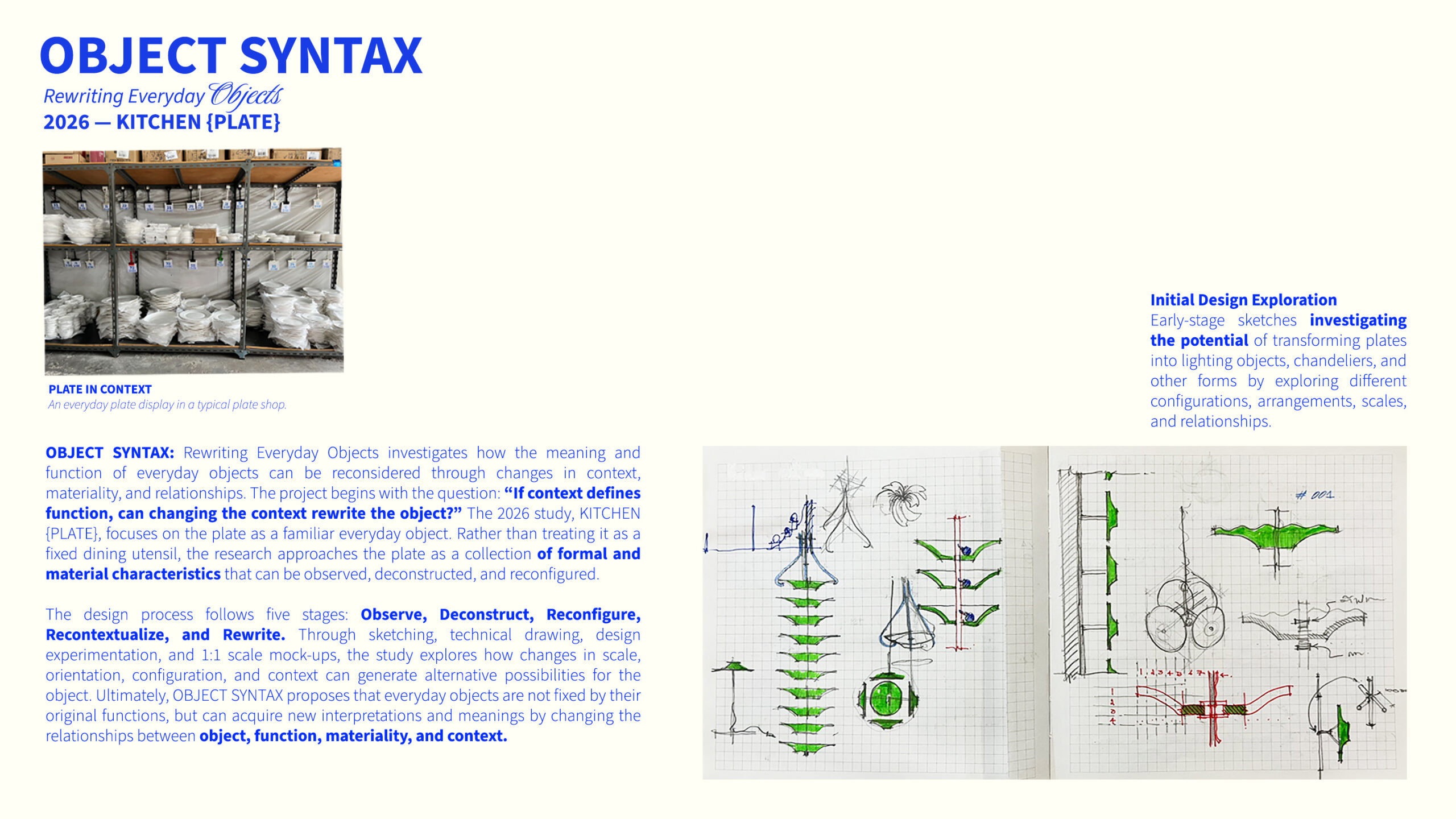
The 2026 study, KITCHEN {PLATE}, focuses on the plate as a familiar everyday object. A plate is conventionally understood through its relationship with food, dining, and the kitchen. However, by removing it from this established context, its identity as a “plate” can be questioned. The research therefore approaches the plate not primarily as a functional utensil, but as a material and formal vocabulary that can be observed, deconstructed, and reconfigured.
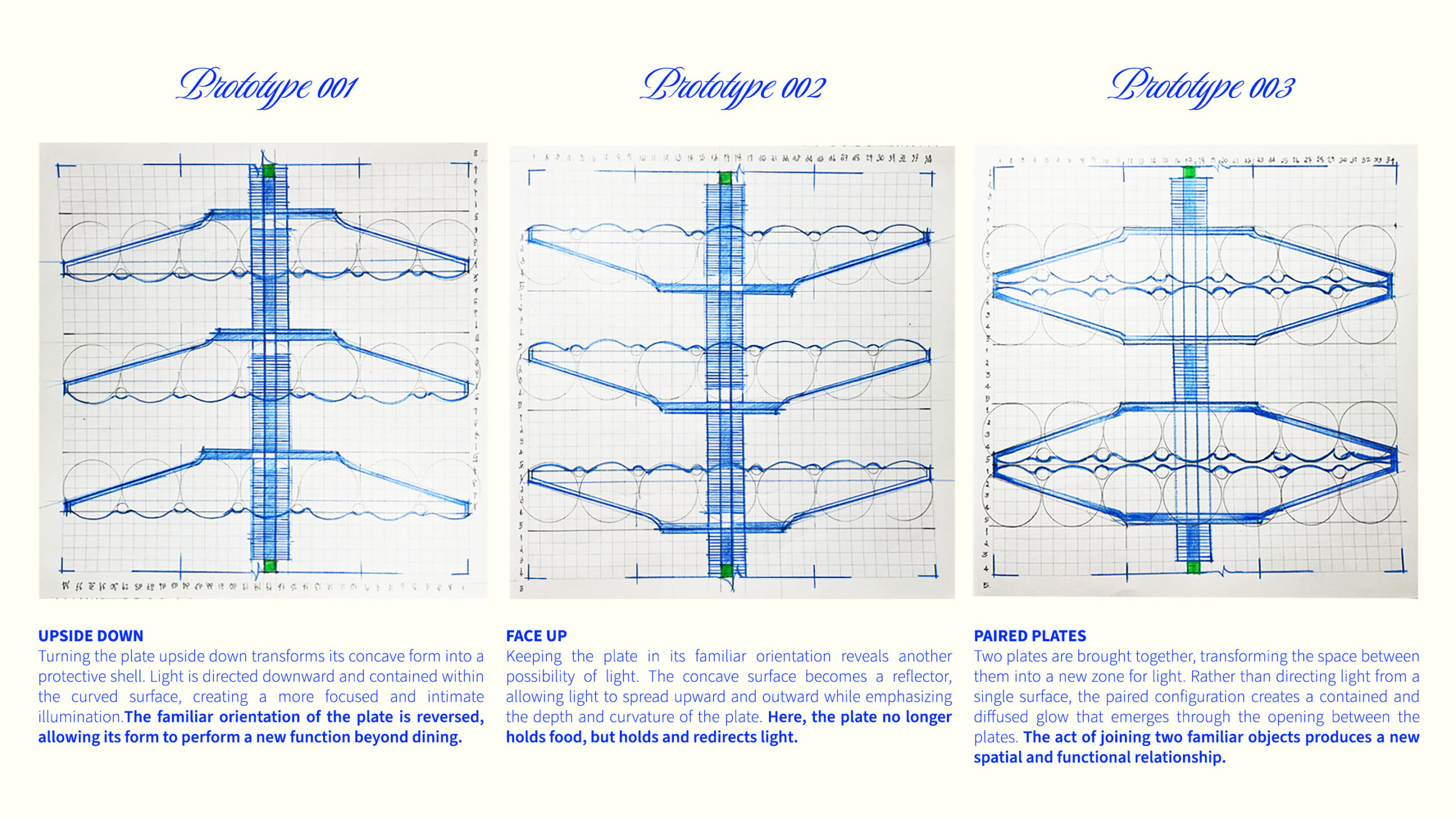
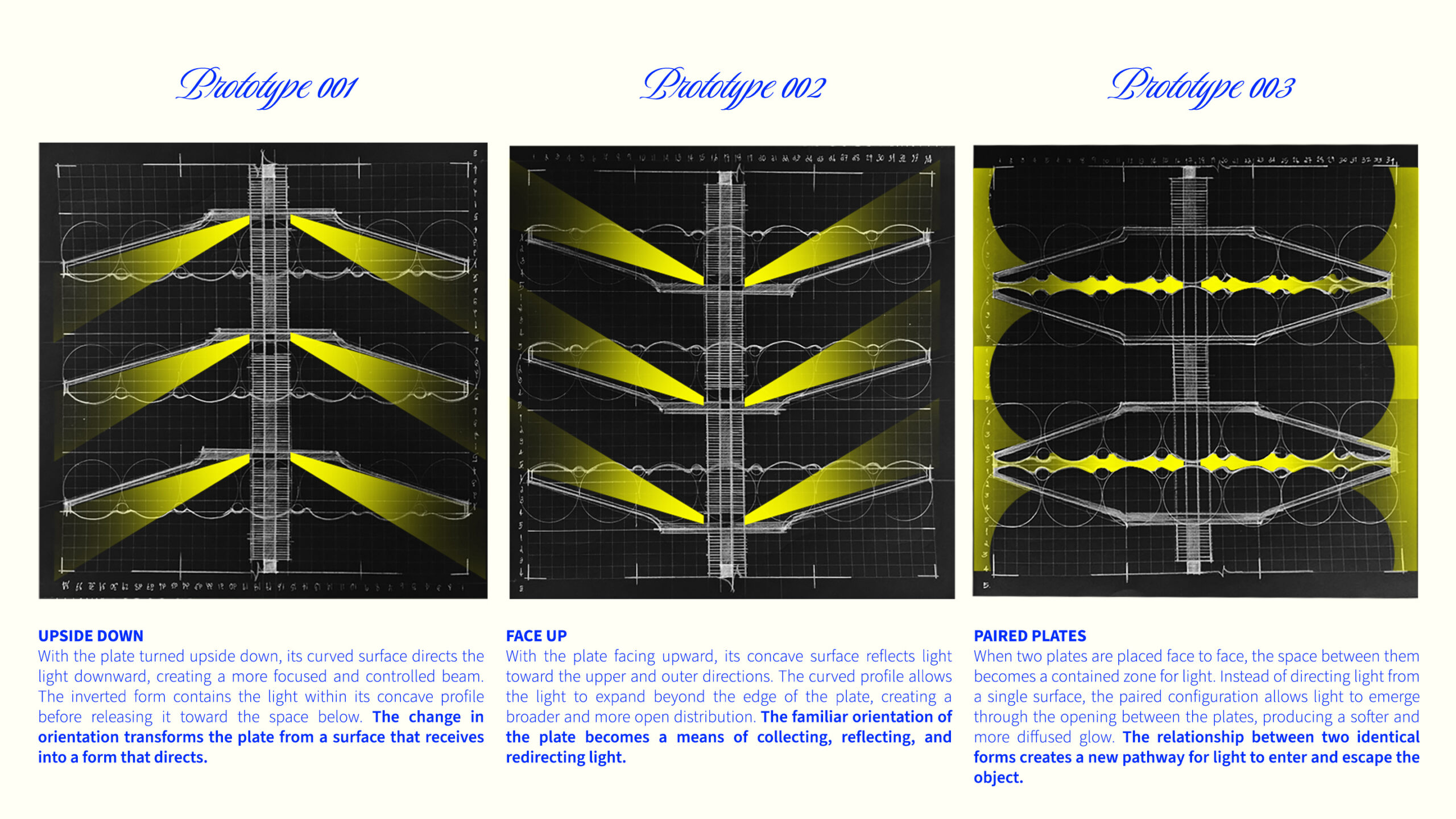
The design process operates through a series of interconnected stages: Observe, Deconstruct, Reconfigure, Recontextualize, and Rewrite. The plate is first examined through its geometry, edge, rim, surface, concavity, thickness, material properties, and modes of arrangement. These characteristics are then explored through sketches and design experiments that investigate orientation, assembly, connection, and configuration. Three primary configurations—Upside Down, Face Up, and Paired Plates—are developed to examine how changes in orientation and arrangement can influence the direction, reflection, distribution, and quality of light.
Sketching is employed not simply as a method of visual representation, but as a research tool for generating and testing possibilities. Through iterative drawing, technical development, and physical experimentation, the transformed plate is developed as a lighting object, allowing the research to investigate new relationships between form, function, and light.
Ultimately, OBJECT SYNTAX proposes that everyday objects are not fixed by their original functions. Their meanings can be rewritten through the manipulation of relationships between object, function, material, context, configuration, and light. KITCHEN {PLATE} serves as an initial study within the broader OBJECT SYNTAX framework, establishing a methodology for examining how familiar objects can be transformed into unfamiliar possibilities.
Objectives :
1. To investigate how context influences the perceived function and meaning of everyday objects.
This objective examines the relationship between an object and the context in which it is situated, with particular attention to how spatial, cultural, and functional contexts influence the way an object is recognized, understood, and used. The study aims to question whether the identity and meaning of an object are inherent to the object itself or are constructed through its relationship with its surrounding context.
2. To examine the material, formal, and functional characteristics of the plate as an everyday object.
The study analyzes the plate beyond its conventional role as a dining utensil by examining its geometry, edge, rim, surface, concavity, thickness, material properties, and modes of arrangement. These characteristics are considered as a set of formal and material components that can be isolated, interpreted, and recombined rather than being limited to their original functional purpose.
3. To explore how transformation, orientation, and reconfiguration can generate alternative functions and interpretations of the plate beyond its original context.
Through iterative sketching and design experimentation, the research explores changes in orientation, assembly, configuration, and spatial relationships. Three primary configurations—Upside Down, Face Up, and Paired Plates—are developed to investigate how different arrangements influence the direction, reflection, distribution, and quality of light. The objective is to explore how these transformations can enable the plate to perform as a new lighting object and acquire alternative meanings beyond its original function.
4. To develop a design research methodology for rewriting everyday objects through relationships between object, function, materiality, context, configuration, and light.
The final objective is to establish a transferable methodological framework for OBJECT SYNTAX through the stages of Observe, Deconstruct, Reconfigure, Recontextualize, and Rewrite. The methodology provides a basis for further studies of other everyday objects, demonstrating how familiar objects can be critically reconsidered and transformed through changes in relationships, configurations, and functions, leading to new interpretations and possibilities.
Conceptual Framework :
The conceptual framework of OBJECT SYNTAX: Rewriting Everyday Objects is based on the proposition that the identity, function, and meaning of an everyday object are not fixed, but are shaped through its relationships with context, materiality, form, configuration, and use. The framework therefore examines the object as a system of interconnected elements rather than as a predetermined functional entity. Changes in these relationships can generate new forms of interaction, function, and interpretation.
The study applies this framework to KITCHEN {PLATE} through five sequential yet iterative stages: Observe, Deconstruct, Reconfigure, Recontextualize, and Rewrite. The process begins by observing the plate within its original context, followed by the analysis of its formal, material, and functional characteristics. These characteristics are then transformed through changes in orientation, assembly, configuration, and spatial relationships. Three configurations—Upside Down, Face Up, and Paired Plates—are explored to examine how the reconfiguration of the plate can influence the behavior of light, including its direction, reflection, distribution, and quality.
Through this process, the plate is recontextualized from a dining object into a lighting object, establishing new relationships between object, function, materiality, context, configuration, and light. The resulting framework demonstrates how changes in these relationships can rewrite the function and meaning of a familiar everyday object, providing a methodological basis for further investigations within OBJECT SYNTAX.
Process / Methodology :
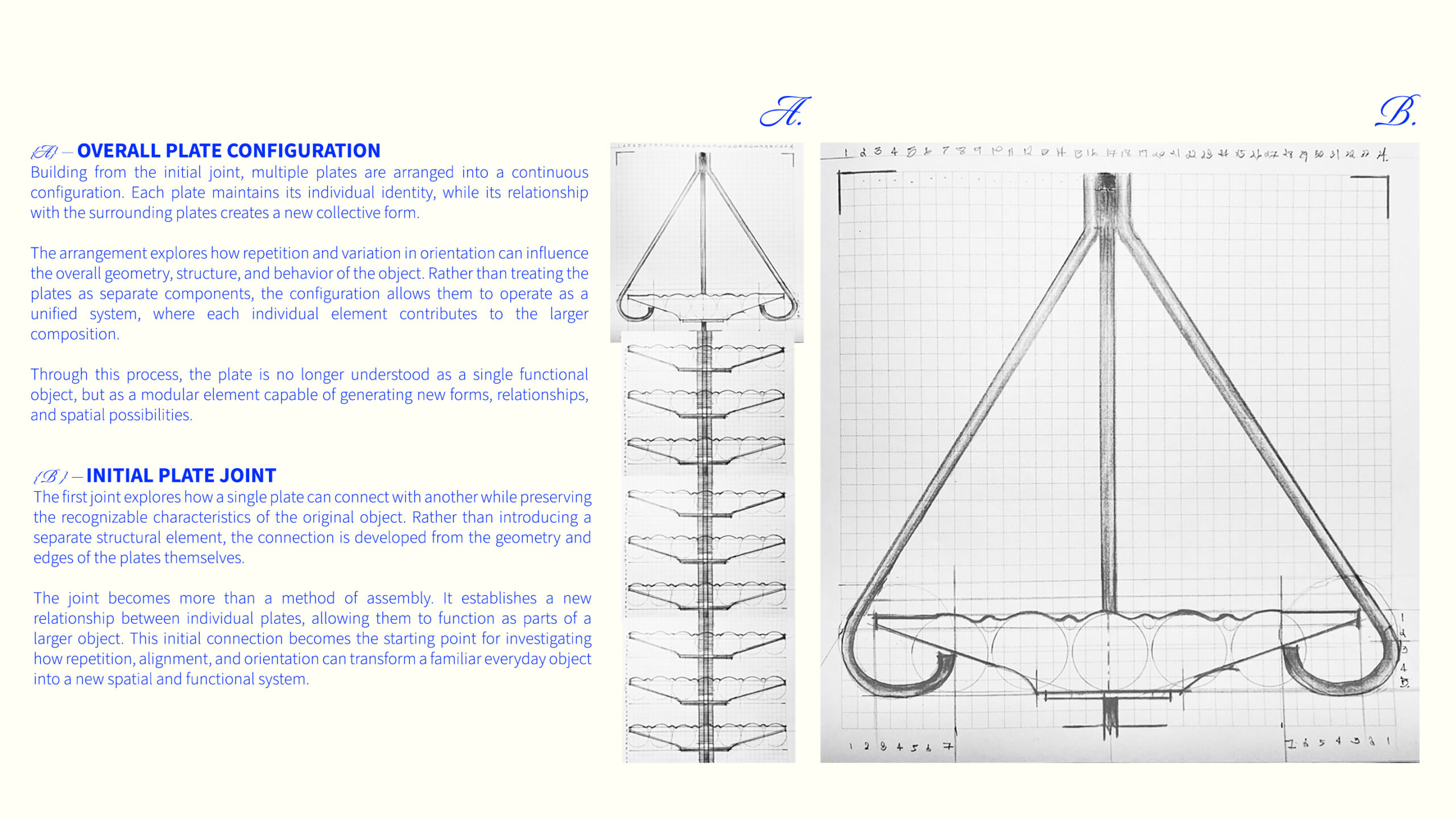
The research adopts a practice-based design methodology in which drawing, sketching, and physical experimentation are used as tools for investigating the transformation of everyday objects into new functional forms. The process begins with the observation and analysis of the plate within its original context, focusing on its formal, material, functional, and spatial characteristics. These observations are translated into a series of exploratory sketches and technical drawings to examine alternative forms, configurations, connections, and relationships between individual plates.
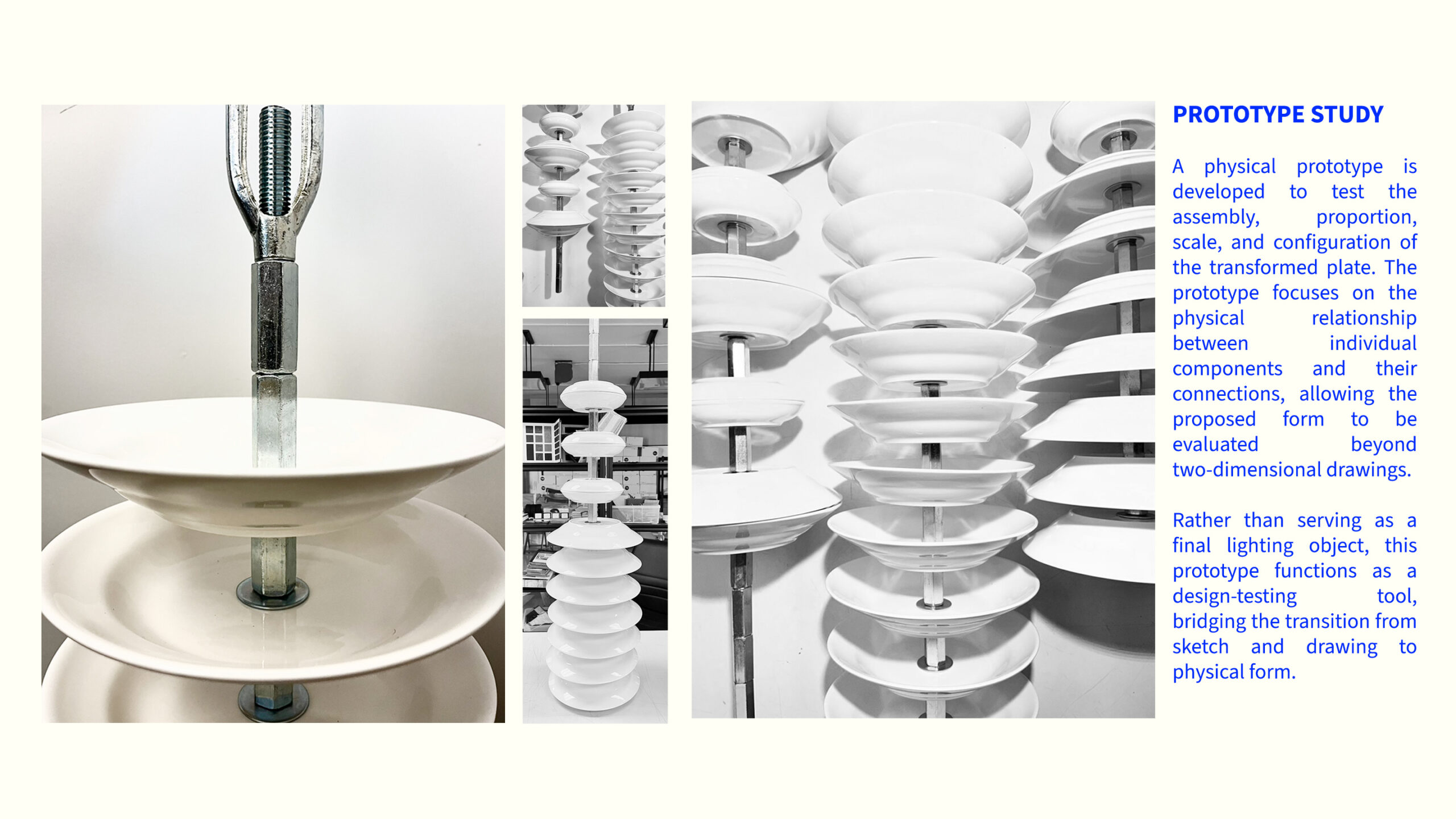
The design development follows the stages of Observe, Deconstruct, Reconfigure, Recontextualize, and Rewrite, with each stage informing and refining the next. Sketches are used to generate and communicate ideas, while technical drawings are used to test proportions, dimensions, connections, and construction possibilities. The transformed plates are then explored as a lighting object through three primary configurations: Upside Down, Face Up, and Paired Plates. Each configuration investigates how the orientation and arrangement of the plates influence the direction, reflection, distribution, and quality of light. Selected concepts are further developed through physical mock-ups, including a 1:1 scale lighting prototype, to examine actual proportions, scale, spatial relationships, and light behavior.
The process is iterative rather than linear, with findings from drawing, light studies, and physical experimentation feeding back into subsequent design decisions. The final outcome therefore emerges through a continuous dialogue between conceptual thinking, visual exploration, material testing, and the behavior of light, transforming the familiar plate into a new functional and spatial object.
Techniques and Materials :
Result / Conclusion :
The ongoing exploration of KITCHEN {PLATE} demonstrates that the identity and function of an everyday object can be reconsidered through changes in context, configuration, orientation, and relationships. Through sketching, technical drawing, light studies, and 1:1 scale mock-up experimentation, the research reveals that the plate can be understood beyond its conventional role as a dining utensil. Its formal and material characteristics provide opportunities for alternative configurations and spatial relationships, allowing the plate to be transformed into a new lighting object.
The development of three primary configurations—Upside Down, Face Up, and Paired Plates—demonstrates how changes in orientation and arrangement can produce different behaviors of light. Each configuration creates a distinct relationship between the plate, light source, and surrounding space, influencing the direction, reflection, distribution, and quality of illumination. The 1:1 mock-up further provides a means of evaluating proportion, scale, physical presence, construction, and light behavior that cannot be fully understood through two-dimensional representation alone.
The iterative process suggests that rewriting an object does not necessarily require changing its fundamental identity, but can occur through changing its relationships with context, function, configuration, and use. In this study, the familiar plate is recontextualized from a dining object into a lighting object, demonstrating how a simple shift in orientation and relationship can generate a new function and interpretation. The research establishes an initial methodological basis for OBJECT SYNTAX and provides a foundation for further investigations into other everyday objects and alternative forms of transformation.
References :
Dunne, A. (2008). Hertzian tales: Electronic products, aesthetic experience, and critical design. MIT Press.
Norman, D. A. (2013). The design of everyday things: Revised and expanded edition. Basic Books.
Papanek, V. (1982). Design for the real world: Human ecology and social change. Van Nostrand Reinhold.
Share :
Facebook
Twitter
LinkedIn
WhatsApp
Email
Print