FORMING FACES
Faculty of Digital Art, Rangsit University, Thailand
Podjanee Kakaew

Abstract :
FORMING FACES is a digital moving-image artwork that explores the diversity of facial forms created by humans through masks from different cultural and contemporary contexts. Masks have appeared in human societies in various forms and have been associated with different traditions, performances, beliefs, and forms of popular culture. Their visual characteristics vary according to their contexts, resulting in a wide range of forms, colors, patterns, and appearances.
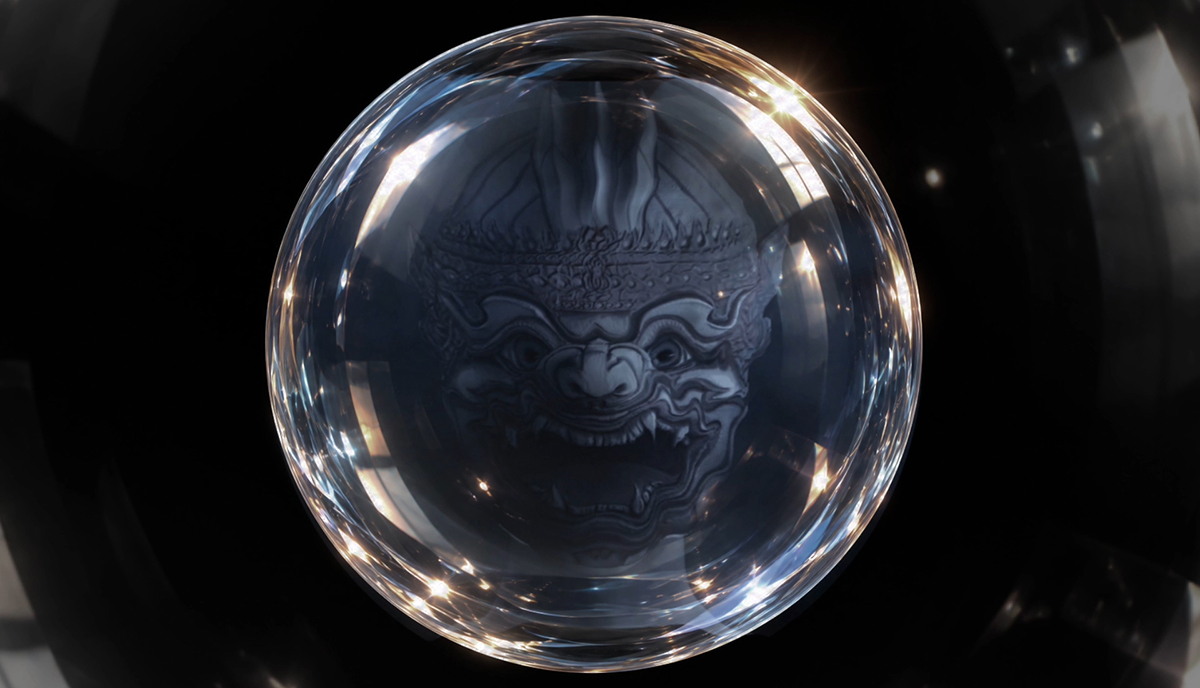
The artwork brings together five visual references: Hanuman from Thai culture, a mask associated with Japanese culture, a Venetian-style mask, a facial form inspired by Chinese opera, and Captain America from contemporary popular culture. These references were selected for their distinctive visual characteristics and their differences in cultural and contemporary contexts. Rather than comparing their cultural meanings, the work focuses on the diversity of facial forms that can be seen through these different masks.
Each selected image was developed as a texture and applied to a three-dimensional human facial model before being rendered as an image. The rendered images were subsequently composed in Adobe After Effects to create a digital moving-image sequence. Within the composition, different facial forms gradually appear, become visible, dissolve, and transition into one another. Smoke, transparency, lighting, and a transparent spherical element are used to support the visual atmosphere and transitions within the work.
Through the digital process, mask references originating from different contexts are brought together within a single moving-image composition. Their differences remain visible while they are presented as a sequence of changing facial forms.
FORMING FACES therefore presents masks as visual forms that demonstrate the diversity of faces created by humans. By bringing together different mask forms and presenting them through contemporary digital media, the artwork invites viewers to observe how the human face has been visually interpreted and represented in diverse forms across cultural and contemporary contexts.
Objectives :
The primary objective of FORMING FACES is to create a digital moving-image artwork that presents the diversity of facial forms created by humans through masks from different cultural and contemporary contexts. The project focuses on the visible characteristics of masks, particularly differences in form, color, pattern, surface, and overall appearance, as elements that create distinctive representations of the face.
The artwork incorporates five visual references: Hanuman from Thai culture, a mask associated with Japanese culture, a Venetian-style mask, a facial form inspired by Chinese opera, and Captain America from contemporary popular culture. These references provide visually different examples of masks originating from different contexts and periods. Their inclusion is intended to demonstrate a range of facial forms rather than to compare, classify, or redefine their individual cultural meanings.
A second objective is to explore how these different visual references can be presented through contemporary digital media. Each selected image is developed as a texture, applied to a three-dimensional human facial model, and rendered before being incorporated into a moving-image composition. This process provides a consistent digital method for presenting visually different mask forms.
The project also explores the use of digital compositing and visual transitions to connect the selected forms within a single artwork. Through gradual appearance, dissolution, transparency, smoke, lighting, and layered imagery, the different faces are presented as a connected visual sequence while retaining their individual visual characteristics.
Ultimately, FORMING FACES aims to draw attention to the visual diversity of facial forms created through masks. By presenting mask references from different cultural and contemporary contexts within a digital moving-image environment, the project encourages viewers to observe the variety of ways in which the appearance of the human face can be visually created and represented.
Conceptual Framework :
The conceptual framework of FORMING FACES begins with the relationship between humans, faces, and masks. Masks have been created in different cultural and contemporary contexts and display a wide range of visual characteristics through differences in form, color, pattern, and surface.
The artwork focuses on this visual diversity by bringing together five mask references with distinctly different appearances. Rather than emphasizing the individual meaning of each mask, the project considers them collectively as examples of the diverse facial forms created by humans.
Digital media provides a means of bringing these different forms into the same moving-image composition. The selected forms gradually appear, dissolve, and transition from one to another, allowing their visual differences to be observed within a connected sequence.
The conceptual framework therefore moves from humans and cultural contexts, to masks, to the diversity of facial forms, and finally to their digital presentation. Through this structure, the artwork emphasizes the variety of visual forms that humans have created upon and in relation to the face.
Conceptual Framework Diagram
HUMAN & CULTURAL CONTEXTS MASKS →DIFFERENT VISUAL CHARACTERISTICS
→DIVERSITY OF FACIAL FORMS→DIGITAL PRESENTATION→FORMING FACES
Process / Methodology :
The creative process began with the selection of five visual references: Hanuman from Thai culture, a mask associated with Japanese culture, a Venetian-style mask, a facial form inspired by Chinese opera, and Captain America from contemporary popular culture. The references were selected for their distinctive visual characteristics, including differences in form, color, pattern, and overall appearance.
Each selected image was developed as a texture and applied to the same three-dimensional human facial model. The textures were positioned and adjusted to correspond with the facial surface. Viewpoint, lighting, and composition were then established before each form was rendered as an image.
The rendered images were imported into Adobe After Effects for sequencing and digital compositing. Individual facial forms were arranged to gradually appear, dissolve, and transition from one form to another.
Multiple smoke footage elements collected from online video sources were selected, combined, and composited to create the transitional smoke effect. The footage was further modified through adjustments to timing, scale, opacity, layering, and compositing.
A transparent spherical visual element was developed with the assistance of an AI image-generation tool and subsequently integrated into the composition. The final stage involved refining movement, lighting, transparency, transitions, timing, and overall visual composition to produce the completed digital moving-image artwork.
Techniques and Materials :
Techniques: 3D texturing and rendering, digital compositing, motion graphics, image layering, transparency and smoke effects using Adobe After Effects.
Materials: Digital images, 3D human face model, mask image textures, smoke footage, and an AI-assisted transparent glass sphere image.
Result / Conclusion :
The creative process resulted in FORMING FACES, a digital moving-image artwork that presents five visually distinct mask forms from different cultural and contemporary contexts. Through three-dimensional texturing, rendering, and digital compositing, the selected visual references are brought together within a single moving-image composition.
The completed artwork emphasizes the visual diversity of the selected masks through differences in form, color, pattern, surface, and overall appearance. Each facial form gradually appears, becomes visible, dissolves, and transitions into another, allowing viewers to observe a sequence of visually different faces. Smoke, transparency, lighting, and layered imagery contribute to the visual atmosphere and support the transitions between the forms.
The use of digital media enables mask references with different visual characteristics to be presented through a consistent creative process while maintaining their visible differences. As a result, the work brings attention to the variety of facial forms that humans have created through masks in different cultural and contemporary contexts.
FORMING FACES demonstrates how digital moving-image techniques can be used to present this visual diversity within a contemporary artwork. The resulting work encourages viewers to observe the differences among the faces and consider the variety of ways in which humans have visually created and represented the face.
References :
จุฑามาศ ลิ้มรัตนพันธ์ (2 เมษายน 2563). หน้ากาก: วัตถุทางวัฒนธรรม ตัวอ้น และโรคระบาด. ศูนย์มานุษยวิทยาสิรินธร (องค์การมหาชน). https://www.sac.or.th/portal/th/article/detail/110
Elliott, B., & Conneller, C. (2020). Masks in context: Representation, emergence, motility and self. World Archaeology, 52(5), 655–666. https://doi.org/10.1080/00438243.2020.1996770
Marino, G. (2021). Cultures of the (masked) face. Sign Systems Studies, 49(3–4), 318–337. https://doi.org/10.12697/SSS.2021.49.3-4.04
Roy, D. (2015). Masks and cultural contexts drama education and anthropology. International Journal of Sociology and Anthropology, 7(10), 214–218. https://doi.org/10.5897/IJSA2015.0618.
Share :
Facebook
Twitter
LinkedIn
WhatsApp
Email
Print