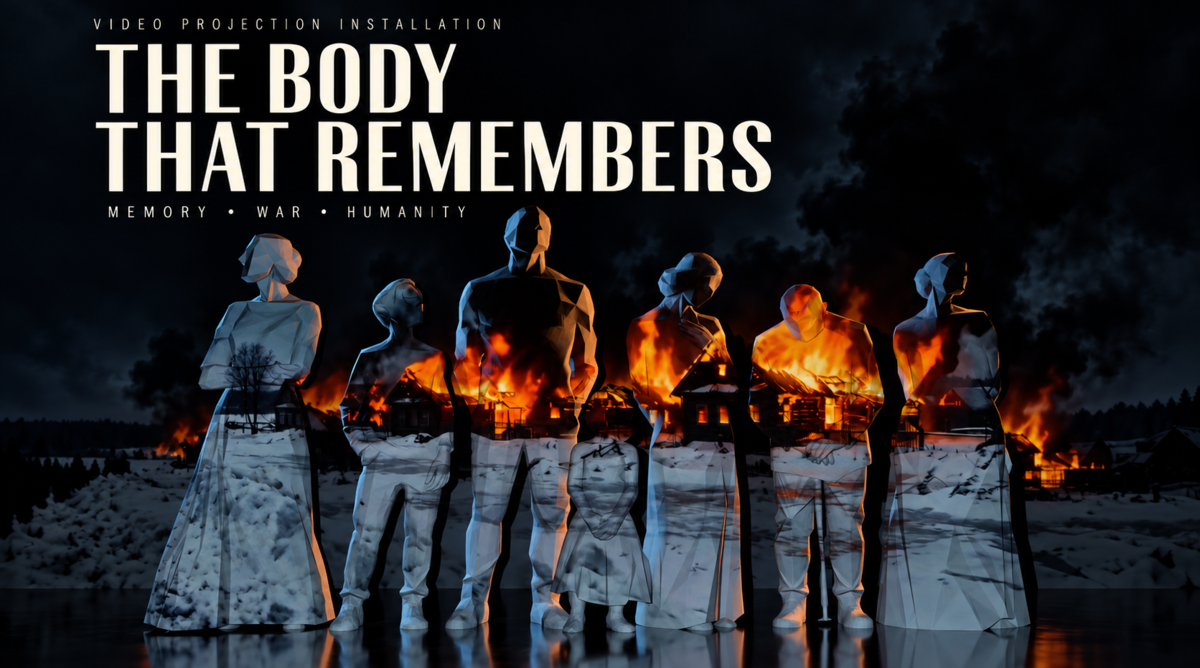
THE BODY THAT REMEMBERS
Faculty of Digital Art, Rangsit University, Thailand
Piyanon Somboon

Abstract :
The Body That Remembers is a 71-second virtual video installation that examines how images of war are inherited by people who did not experience the original events. The work presents seven faceted, faceless human figures of different ages, genders, heights, and postures standing together in a dark digital space. A fixed frontal camera observes them as moving images of four historical periods—an ancient battlefield associated with Thermopylae, Napoleon’s retreat from Russia, the D-Day landing at Omaha Beach, and a contemporary urban conflict viewed through a body-camera interface—are projected across their bodies and the surrounding environment.
The project is informed by Marianne Hirsch’s concept of postmemory, which explains how later generations can develop powerful relationships with traumatic histories through stories, photographs, cultural objects, and other mediated representations. None of the figures is presented as a direct witness. Instead, their bodies become shared surfaces on which inherited images repeatedly appear, overlap, disappear, and return. The differences in age and physical form suggest that mediated memories do not remain within one generation but circulate among adults, young people, and children.
Generative AI was used to create the projected war sequences, but these sequences are treated as source material rather than as the complete artwork. They were reorganized within a virtual environment created and rendered in Blender through spatial composition, figure arrangement, lighting, material design, projection mapping, camera placement, typography, editing, and sound. The combination of synthetic imagery and a deliberately constructed three-dimensional installation makes the production process visible as an act of mediation rather than a reconstruction of historical fact.
Continuous breathing, heartbeat, wind, water, distant combat, and restrained musical textures connect the different periods. As the projected images move from mythic warfare to machine vision, the motionless figures appear to absorb a history that is not personally theirs. The work asks how technological images shape collective memory, and whether repeated representations of violence eventually become part of the emotional inheritance of those who were never present. When the projected image disappears, the bodies remain, suggesting that the screen may go dark while its memory continues.
Objectives :
The objective of The Body That Remembers is to investigate how images of war become inherited memories for people who did not directly experience the original events. The project transforms a moving-image sequence of conflicts from different historical periods into a video projection installation. Images of snow, fire, ruined landscapes, and human loss are projected across seven faceless low-poly figures representing children, adults, and older generations. Their bodies function as living screens, suggesting that cultural trauma is carried not only through archives and historical records, but also through families, media, cinema, and collective imagination.
The installation aims to make the concept of postmemory physically visible by allowing one image to pass simultaneously across bodies of different ages. It also explores how the meaning of historical violence changes when it is reconstructed through contemporary digital tools and displayed as an embodied experience rather than as a conventional film. Instead of recreating war as spectacle or celebrating victory, the work invites viewers to consider what remains after conflict: fragmented images, emotional traces, and memories inherited by those who were never present. Ultimately, the project seeks to encourage reflection on personal responsibility, shared humanity, and the ways mediated images continue to shape our understanding of the past.
Conceptual Framework :
The conceptual framework of The Body That Remembers is grounded primarily in Marianne Hirsch’s concept of postmemory, which describes how later generations form a powerful relationship with traumatic events they did not experience directly. These events are transmitted through photographs, stories, films, archives, and other cultural images until they can feel similar to personal memories.
The project develops this idea through three connected elements: image, body, and transmission. The war imagery represents mediated historical memory rather than a literal reconstruction of one specific event. The seven faceless figures represent different generations and function simultaneously as human forms, projection surfaces, and symbolic archives. As the same moving images travel across children, adults, and older bodies, memory is presented as something transferred, transformed, and carried collectively.
The framework also considers the body as a site where historical trauma becomes emotionally and physically visible. Projection removes the boundary between the recorded event and the present viewer: fire, snow, ruins, and human loss appear to enter and reshape each figure. The faceless low-poly forms prevent the work from identifying one nationality, army, or victim, allowing them to represent shared human vulnerability. Through this relationship between mediated images and embodied installation, the project asks whether contemporary societies remember historical violence itself, or inherit versions of it continually reconstructed by families, cinema, digital media, and collective imagination.
Process / Methodology :
The project was developed through a combination of moving-image editing, three-dimensional modeling, virtual projection, and iterative visual testing. The process began by selecting and restructuring imagery associated with wars from different historical periods. Rather than presenting the material as a chronological documentary, the sequences were edited according to recurring visual motifs, including snow, fire, ruined landscapes, human bodies, and traces of loss. This created a continuous flow of inherited images rather than a factual reconstruction of a single conflict.
A virtual installation space was then constructed in Blender. Seven faceless low-poly human figures were created to represent a young child, an older child, a teenager, three adults, and an older adult. Their proportions, heights, and poses were varied to communicate age and emotional response while maintaining an anonymous, sculptural appearance. The figures were arranged as a multigenerational group in front of a projection surface.
The edited video was mapped simultaneously onto the figures and the background screen. Projection intensity, material roughness, lighting, shadows, camera framing, and floor reflections were tested repeatedly to preserve both the moving images and the anatomical form of each figure. Cool and warm lighting was used to separate the bodies from the background and reinforce the contrast between snow and fire. Typography was kept separate from the projected imagery and added only during the opening and closing sequences. Finally, the installation was rendered as a fixed-camera video, combined with atmospheric sound, and reviewed frame by frame for visual continuity, readability, and emotional rhythm.
Techniques and Materials :
The work combines digital moving-image production, low-poly 3D modeling, virtual projection mapping, lighting design, sound design, and video editing. The source imagery was developed through an artist-directed digital workflow combining generative image and video tools with manual selection, sequencing, compositing, and color adjustment. The resulting video contains recurring images of snow, fire, damaged environments, and human traces drawn from different representations of war.
Blender was used to construct the virtual installation space and seven faceless human figures. Polygonal modeling and flat shading created visible geometric surfaces while preserving recognizable human anatomy and differences in age, scale, and posture. Camera-based projection mapping and shader nodes were used to apply the moving video continuously across the figures and the background projection screen. Matte and semi-reflective digital materials controlled the visibility of the projected imagery, while a dark reflective floor extended the light and movement into the surrounding space.
The lighting system combines cool blue side light, warm orange rim light, and soft overhead illumination. These sources reveal the faceted bodies, separate them from the background, and visually connect the contrasting environments of snow and fire. A fixed frontal camera presents the installation as a unified tableau rather than a conventional narrative scene. Adobe Premiere Pro was used for final editing, timing, opening and closing typography, color refinement, and atmospheric sound mixing. The primary materials are digital video, polygonal human forms, virtual projection surfaces, light, shadow, reflection, typography, and layered environmental sound.
Result / Conclusion :
The resulting work is a virtual video projection installation in which seven faceless low-poly figures stand together as a multigenerational group. A continuous sequence of war-related imagery moves across their bodies and the surrounding screen, transforming each figure from a static sculpture into a temporary carrier of historical memory. Although every figure receives the same projected material, differences in height, age, anatomy, and posture cause the images to fragment and appear differently on each body. This visual variation demonstrates that inherited memory is shared collectively but experienced individually.
The combination of snow, fire, ruins, shadow, and reflected light creates a space that moves between mourning, remembrance, and uncertainty. The work avoids identifying a single nation, conflict, victor, or victim. Instead, the anonymous figures direct attention toward the wider human consequences of war and the ways traumatic images continue to circulate beyond the lifetime of their original witnesses.
The project concludes that contemporary memory of war is inseparable from the media through which it is transmitted. Later generations may not remember historical violence through direct experience, yet they inherit its photographs, films, stories, and reconstructed images. By allowing these images to enter and reshape symbolic human bodies, The Body That Remembers makes postmemory visible as an embodied and continuing process. The installation ultimately proposes that the past does not remain inside an archive; it survives through the images carried by living generations.
References :
Assmann, A. (2011). Cultural memory and Western civilization: Functions, media, archives. Cambridge University Press.
Bennett, J. (2005). Empathic vision: Affect, trauma, and contemporary art. Stanford University Press.
Grau, O. (2003). Virtual art: From illusion to immersion (G. Custance, Trans.). MIT Press.
Hirsch, M. (2008). The generation of postmemory. Poetics Today, 29(1), 103–128. https://doi.org/10.1215/03335372-2007-019
Hirsch, M. (2012). The generation of postmemory: Writing and visual culture after the Holocaust. Columbia University Press.
Landsberg, A. (2004). Prosthetic memory: The transformation of American remembrance in the age of mass culture. Columbia University Press.
Paul, C. (2023). Digital art (4th ed.). Thames & Hudson.