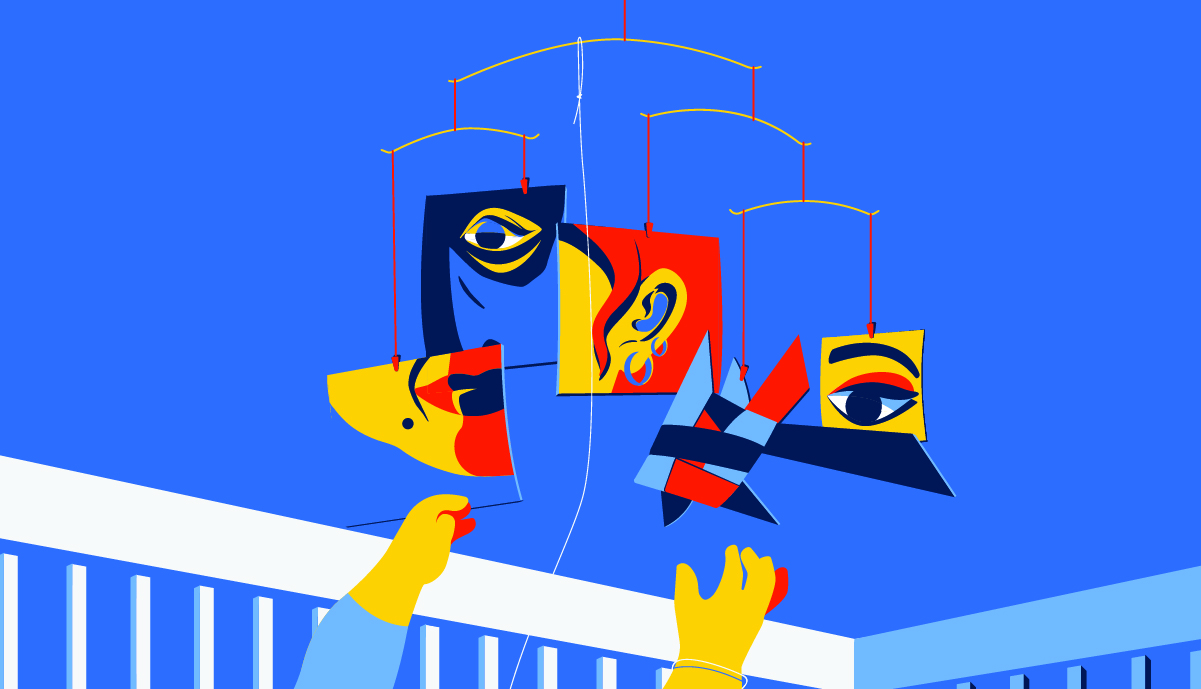
New Original: Cycle of reception, reconstruction, and reinvention in immigrant motherhood
Stamford International University, Thailand
Pirawan Numdokmai Becker
Abstract :
This series of three digital illustrations, New Original, emerges from the artist’s own experience of relocating from Thailand to Germany, and raising children there as a first-generation immigrant mother, functioning as a visual documentation of this period in the artist’s life. It draws on Marianne Hirsch’s concept of postmemory, defined as the relationship of a generation to experiences preceding their birth, transmitted not through direct recollection but through images, objects, and behaviors. Building on this concept, the work asks what happens when the mother embodies the transmitter working from a partial, already-reconstructed memory of home.
Relocated far from the extended family, rituals, and daily texture of her own upbringing, the artist found herself unable to pass on tradition “as it was.” What she offers her children instead are her own approximations: a soul-blessing ritual (“sai sin”) remembered only in fragments, a childhood sweater pattern half-recalled and knitted anew and a family history made up of imaginary portraits she can only partially picture. No original remains to be transmitted faithfully; there is only the version the mother is able to reconstruct.
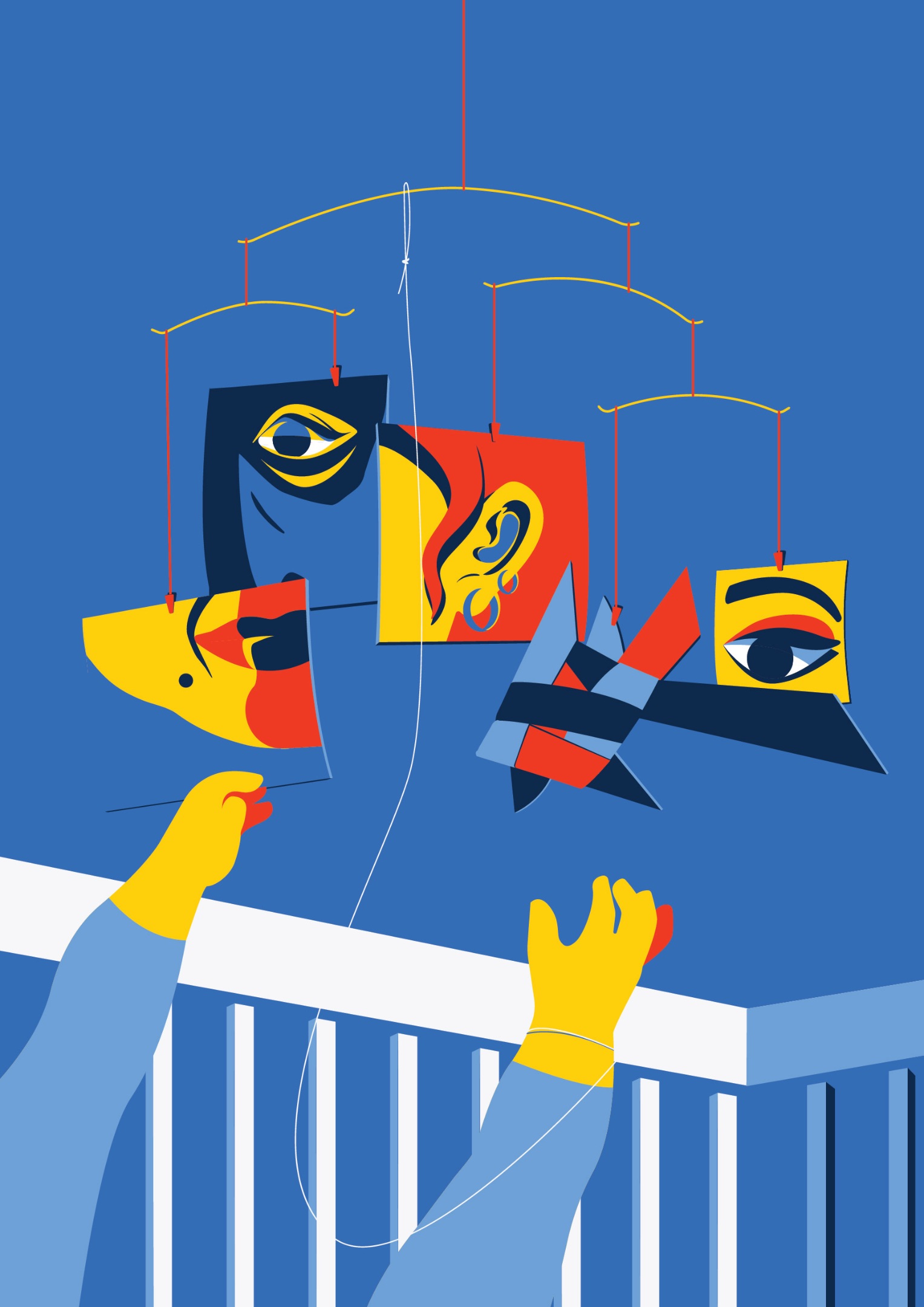
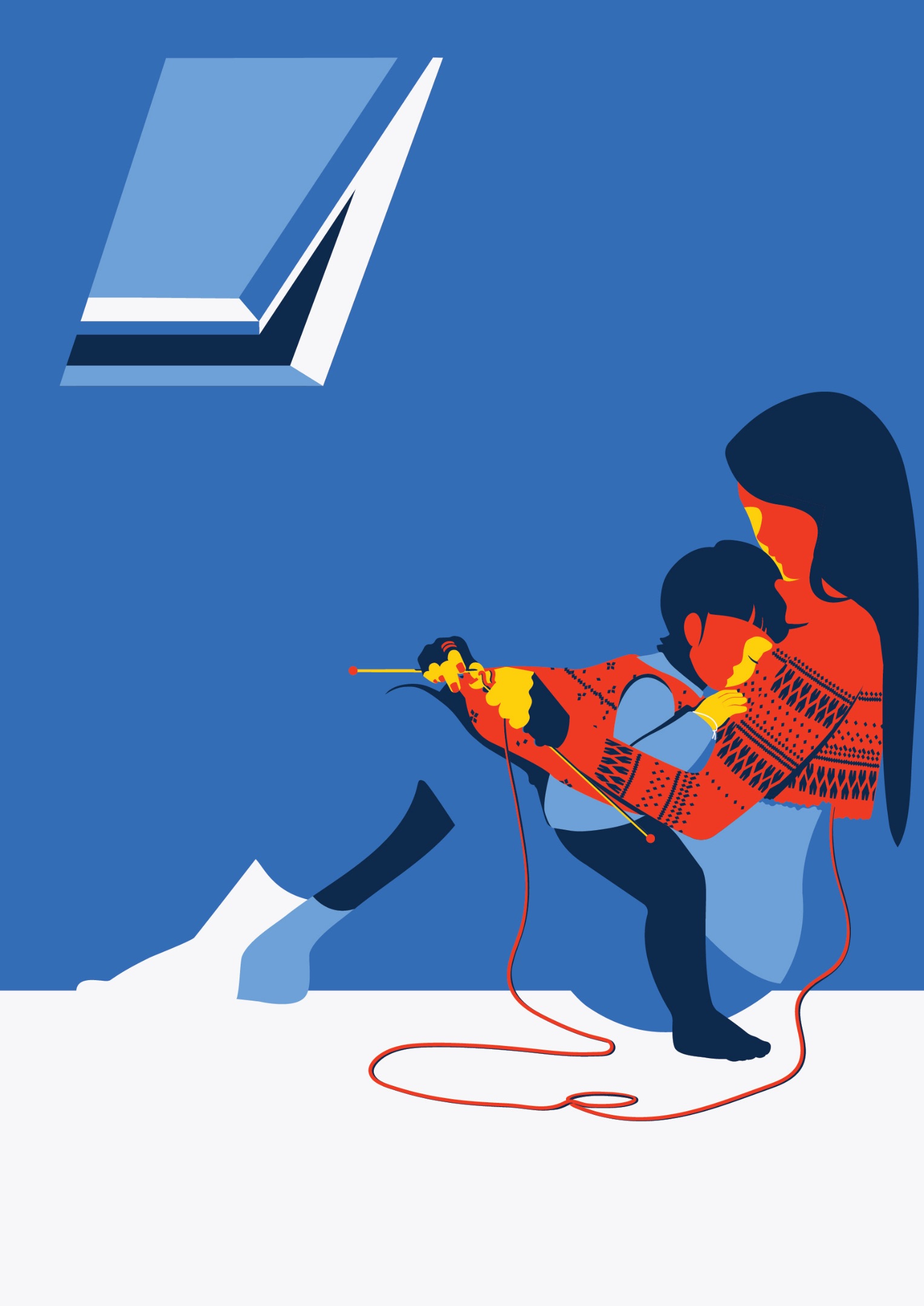
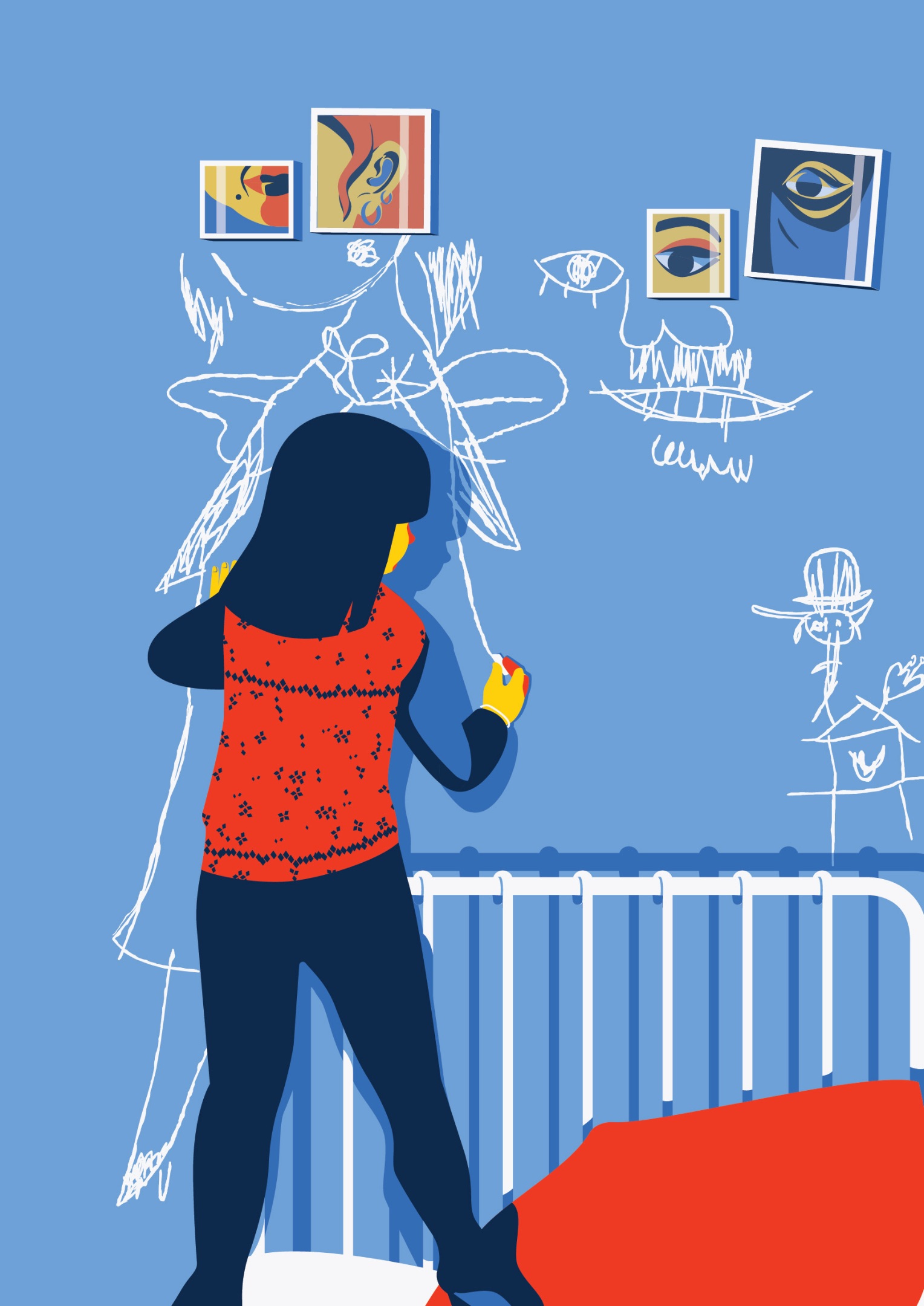
The first illustration depicts an infant reaching toward a mobile of fragmented portraits of ancestors, connected by a sacred thread tied to the child’s wrist in a manner that reinterprets the traditional religious practice, alongside a woven fish charm (“pla tapian”) whose weave is imperfect yet still functional. The second shows the mother knitting a new sweater for her sleeping child by unraveling yarn from her own worn sweater, its pattern drifting into something new partway through. The third follows the same child, older now, adding chalk lines to the same family portraits from the first illustration, forming connections to relatives the child has never met.
Throughout the series, the child’s face is withheld or only partially shown, inviting the viewer to complete it, just like the child finishes the look of his or her ancestors.
Read together, the three works propose that postmemory is not a failure of transmission, but a continuous act of remaking, with each generation working with artifacts that were already incomplete when they arrived.
Objectives :
This series aims to explore the potential of digital illustration as a medium for understanding postmemory itself as an unfinished, ongoing process, work in progress in the most literal sense, rather than a fixed, pre-formed body of inherited knowledge.
Building on this, the work aims to present postmemory as a material and gestural process rather than a purely narrative or photographic one. While much postmemory scholarship centers on photography and archival trauma, this work asks whether everyday domestic acts, such as tying a thread, unraveling yarn, or coloring outside a frame, can carry the same weight of transgenerational transmission as more conventionally documented forms of historical memory. In doing so, it seeks to widen the range of objects and gestures postmemory theory is understood to encompass.
It further aims to depict the specific position of the immigrant mother as an active reconstructor of memory: someone who, lacking access to a complete original, creates her own version of inherited rituals for her children, and whose own reconstruction is itself imperfect. This positions the mother not as a neutral channel of tradition, but as a figure who must continuously improvise within the gap left by distance and displacement. Her labor became visible through its incompleteness, rather than hidden behind an illusion of continuity.
Finally, the work aims to show the child not as a passive recipient of this inheritance but as an active co-creator, particularly in the third piece, where imaginative reconstruction is visualized through an explicit, hand-drawn act, continued directly onto the inherited image rather than kept separate from it. This same incompleteness is extended to the viewer through the child’s consistently withheld or partial face across all three illustrations, asking them to participate in imaginative reconstruction rather than observe it from a distance. Ultimately, the series aims to communicate that the concept of postmemory is not confined to catastrophic or collective historical trauma, but can be located equally within the quiet, repeated labor of raising children far from one’s place of origin.
Conceptual Framework :
The series is grounded in Marianne Hirsch’s (2008, 2012) theorization of postmemory: a relationship to the past mediated not by recall but by imaginative investment, projection, and creation. Hirsch’s earlier work on family photography (1997) establishes the family as the primary site where such transmission occurs, through objects and images rather than testimony.
This framework is here relocated from its original context of collective historical trauma into the everyday condition of immigrant motherhood. The mother figure in this series is not a witness passing down a complete inheritance, but, following Jacobson’s (2021) account of diaspora memory-objects, an active reconstructor working from her own incomplete recollection of home. Rothberg’s (2009) concept of multidirectional memory further supports reading this transmission as cumulative and layered rather than linear: the sweater in the second illustration carries traces of three generations at once, its pattern drifting from the original partway through the work, showing that even the mother’s own act of reconstruction cannot fully replicate what she intends.
Immigrant motherhood is among the most recurrent subjects in postmemory-informed art; this recurrence is itself significant, suggesting that what the series depicts is not a chosen artistic device but a structural condition of displacement that repeats across unrelated lives. Rather than avoiding this familiarity, the work asks what remains specific within it, namely the particular objects, gestures, and failures of transmission belonging only to this one family. The withheld or partial face of the child throughout the series extends this further to the viewer, who is invited to complete the image imaginatively, entering the same postmemorial process the work depicts.
Process / Methodology :
Source materials
Each illustration was based on the artist’s own experience raising children in Hamburg, Germany, from a far distance to her family’s home in Bangkok, Thailand. Rather than referencing historical archives, the series draws on personal rituals: the Thai “rap khwan” soul-blessing practice (“sai sin” thread), acts of hand-knitting passed within the artist’s family, and the informal, unsupervised drawing children do on domestic surfaces.
The withheld face
Across all three works, the child’s face is deliberately withheld or only partially shown, running parallel to the fragmented ancestral imagery in the first piece. The intention is twofold: to keep the child a vessel for the postmemory process rather than a fixed portrait, and to invite the viewer to complete the child’s face imaginatively. This mirrors the same imaginative reconstruction the child performs toward their ancestors in the third piece.
Visual continuity
A single sacred-thread motif, rendered in the same color throughout all three illustrations, unifies the series and marks the ritual’s continuity across each stage.
Image 1: Reception (“The Mobile”)
The infant reaches toward a mobile of fragmented ancestral faces, connected by the sacred thread and an imperfectly woven fish charm (“pla tapian”).
Image 2: Reconstruction (“The Sweater”)
The mother unravels yarn from her own worn sweater to knit a new one for her child; the pattern drifts from its original partway through.
Image 3: Reinvention (“The Completion”)
The child, older now, adds chalk marks directly onto the framed ancestral portrait from Image 1, extending beyond its edges rather than working on a separate surface, so that received and invented memory occupy the same physical space.
Techniques and Materials :
Medium
Flat digital illustration created in Adobe Illustrator, with deliberately reduced detail, so as not to overwrite the viewer’s own frame of reference, which may already hold a comparable collective experience of these objects and gestures.
Recurring elements
Recurring elements such as the sacred thread and the ancestral images anchor the piece within the same series. The imperfectly woven fish charm (pla tapian), the drifting yarn pattern in Image 2, the chalk marks the child adds in Image 3, and the overall tonal palette unify the series visually and mark the continuity of a ritual that has been unraveled and reworked across generations.
Effect
This consistency lets the boundary between the received and the invented gradually merge, as it does in everyday life, until it becomes difficult to tell which element is original and which was passed down, itself becoming a “new original.”
Result / Conclusion :
The three illustrations, read in sequence, trace postmemory as a process rather than a static inheritance: reception (the infant reaching toward fragmented ancestral images), reconstruction (the mother re-forming inherited material into something new, itself imperfectly), and reinvention (the child completing what remains incomplete, from imagination rather than memory). Read together, they suggest that postmemory is not a single transfer from one generation to the next, but a chain of repeated, imperfect remaking, with each generation handling material that was already partial when it arrived.
By withholding the child’s face throughout the series, the work extends this process to the viewer, who is invited to complete the child’s identity just as the child completes the ancestral image in the final piece. The mother and child may also stand in for the viewer, should the viewer share a comparable lived experience of their own. In shifting Hirsch’s framework from a context of collective historical trauma to the everyday duties of diasporic motherhood, this series proposes that postmemory can also live in ordinary routines that are repeated and appear unremarkable. A process that usually goes unseen thus becomes visible, revealing itself as a work in progress: a cycle of postmemory whose endpoint no one can determine.
By withholding the child’s face throughout the series, the work extends this process to the viewer, who is invited to complete the child’s identity just as the child completes the ancestral image in the final piece. The mother and child may also stand in for the viewer, should the viewer share a comparable lived experience of their own. In shifting Hirsch’s framework from a context of collective historical trauma to the everyday duties of diasporic motherhood, this series proposes that postmemory can also live in ordinary routines that are repeated and appear unremarkable. A process that usually goes unseen thus becomes visible, revealing itself as a work in progress: a cycle of postmemory whose endpoint no one can determine.
References :
Hirsch, M. (1997). Family frames: Photography, narrative, and postmemory. Harvard University Press.
Hirsch, M. (2008). The generation of postmemory. Poetics Today, 29(1), 103–128. https://doi.org/10.1215/03335372-2007-019
Hirsch, M. (2012). The generation of postmemory: Writing and visual culture after the Holocaust. Columbia University Press.
Jacobson, A. (2021). Diaspora memory-objects. TEXT, 25(Special 63), 1–16. https://doi.org/10.52086/001c.29722
Rothberg, M. (2009). Multidirectional memory: Remembering the Holocaust in the age of decolonization. Stanford University Press.
Share :
Facebook
Twitter
LinkedIn
WhatsApp
Email
Print