Fade and Trace
Mahidol University International Collage, Thailand
Napatt Piyawongwatthana
Abstract :
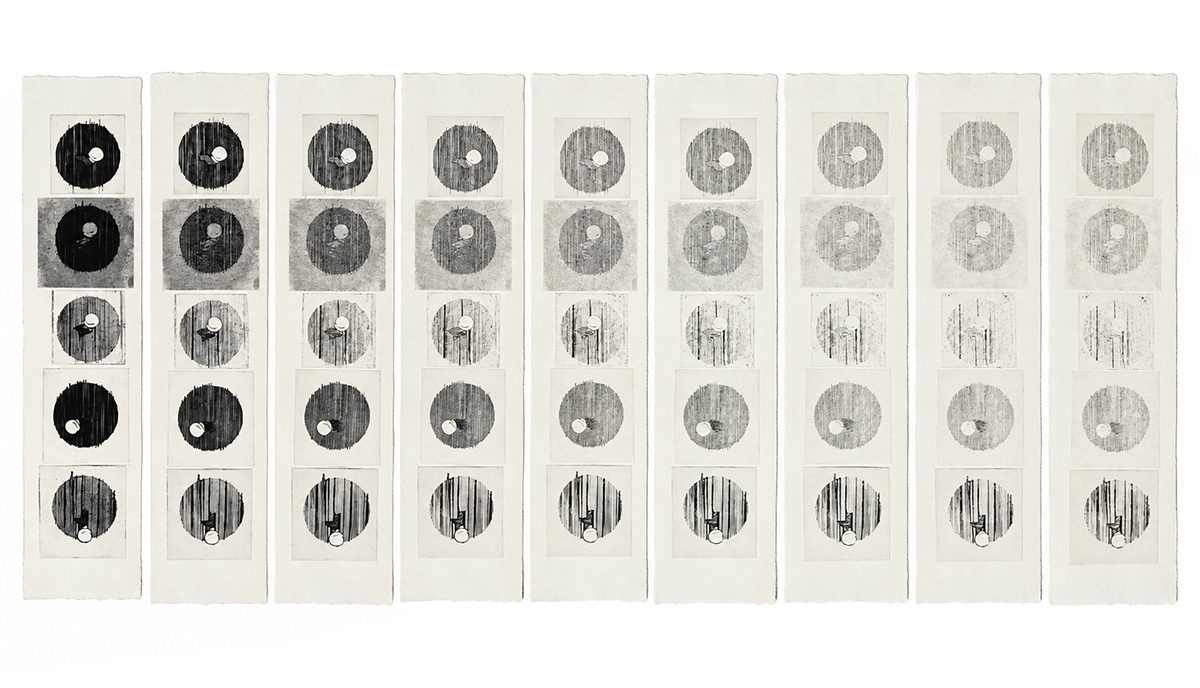
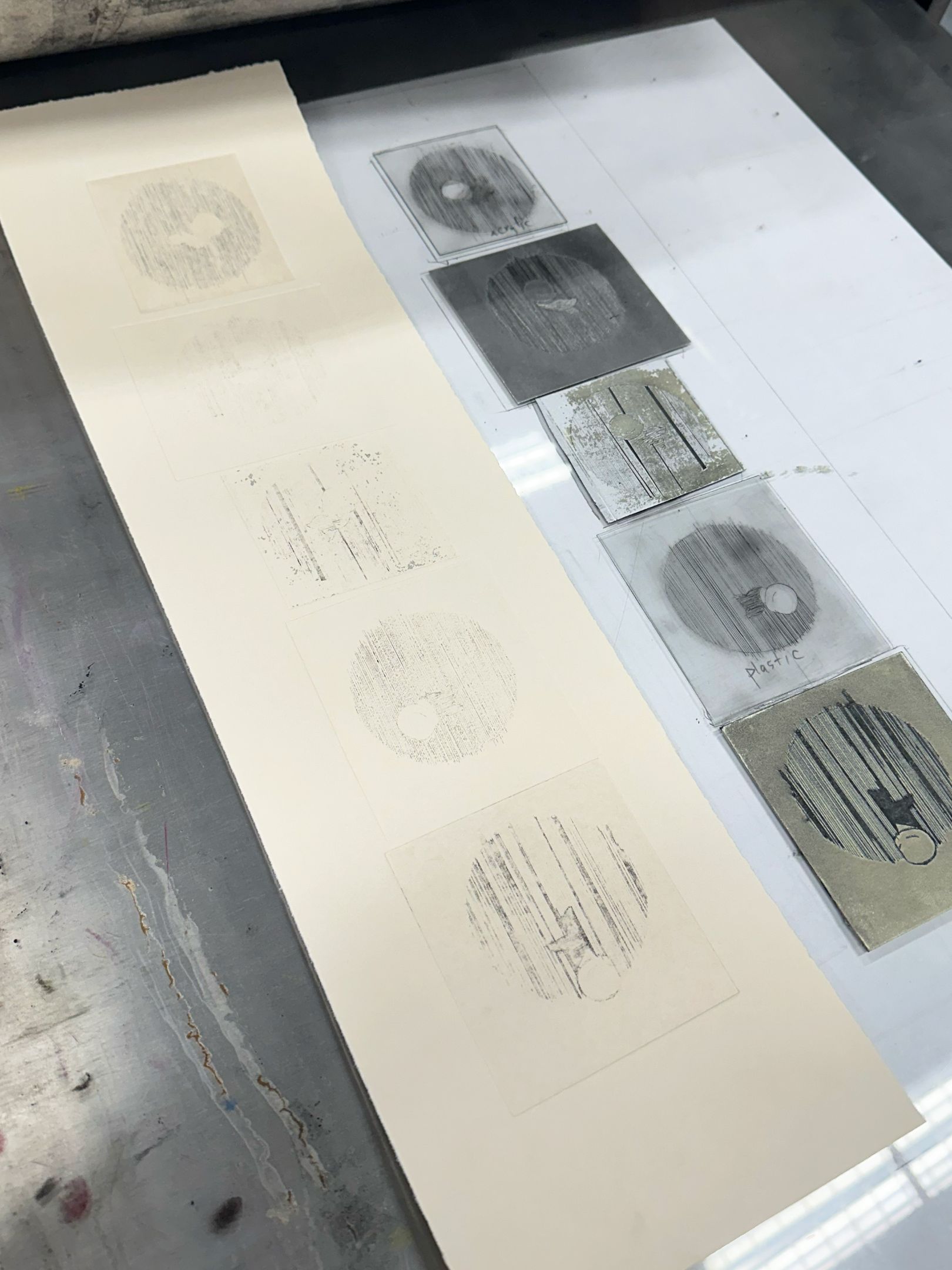
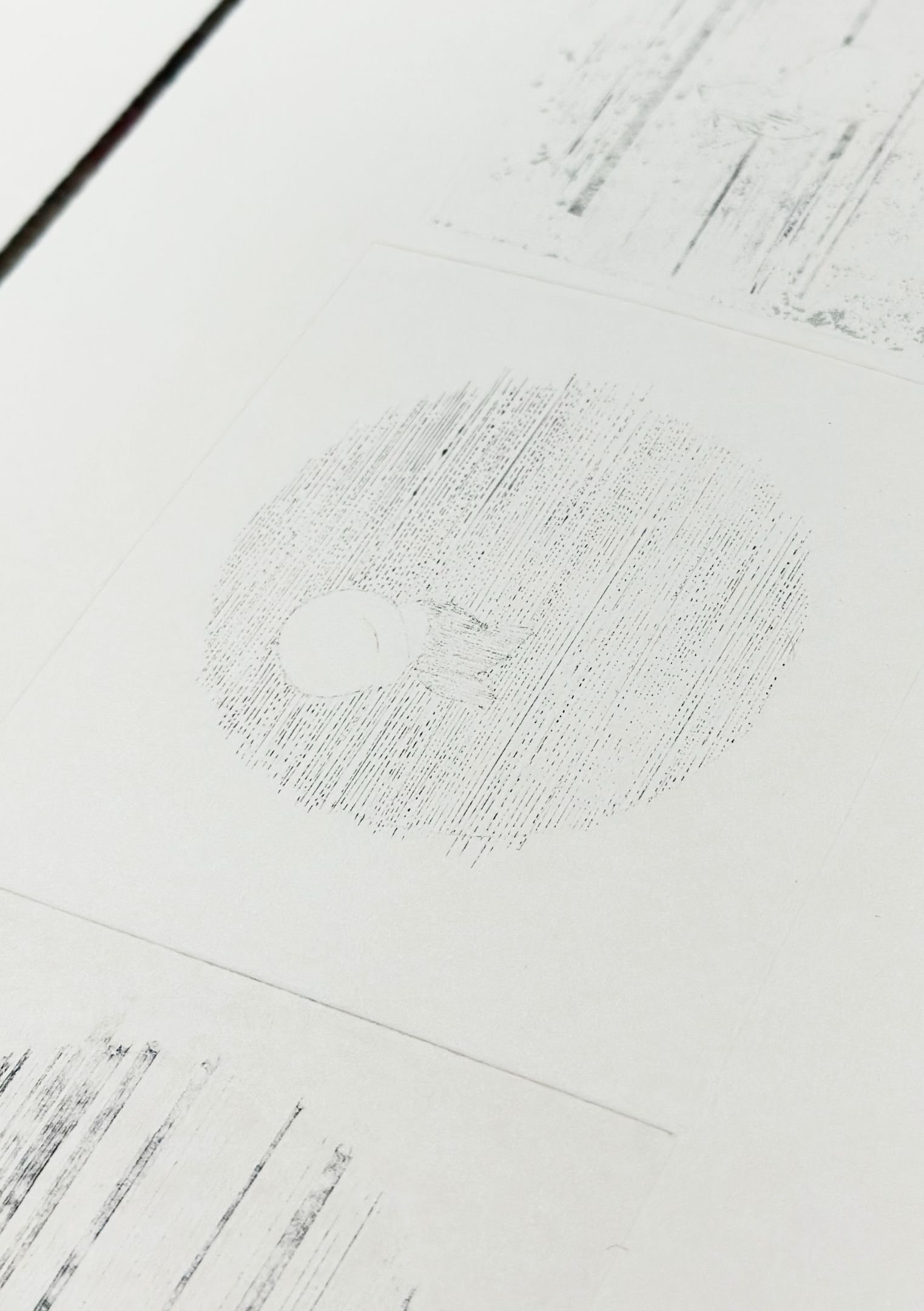
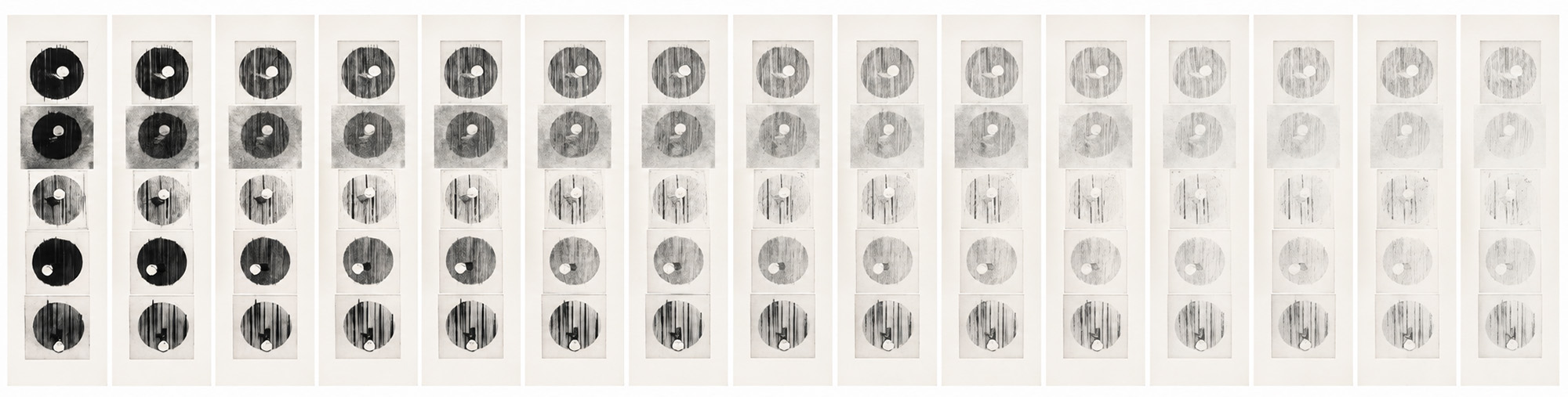
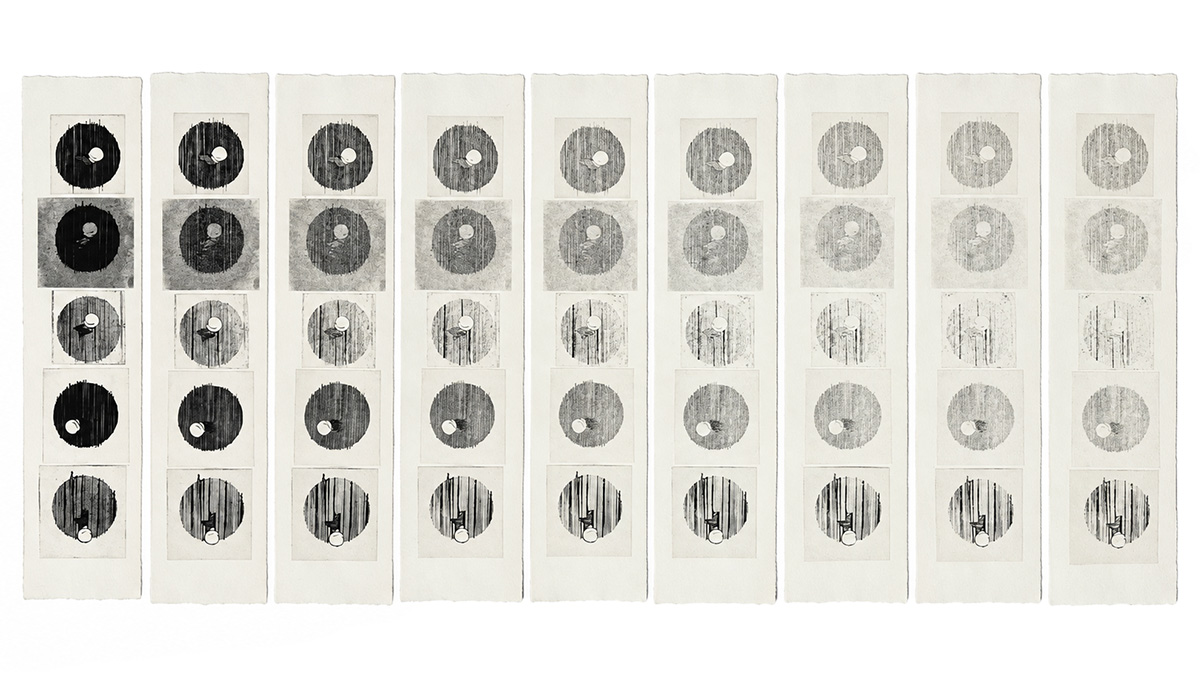
This project explores repetitive thoughts and how they slowly fade over time through the process of printmaking. The concepts are translated into the printmaking process. Only once time, the plates were applied ink, then continuously printed without adding more until the image gradually fades. The fading impressions represent thoughts that repeat again and again until they slowly lose their power, while the remaining marks on the plate represent experiences that may stay within mind even when they are no longer clearly visible.
Different waste and leftover materials from the Traditional Techniques Studio class at MUIC were tested as printing plates to explore how each material creates marks and fading results. This project focuses on experimenting with how different plate materials respond to repeated printing without re-inking. Through this experiment, each material produces different ink retention and levels of fading. The results show how repetition and fading can be used not only as a printing process, but also as visual elements to communicate the idea of repetitive thoughts and traces that remain over time.
Objectives :
Objective
- To reduce printmaking studio waste.
- To discover the possibility of using recycled materials as drypoint plates.
- To compare how different plate materials fade over repeated printing, interpreting the results as an analogy for how memories embedded in different mediums fade at different rates.
Conceptual Framework :
| The project was developed using the Double Diamond framework by the Design Council, including four stages: Discover, Define, Develop, and Deliver.
The first stage, Discover, focuses on exploring different possibilities and is divided into two parts: Exploring Recycled Materials and Intaglio Technique Testing. Waste and leftover materials from the Traditional Techniques Studio were collected and explored as possible printing plates based on their different surfaces, thicknesses, and ability to create and retain marks. Intaglio was explored because marks are created by cutting or scratching into the plate surface. These marks become physically embedded in the material, while ink is held inside the grooves and transferred onto paper. This process connects with the idea of memory as an imprinted and embedded trace. In the Define stage, drypoint was selected based on its connection to the ideas of repetition, fading, and remaining traces. The printing process was defined by applying ink only once and repeatedly printing without re-inking to observe how the image gradually faded. Five materials were selected for further experimentation: acrylic sheet, plastic sheet, zinc plate, Tetra Pak, and cardboard, as they produced clear marks and retained ink well. In the Develop stage, the same design was created on the five selected plate materials. The designs were cut and scratched into each surface using the drypoint technique. Each plate was inked only once and repeatedly printed without re-inking until the image gradually faded. Each impression was compared to observe differences in marks, ink retention, texture, and levels of fading. This process explored how the physical qualities of different materials affected the results of repeated printing. The final stage, Deliver, developed the experimental results into the final artwork. The prints were arranged as a series showing repetition and gradual fading. Differences in marks, textures, and fading became part of the visual expression. Repeated printing was used not only as a printmaking process but also as a visual language for repetitive thoughts. As each impression gradually fades, some traces remain, reflecting how thoughts may lose their intensity over time while still leaving traces behind. |
Process / Methodology :
| The design process began with sketch design to find various compositional possibilities and visual elements, aiming to identify the approach that best fit with the concept. Then continued with the collecting of waste materials from the Traditional Techniques Studio.
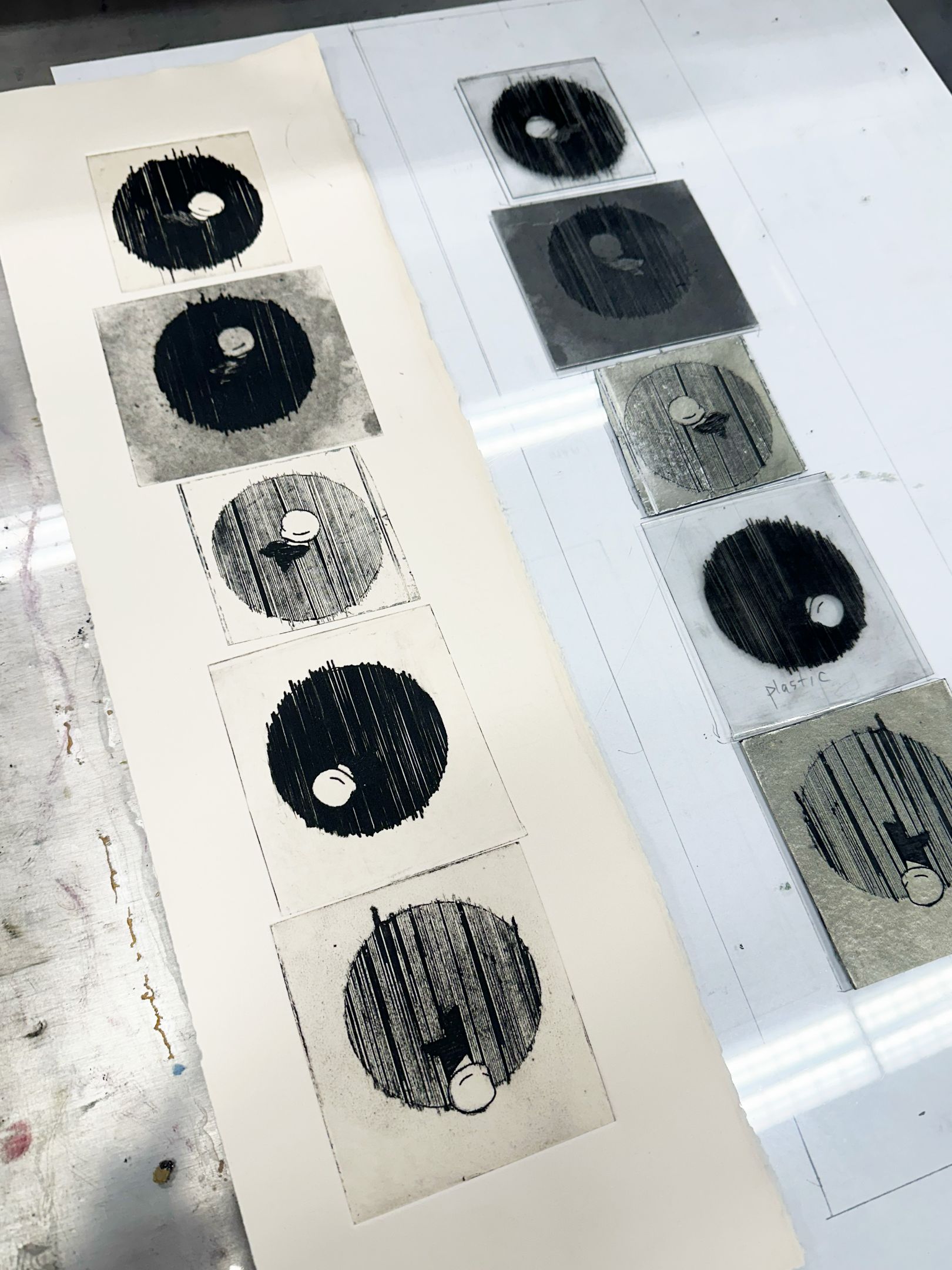
Five materials from different printmaking processes were selected: acrylic sheets left over from drypoint technique, Tetra Pak from monoprint and collagraph techniques, aluminum sheet from organic printing, plastic sheets from collagraph, and cardboard. The five selected materials were tested using drypoint technique. Sharp tools such as needle and cutter were used as drawing materials to explore different visual elements including lines, dots, scratched marks, and textures. After experiment, straight lines and cross-hatching were selected. The next step was plate preparation. The shapes were drawn onto each plate before cutting. Once all the plates were completed, only the acrylic sheet required its edges to be filed due to its thickness before printing. Before printing, all plates were cleaned and placed on the prepared inking station. Ink was applied to each plate. Areas drawn with hard pressure created deeper grooves that held more ink, resulting in darker values, while lighter grooves produced lighter values. After that, clean and thin paper was used to wipe. Excess ink was removed, leaving ink only in the grooves. All plates were put on the printing press, followed by dampening paper on top. A clean sheet of paper was placed as a protective layer before rolling the plates through the press machine. Later straighten all the prints on the wooden board with water-based masking tape. The printing process was repeated without reapplying ink, allowing each successive print to gradually fade until the remaining ink was fully transferred from the plates. |
Techniques and Materials :
This artwork use printmaking in the intaglio process in which when ink is applied and wipe, ink will remain into incised mark. The value created by using various types of drawing techniques such as hatching and cross hatching. As well, the values can be created by using different tools and pressure. In this artwork, cutter and needle were selected. Cutter gave deeper grooves and contain moist along the lines, whreras needle showed cleaner lines and lighter grooves.
Materials: Acrylic sheet, Aluminum plate, Tetra pak, Plastic sheet, and cardboard
Result / Conclusion :
| Material | Marks / Texture | Ink Retention | Fading Behavior | Observation |
| Acrylic Sheet | Clear with visible linear texture | Medium | Gradual | The first impression is strong and dark, then gradually becomes lighter. The overall form remains visible through several repeated prints. |
| Aluminum Plate | Clear and relatively even marks | Medium–Low | Relatively fast | The first impressions are clear, but the image loses contrast faster than acrylic. The marks become softer and less visible through repetition. |
| Tetra Pak | Fine scratched and linear marks | Low | Fast | The image starts lighter and fades quickly. Fine marks remain visible for a short period, but the overall form becomes unclear after repeated printing. |
| Plastic Sheet | Strong dark areas with visible linear marks | High | Slow | The material retains ink well. The circular form and marks remain visible through many impressions and fade gradually. |
| cardboard | Strong linear and textured marks | High | Slow | The scratched marks continue to hold and transfer ink through many repeated prints. Some lines remain visible even when the overall image becomes very light. |
The results show that each material responded differently to the same repeated printing process. Acrylic sheet and aluminum plate produced clear first impressions, but gradually lost their intensity through repeated printing. Tetra Pak faded quickly, while plastic sheet and photoboard retained visible marks for a longer period. Even when the same drypoint and printing process was applied, the different surfaces and physical qualities of each material affected how the ink was retained and transferred.
These differences became part of the concept of the work. The experiment shows that traces do not disappear at the same rate. Some fade quickly, while others remain visible through many repetitions. This can be interpreted as a memory and repetitive thoughts, where different experiences may remain, change, or slowly lose their intensity over time.
References :
Freud, S. (1955). Beyond the pleasure principle. In J. Strachey (Ed. & Trans.), The standard edition of the complete psychological works of Sigmund Freud (Vol. 18, pp. 7–64). Hogarth Press. (Original work published 1920)
Freud, S. (1961). A note upon the “Mystic Writing-Pad.” In J. Strachey (Ed. & Trans.), The standard edition of the complete psychological works of Sigmund Freud (Vol. 19, pp. 227–232). Hogarth Press. (Original work published 1925)
Hirsch, M. (2008). The generation of postmemory. Poetics Today, 29(1), 103–128. https://doi.org/10.1215/03335372-2007-019
Robins, S. (2025). A place for the memory trace. In L. Nadel & S. Aronowitz (Eds.), Space, time, and memory (pp. 112–134). Oxford University Press. https://doi.org/10.1093/oso/9780192882547.003.0006