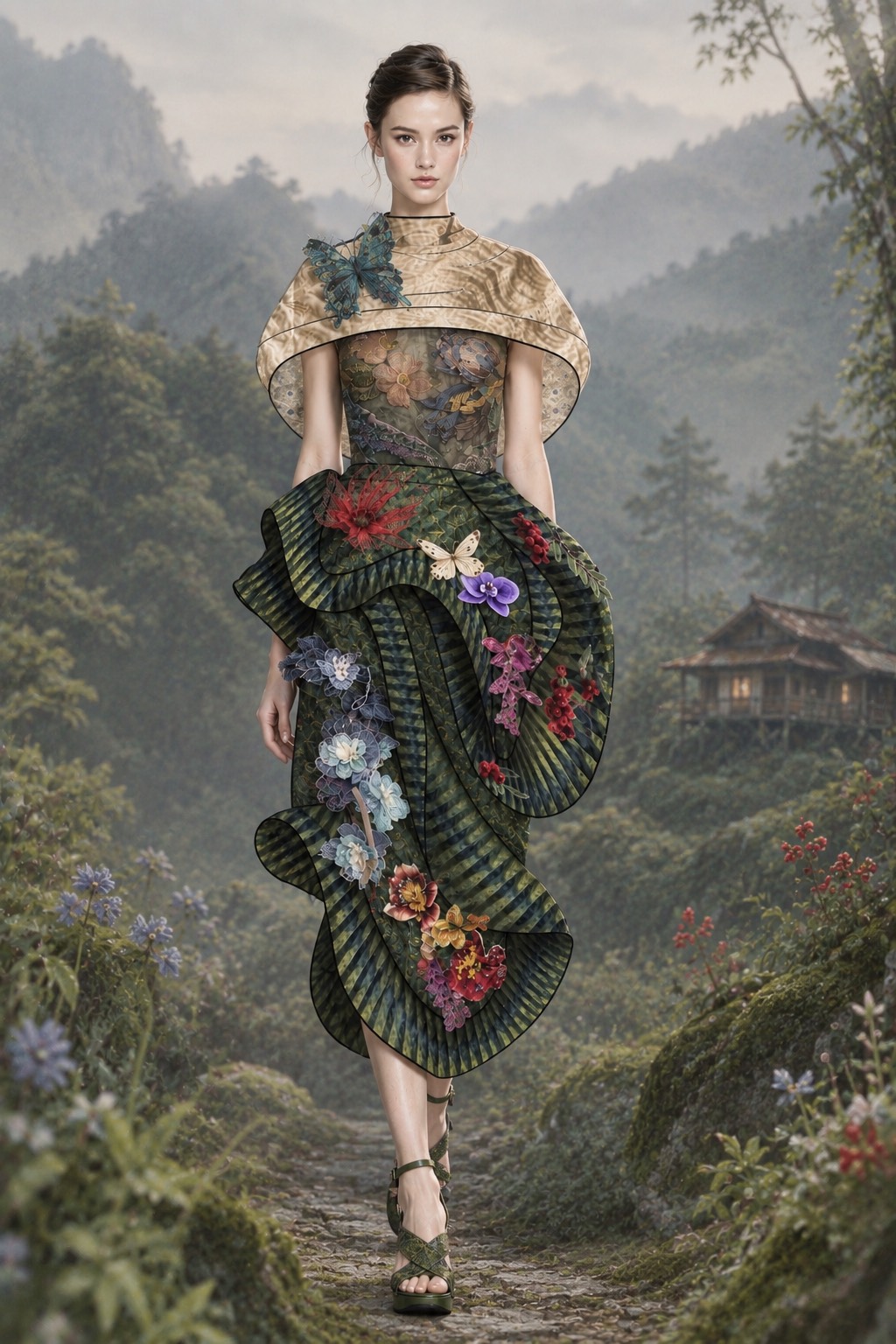
WITHIN THE BIG FOREST
College of Design, Rangsit University, Thailand
Laddawan Sarapat
Abstract :
The royal statement, “The King is water; I shall be the forest,” reflects the profound vision of Her Majesty Queen Sirikit the Queen Mother toward the conservation of natural resources and watershed forests. This vision contributed to a sustainable development approach that redefined the relationship between people and nature through the “Small House in the Big Forest” initiative. The initiative not only focused on forest restoration but also supported sustainable livelihoods among highland communities through self-reliance, traditional textile practices, natural dyeing, and environmentally responsible agriculture, fostering harmonious coexistence between communities and nature.
This creative research was inspired by the researcher’s journey to a highland community in Chiang Mai Province. The challenging journey along winding mountain roads revealed an extraordinary landscape of dense forests, towering trees, wildflowers, butterflies, and fresh mountain air. These encounters created a profound sense of connection with nature, evoking the image of a “little girl adventuring through a vast forest.” At the same time, the researcher observed how local communities continue to preserve traditional weaving, embroidery, cultural practices, and respect for the surrounding environment despite the influence of modern lifestyles.
The concept of being a “small person in a great forest” reflects human humility in relation to the vastness of nature and resonates with the philosophy of the “Small House in the Big Forest.” The concept emphasizes that even a small community can live with dignity by drawing upon cultural wisdom while conserving its natural environment. These experiences became the conceptual foundation of the creative fashion research, which seeks to carry forward the green royal vision through the study of local ways of life and indigenous knowledge.
The research translates these insights into contemporary fashion design through the interpretation of natural forms, forest structures, local textile wisdom, textures, layering, and sustainable material practices. The resulting fashion collection aims to communicate the interconnectedness of people, culture, and nature, presenting fashion as a creative medium for preserving cultural identity and promoting a sustainable coexistence between humans and the natural environment.
Objectives :
- To study and interpret the philosophy of forest conservation and sustainable development embodied in the Ban Lek Nai Pa Yai (Little House in the Big Forest) Royal Project, with emphasis on the harmonious coexistence between people, forests, and local communities.
- To explore and translate the ecological characteristics, local wisdom, and traditional textile practices of mountain communities—including hemp-fiber weaving, embroidery, and natural dyeing—into creative concepts for contemporary fashion design.
- To develop a contemporary fashion collection that communicates the interconnectedness of humans and nature through the creative interpretation of forest landscapes, ecological forms, structures, layering, textures, and locally rooted materials, while promoting awareness of sustainable fashion and cultural conservation.
4. To honor and commemorate the far-sighted vision and profound wisdom of Her Majesty Queen Sirikit, The Queen Mother, by translating the enduring principles of environmental conservation, community development, and sustainable coexistence between people and nature into contemporary creative fashion.
Conceptual Framework :
The conceptual framework of this creative fashion research is rooted in the philosophy of forest conservation and sustainable development reflected in the Ban Lek Nai Pa Yai (Little House in the Big Forest) Royal Project under the royal initiatives of Her Majesty Queen Sirikit, The Queen Mother. The research explores the relationship between people, forests, and local communities, emphasizing coexistence, mutual dependence, and respect for natural resources.
The concept is developed from the researcher’s field experience in a mountain community in Chiang Mai Province, where the vastness of the forest created an awareness of human beings as “small” within the “big forest.” This perspective became a conceptual metaphor for humility, respect, and responsible coexistence with nature.
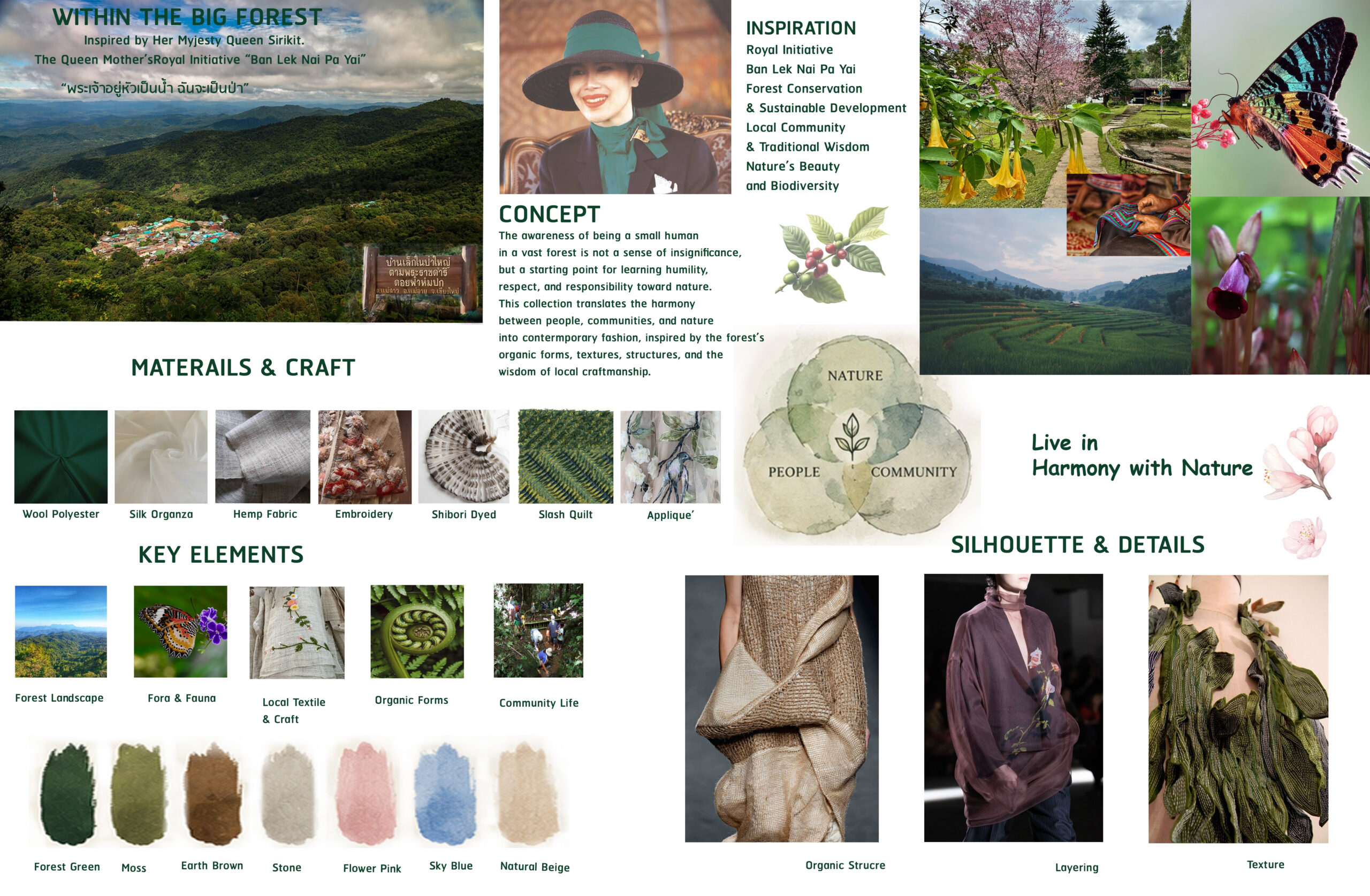
The framework consists of three interconnected dimensions: Forest Ecosystem, Local Cultural Wisdom, and Contemporary Fashion Expression. The forest ecosystem provides visual and structural inspiration through organic forms, layered landscapes, winding pathways, textures, and the complexity of natural environments. Local cultural wisdom contributes traditional textile practices, including hemp-fiber weaving, embroidery, and natural dyeing derived from bark, flowers, and leaves. These elements are then interpreted through contemporary fashion design using form, structure, layering, texture, and material.
The framework ultimately translates ecological and cultural knowledge into a creative fashion collection that communicates the interconnectedness of humans, communities, culture, and nature, while promoting awareness of sustainable and respectful relationships with the environment.
Process / Methodology :
This creative fashion research employed a qualitative and practice-based methodology, integrating reflective inquiry, contextual study, visual analysis, and creative design development. The process was conducted through four main stages.
- Reflective Recollection and Inspiration: The research began with the researcher’s recollection of past experiences and impressions gained from journeys through mountain communities in Chiang Mai Province. Memories of vast forests, natural landscapes, flowers, and the surrounding environment evoked a sense of wonder and inspired the concept of being a “small person in a big forest.”
- Analysis of Natural and Cultural Elements: Visual and sensory elements derived from memory and previous experiences were analyzed and selected as sources of inspiration. Particular attention was given to natural textures, the forms and beauty of wildflowers, local vegetation, and coffee, an important economic crop of the region. These elements provided the foundation for the design process.
- Concept and Design Development: The characteristics of natural forms, textures, layering, rhythms, and details were translated into fashion language through experimentation with silhouette, structure, layering, surface treatment, techniques, and materials. Sketches and design explorations were developed to transform natural and cultural inspirations into contemporary fashion expressions.
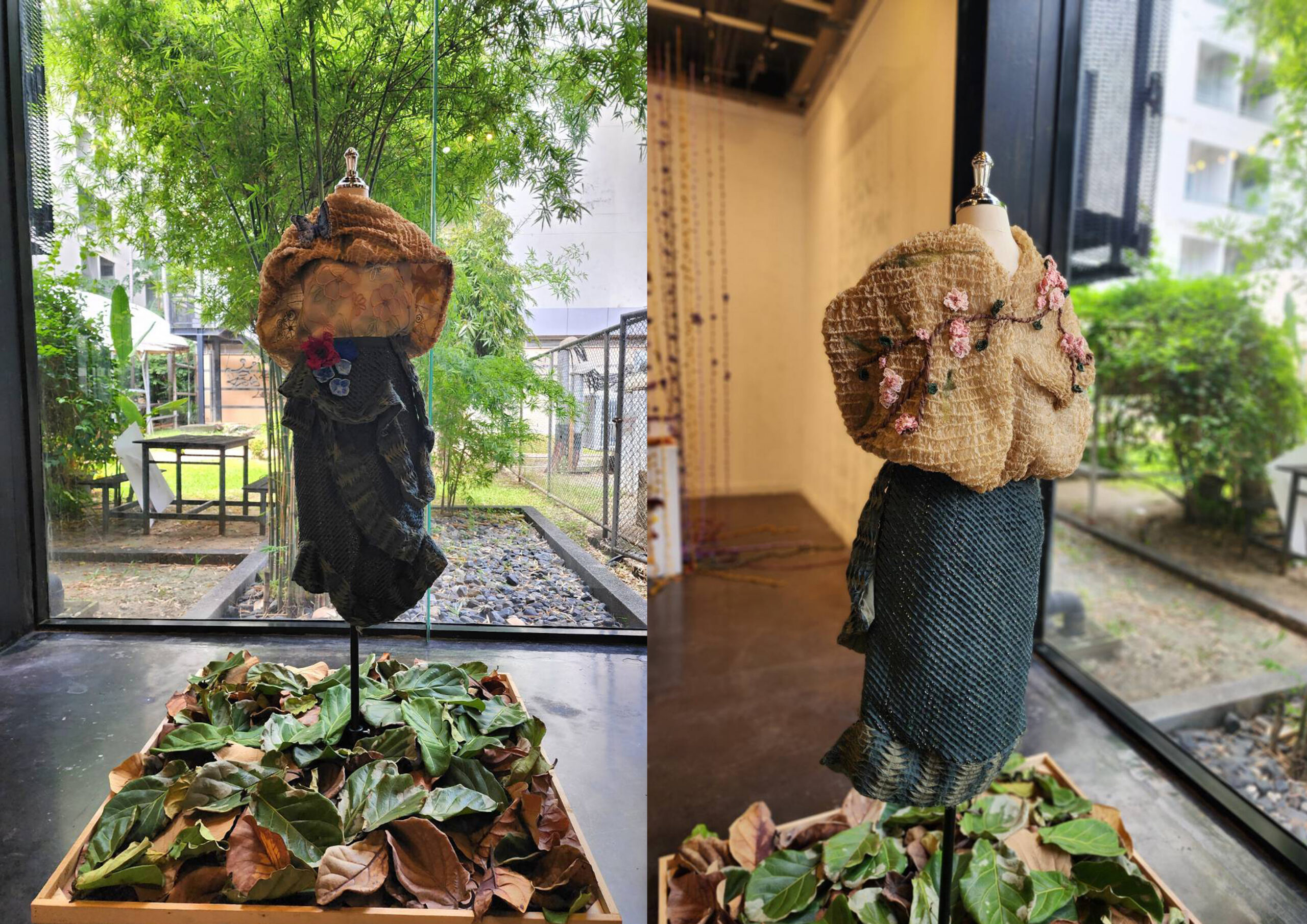
- Creative Production and Final Collection The selected designs were developed into garment prototypes and refined through material experimentation using hemp, silk, wool, and polyester, representing the coexistence of diverse elements within the forest ecosystem. The design development process incorporated various textile and garment techniques, including Shibori, embroidery, layering, fabric manipulation, appliqué, and weaving. The prototypes were further evaluated through fitting sessions and detailed refinement of garment construction and finishing.
The completed fashion collection communicates the interconnected relationship between humans, nature, and local ways of life, while reflecting the values of sustainable coexistence, respect for the environment, and the harmonious interdependence of diverse elements within the natural ecosystem.
Techniques and Materials :
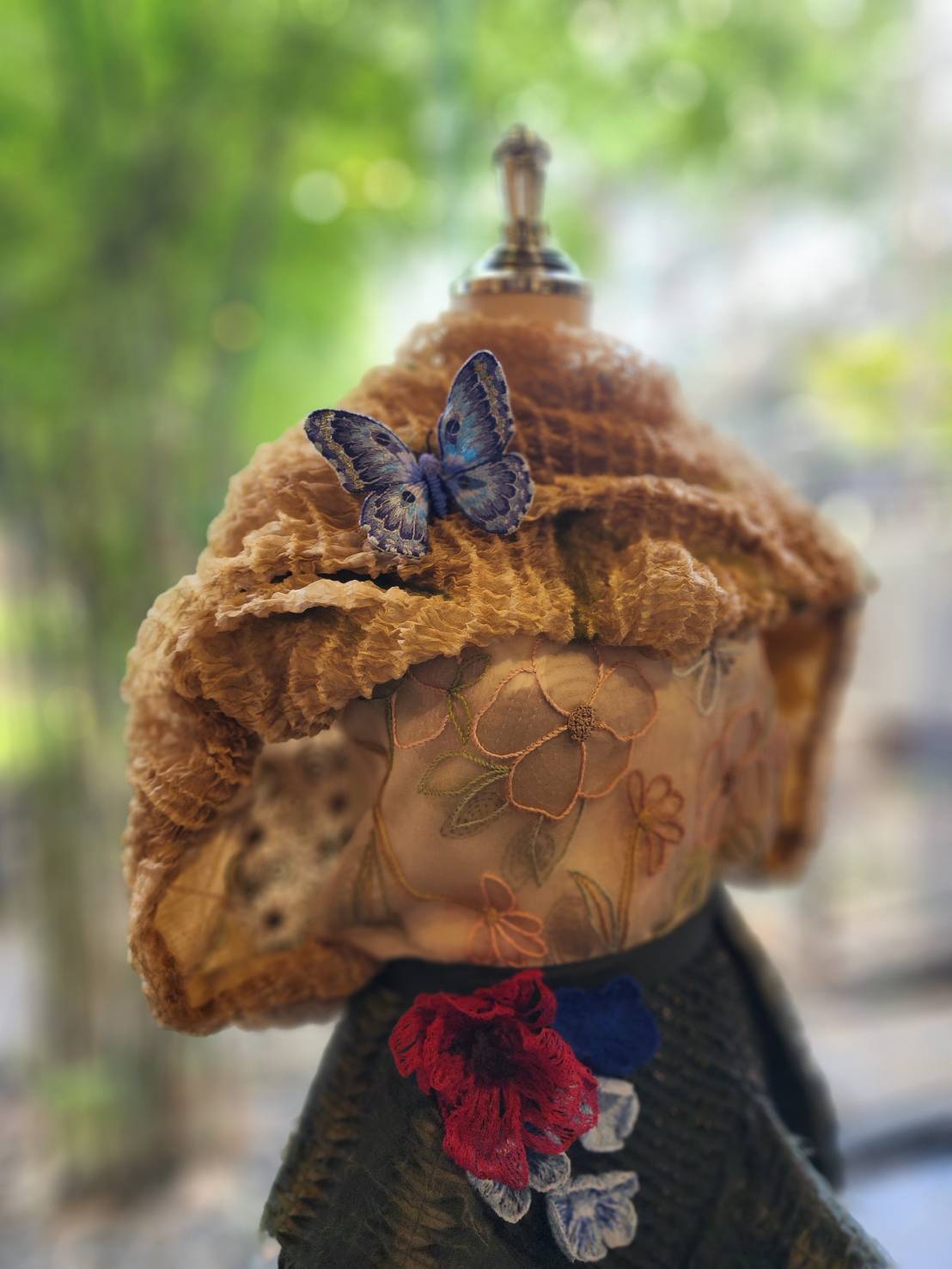
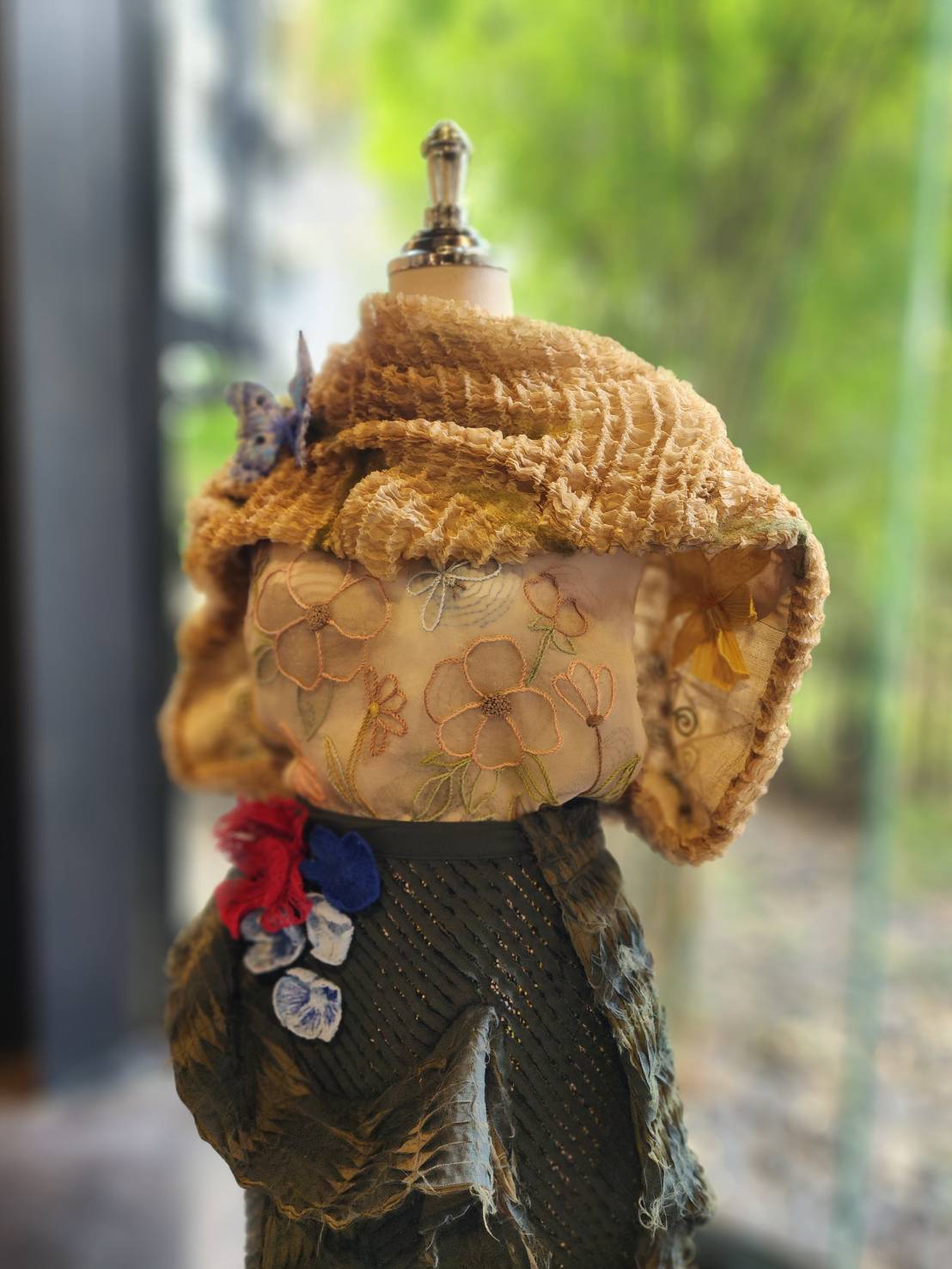
The collection combines natural and synthetic fibers to express the coexistence and interdependence between humans and nature, while emphasizing the researcher’s awareness of being a small part of the vast forest. The materials include silk organza, silk, hemp fiber, wool-polyester blend, nylon taffeta, and sheer fabric. Silk, regarded as the “queen of textiles,” symbolizes Her Majesty Queen Sirikit, The Queen Mother, while hemp fiber represents the cultural significance of the Hmong community, where hemp textiles are traditionally associated with protection from spirits and spiritual beliefs. The use of both natural and synthetic fibers reflects the coexistence of different elements within an ecosystem.
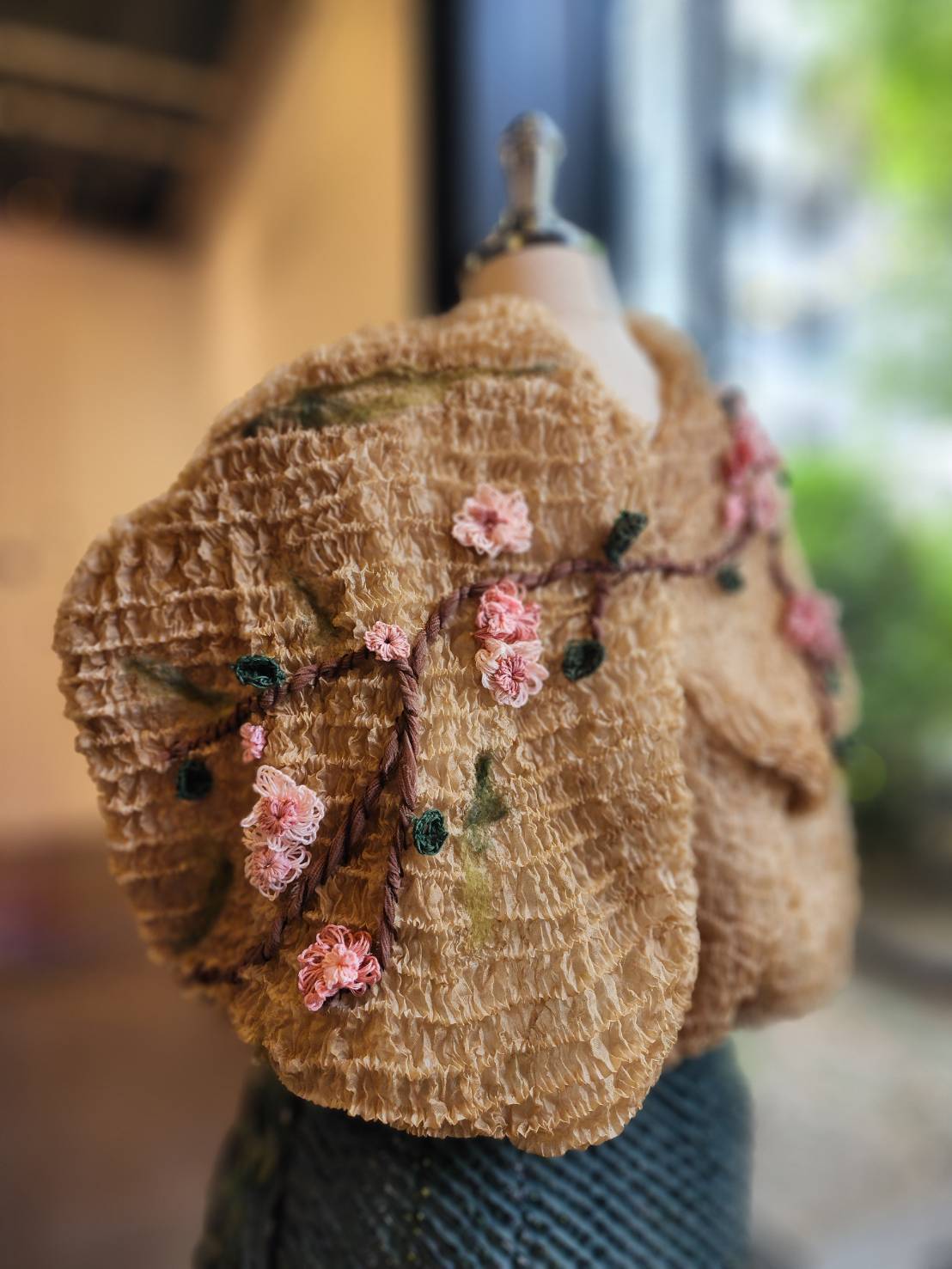
The color palette is inspired by the forest, including Forest Green, Moss, Earth Brown, Stone, Flower Pink, Red, Sky Blue, and Natural Beige. Textile techniques draw inspiration from natural forms such as moss, leaves, flowers, and butterflies, as well as traditional crafts promoted through the SUPPORT Foundation. Techniques include shibori, coffee dyeing, draping, felt embroidery, slash quilting, shadow appliqué, and botanical embroidery. Draped surfaces interpret the undulating topography of mountains, while slash quilting creates panoramic forest-like textures. Layered sheer appliqué creates atmospheric effects resembling overlapping mountain ranges and mist.
The silhouettes combine organic forms inspired by mountains and winding roads with strong structural forms. A silk-organza cape layered over hemp fabric embroidered with Hmong motifs symbolizes the protective embrace of Her Majesty Queen Sirikit, The Queen Mother, conveying her enduring care and compassion for people, even those living in remote communities.
Result / Conclusion :
The creative fashion research resulted in a contemporary fashion collection that translates the researcher’s memories and experiences of the natural landscape and local way of life in Chiang Mai into a visual and material expression. The concept of the “small human within the big forest” became the central perspective for interpreting the relationship between humans and the natural environment.
The design development demonstrated that characteristics found in nature, including organic forms, natural textures, the beauty of flowers, forest vegetation, and coffee as an important local economic crop, can be transformed into contemporary fashion elements. These references were expressed through silhouette, structure, layering, surface texture, and material composition.
The use of hemp, silk, wool, and polyester represents the coexistence of diverse elements within the forest, while techniques including Shibori, embroidery, layering, fabric manipulation, appliqué, and weaving were employed to create varied textures and visual depth. The combination of contrasting materials and techniques contributed to the development of distinctive garment structures while maintaining a connection to natural and cultural references.
The final collection demonstrates how personal memories and sensory experiences can serve as meaningful sources for creative fashion research. More importantly, the work communicates an understanding of coexistence between humans, nature, and local communities, emphasizing humility, respect for the environment, and the value of sustainable relationships between people and their surrounding ecosystems.
References :
Department of Public Relations. (2025, December 10). พระราชกรณียกิจ สมเด็จพระนางเจ้าสิริกิติ์ พระบรมราชินีนาถ พระบรมราชชนนีพันปีหลวง “บ้านเล็กในป่าใหญ่” [Royal duties of Her Majesty Queen Sirikit, The Queen Mother: “Little House in the Big Forest”]. Government Public Relations Department.
Royal Development Projects Board. (n.d.). โครงการบ้านเล็กในป่าใหญ่ [Little House in the Big Forest Royal Project]. Office of the Royal Development Projects Board.
Royal Development Projects Board. (n.d.). บ้านเล็กในป่าใหญ่บ้านขุนวิน (งานอนุรักษ์ทรัพยากรป่าไม้) [Ban Lek Nai Pa Yai, Ban Khun Win: Forest resource conservation]. Office of the Royal Development Projects Board.
Share :
Facebook
Twitter
LinkedIn
WhatsApp
Email
Print