BLACK-WHITE WOVEN
Faculty of Fine and Applied Arts, Programme in Creative Industrial Crafts Design, Thammasat University, Thailand
Kittipong Keativipak
Abstract :
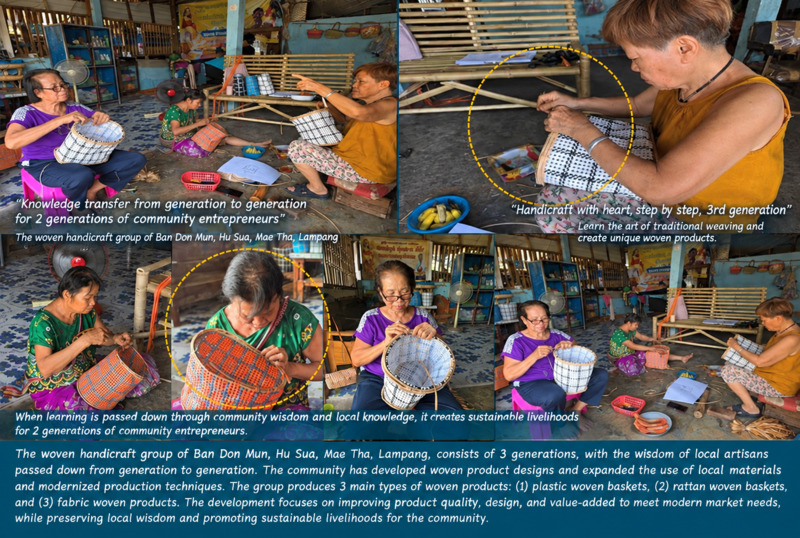
This project develops products by building on community identity and local wisdom together with data obtained from analysis, then applying this to refine products so they gain added value and meet quality standards that respond to the needs of target consumers. It relies on society and community as the driving and creative force, through a process of thinking and analysis based on the study of the project, in order to create new forms of community products that are interesting and distinctive. It also enables local craft wisdom to be built upon and to endure within today’s consumer society, creating product differentiation and leading to further development in technology and innovation that supports the creation of added business value or future industry. This product development activity using cultural capital and innovation (Upgrade) therefore combines technology and analysis in developing products that can fully respond to the needs and expectations of consumers in the current era, resulting in products that are modern, of high quality, and able to compete sustainably in the market.
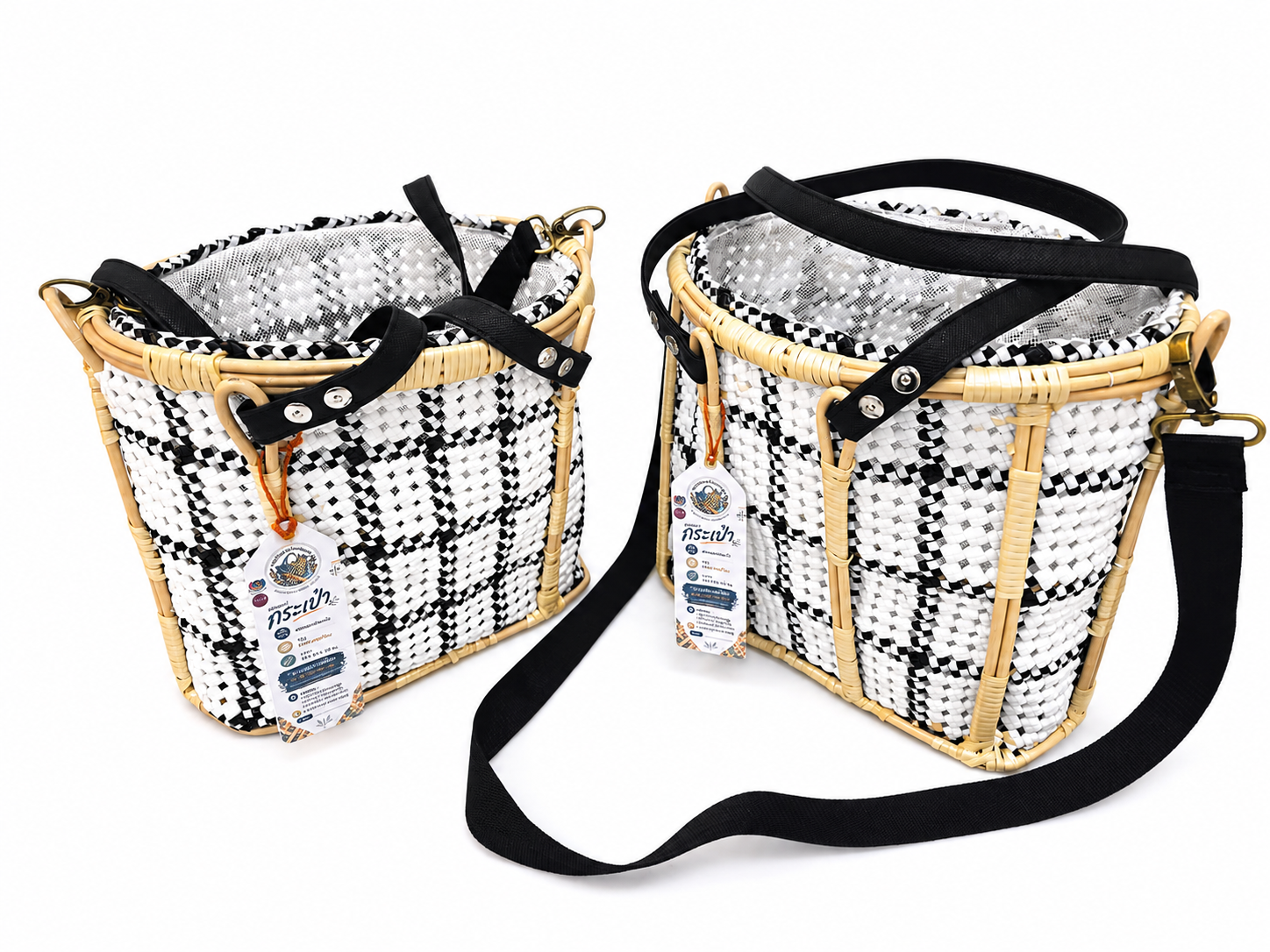
Fashion bag woven from rattan core using the hooked-strand technique (BLACK-WHITE BAG): Woven from rattan core using the hooked-strand technique, which creates patterns and evenly sized gaps in the weave according to the width of the hooked strands. The bag is inspired by the “sapiew” (traditional back-strap basket), has a side strap, and features four horizontal rattan support lines for strength. The bag opens and closes at the front and targets teenage and working-aged women. Previously, products in the form of various baskets sold at 250–500 baht per piece; after being developed into rattan-core bags using the hooked-strand technique, they can now be priced at no less than 300–500 baht per piece. Although the price is not greatly different, the design is contemporary and appeals to today’s consumers. There are also plans to apply for Thai Community Product Standard (TCPS) certifica
Objectives :
To develop and elevate product design and development by applying cultural capital, identity, and local wisdom in combination with innovation and technology, with a focus on raising products to meet quality standards, adding value, and aligning with the needs of the target market.
Conceptual Framework :
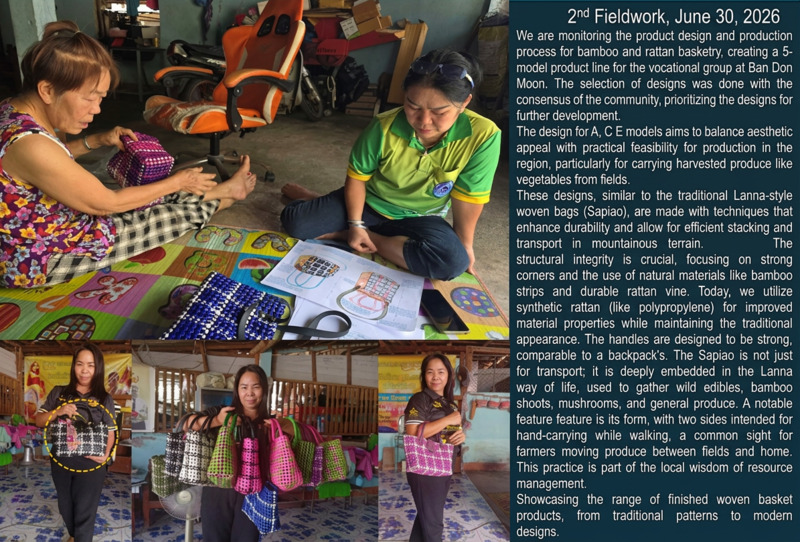
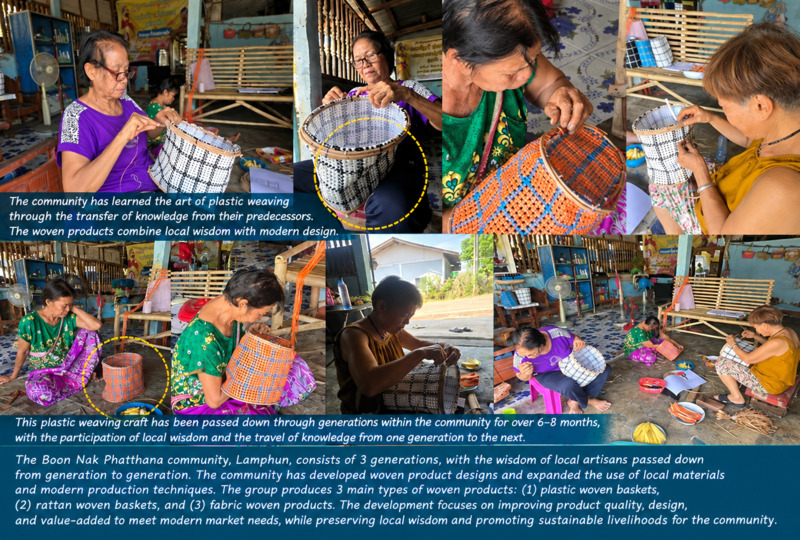
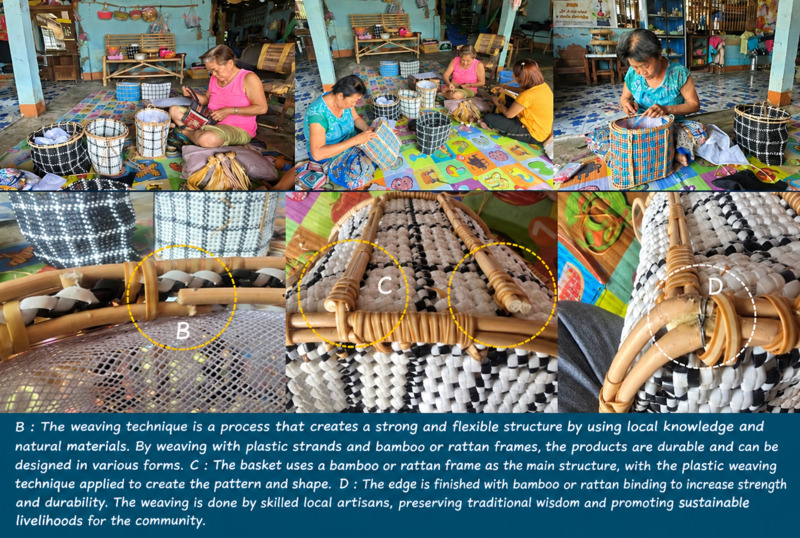
The concept to be conveyed to the target audience is the transformation of the product form from a basket into a bag, making it more interesting and distinctive — not merely by adjusting the decorative pattern, but through a deeper structural change. Originally, bamboo and rattan served as the main structural framework, with plastic strands used for the weaving. In the new approach, bamboo and rattan will play a greater role within the product itself — for example, using bamboo or rattan strands to wrap and finish all the edges of the basket or bag, allowing the authenticity of the natural material to come through more strongly, replacing the industrial hardness of plastic strand material.
Bamboo or rattan will be shaped through bending techniques, and binding methods using rattan core material will be applied to enhance the sense of handcraftsmanship. The color palette for the plastic or rattan-core weaving will be selected to be tonal and suitable for everyday use — the work will avoid contrasting/opposing colors, overly vivid colors, or an excessive mix of many colors. Each piece will use a set of two colors in its creative composition.
The bag’s form emphasizes contemporary style while still conveying the cultural flavor of the northern Thai urban (Lanna) people. Therefore, the design will draw inspiration from the basket and reinterpret it into a new product (the bag) in a way that remains cohesive and connected to its origin. This requires drawing on the community’s existing weaving expertise while also exploring new weaving perspectives to enrich the work.
Process / Methodology :
- The design concept of this bag is to combine the “structural simplicity of the sapiew form in the Lanna way of life” with “contemporary graphics derived from hook-weave patterns, creating motifs, density, strength, and grid-like openings.” The charm of traditional craftsmanship is reinterpreted here in the form of “Modern Industrial Craft.” The design employs rattan-core weaving using the hook-weave technique, developed in white and black to create visual interest while remaining practical for real-world use. White and black serve as colors that are easy to wear, cool, and smart — suited to modern, confident women. The hook-weave technique is used to give the woven work greater strength and durability, since this technique results in denser weaving, while also producing evenly sized gaps corresponding to the width of the rattan core, creating an interesting pattern of white and black strands interspersed with openings. The structure uses bamboo or rattan running vertically to form the supportive frame that gives the bag its strength. The bag’s rounded, organic form helps soften the rigidity of the wooden structure, making the overall look lighter and better suited to the user’s body.
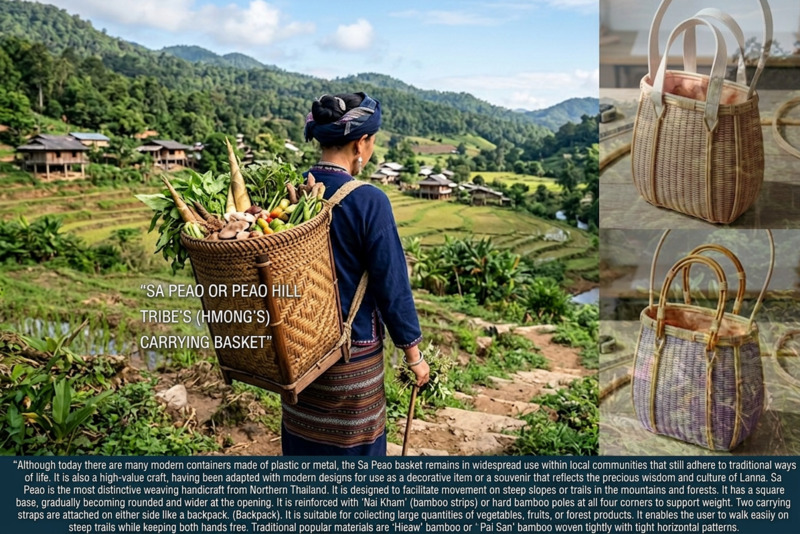
2. Inspired by the sapiew — although modern containers made of plastic or metal exist today, the sapiew remains widely used in local communities that still uphold traditional ways of life, and continues to be a valuable craft. It has been redesigned for use as a decorative item or souvenir that reflects the precious wisdom and culture of Lanna. The sapiew is the most distinctive woven container of Northern Thailand, designed for mobility on steep terrain or when trekking. It has a square base that gradually flares out into a rounder mouth, reinforced at all four corners with “mai kham” — sturdy shaved bamboo struts — to bear weight. It is carried like a backpack, with two straps worn over the shoulders, making it suitable for carrying large quantities of vegetables, fruit, or forest produce, and allowing the user to walk on steep slopes with both hands free. It is typically made from mai phai hia or mai phai bong bamboo, woven in a tight plain-weave or twill pattern.
Techniques and Materials :
inspiration from Cultural: SA-PIEW / Plastic strip weaving
Result / Conclusion :
The design combines the “structural simplicity of the sapiew form in the Lanna way of life” with “contemporary graphics derived from hook-weave patterns, creating motifs, density, strength, and grid-like openings.” The charm of traditional craftsmanship is reinterpreted here in the form of “Modern Industrial Craft.” The design employs rattan-core weaving using the hook-weave technique, developed in white and black to create visual interest while remaining practical for real-world use. White and black serve as colors that are easy to wear, cool, and smart — suited to modern, confident women. The hook-weave technique is used to give the woven work greater strength and durability, since this technique results in denser weaving, while also producing evenly sized gaps corresponding to the width of the rattan core, creating an interesting pattern of white and black strands interspersed with openings. The structure uses bamboo or rattan running vertically to form the supportive frame that gives the bag its strength. The bag’s rounded, organic form helps soften the rigidity of the wooden structure, making the overall look lighter and better suited to the user’s body.
Design Concept: The bag has a sleek, luxurious style — clean and refined — with white and black adding a sense of sophistication. It is designed for working women aged approximately 25–35. The bag emphasizes compactness and versatile, everyday usability. Rattan core material and the hook-weave technique are used, resulting in weaving that is denser and softer than conventional weaving. The gaps created by the rhythm of the hooking motion keep the bag from feeling harsh or industrial. The internal structure is built entirely from rattan or bamboo, which is also used to finish both side panels as well as the hand-hook handle at the front — giving this design a beautiful sense of naturalness and craftsmanship. The rigidity is further softened by the flexibility of the rattan or bamboo. The interior is lined with fabric, the top is finished with fabric and closes with a zipper, and the sides can accommodate a shoulder strap.
References :
–