REBACK-BAG
Faculty of Fine and Applied Arts, Programme in Creative Industrial Crafts Design, Thammasat University,Thailand
Kittipong Keativipak
Abstract :
Fabric scraps obtained from the production process of sewing military and police uniforms were found to have properties of toughness, hardness, and rigidity, good load-bearing capacity, resistance to tearing, and good water resistance. They can be used for sewing or assembling patterns that need to bear weight. Therefore, these outstanding characteristics should be put to use. It was concluded that the fabric scraps to be used would come from the lengthwise cutting of the side edges from the marking process of industrial machines. Most of these scraps are 1 inch or 1.5 inches wide and approximately 4 meters long (the largest size of scrap), and scraps 1 inch wide with a length of approximately 1 meter (the next largest size). Although there are fewer of these remnants compared to the small fabric scraps cut from the gaps between pattern pieces, for creative application the fabric scraps need to be of a suitable size and able to be effectively utilized in product design. This project uses the method of reuse, and the creative application can be used in various ways.
For the fabric scraps obtained from the production process of military and police uniforms, experiments were conducted to find uses beyond simply bundling them for transport. They were sewn together in continuous rows to form a piece of fabric — a simple yet interesting technique that allows the scraps to be reused effectively. Since military and police uniforms come in different colors, the fabric scraps that are 1 inch or 1.5 inches wide and approximately 4 meters long can be arranged compositionally to create even greater visual interest. This represents a way of taking leftover materials through a reuse process to create a new type of material.
Objectives :
To enhance the competitiveness of businesses in the creative industry, enabling them to apply creativity, innovation, and technology in developing creative products.
Conceptual Framework :
A study was conducted on mustus fabric scraps obtained from the production process of sewing military and police uniforms. It was found that the properties of these fabric scraps include toughness, hardness, and rigidity, good load-bearing capacity, resistance to tearing, and good water resistance. They can be used for sewing or assembling patterns that need to bear weight. Therefore, these outstanding characteristics should be put to use, and they have been applied in creative design to produce bags in a variety of styles.
It was concluded that the fabric scraps to be used would come from the lengthwise cutting of the side edges from the marking process of industrial machines. Most of these scraps are 1 inch or 1.5 inches wide and approximately 4 meters long (the largest size of scrap), and scraps 1 inch wide with a length of approximately 1 meter (the next largest size). Although there are fewer of these remnants compared to the small fabric scraps cut from the gaps between pattern pieces, for creative application the fabric scraps need to be of a suitable size and able to be effectively utilized in product design.
The method used is reuse, and the creative application can be used in a variety of ways, such as in designing shoulder-strap travel bags or various interesting styles of fashion bags. This is done by cutting and sewing the fabric scraps in a shingle-like (roof-tile) pattern, stitched together lengthwise in continuous rows until they form a single piece of fabric. This material is then cut and sewn into the designed bag, creating a new perspective on how mustus fabric scraps can be put to use, beyond simply being used as tie-cords for closing product bags.
In creatively designing various styles of fashion bags, it is necessary to find a form with enough surface area to appropriately incorporate the mustus fabric material for sewing. The bag should be wide and long enough to create an attractive visual effect, allowing viewers to clearly and beautifully see the lines of the fabric scraps used. If the area is too small, it may not be suitable for making good use of the fabric scraps. In development, other industrial materials can also be applied in the design, such as genuine leather, faux leather, or cotton fabric, to be combined appropriately — for instance, for closing the top of the bag or for lining the inside of the bag.
Process / Methodology :
1.The creative design work is a travel bag that uses mustus fabric scraps as the main material for sewing. Fabric scraps measuring 1–1.5 inches in width and 1–4 meters in length were selected for use in production.
2.The mustus fabric scraps are taken from the lengthwise cutting of the side edges from the marking process of industrial machines, since these scraps are straight and suitable for sewing together into a single piece of fabric.
3.In processing the fabric scraps, they are cut and sewn in a shingle-like (roof-tile) pattern, stitched together lengthwise in continuous rows until they form a single piece of fabric. This material is then cut and sewn into the designed bag, creating a new perspective on how mustus fabric scraps can be put to use.
4.Fabric scraps with a width of 1–1.5 inches and a straight length — not curved or excessively jagged from cutting — were selected, because assembling the material requires overlapping stitching in a shingle-like manner, with the seams overlapping the fabric edges by about 0.5 inches, and the stitching must be aligned straight along the length.
5.For the handles and shoulder strap, fabric or faux leather materials can be used in the initial design. Other styles of handle straps may also be incorporated into the creative process to enhance the aesthetic appeal in the future.
6.For supplementary materials — such as the D-rings hanging on the sides of the bag for attaching the shoulder strap, zippers, magnetic snap buttons used to close the bag, or eyelet fittings for the front opening strap — commercially available industrial materials can be used as appropriate.
7.From cutting the pattern into individual pieces for sewing and assembling military and police uniforms, many small fabric scraps of unequal sizes are produced, resulting from cutting away the gaps between pattern pieces. These scraps vary widely in both shape and size, making them difficult to use in creative design. Therefore, this type of fabric scrap will not be used in the design.
Techniques and Materials :
Mustus Fabric
Result / Conclusion :
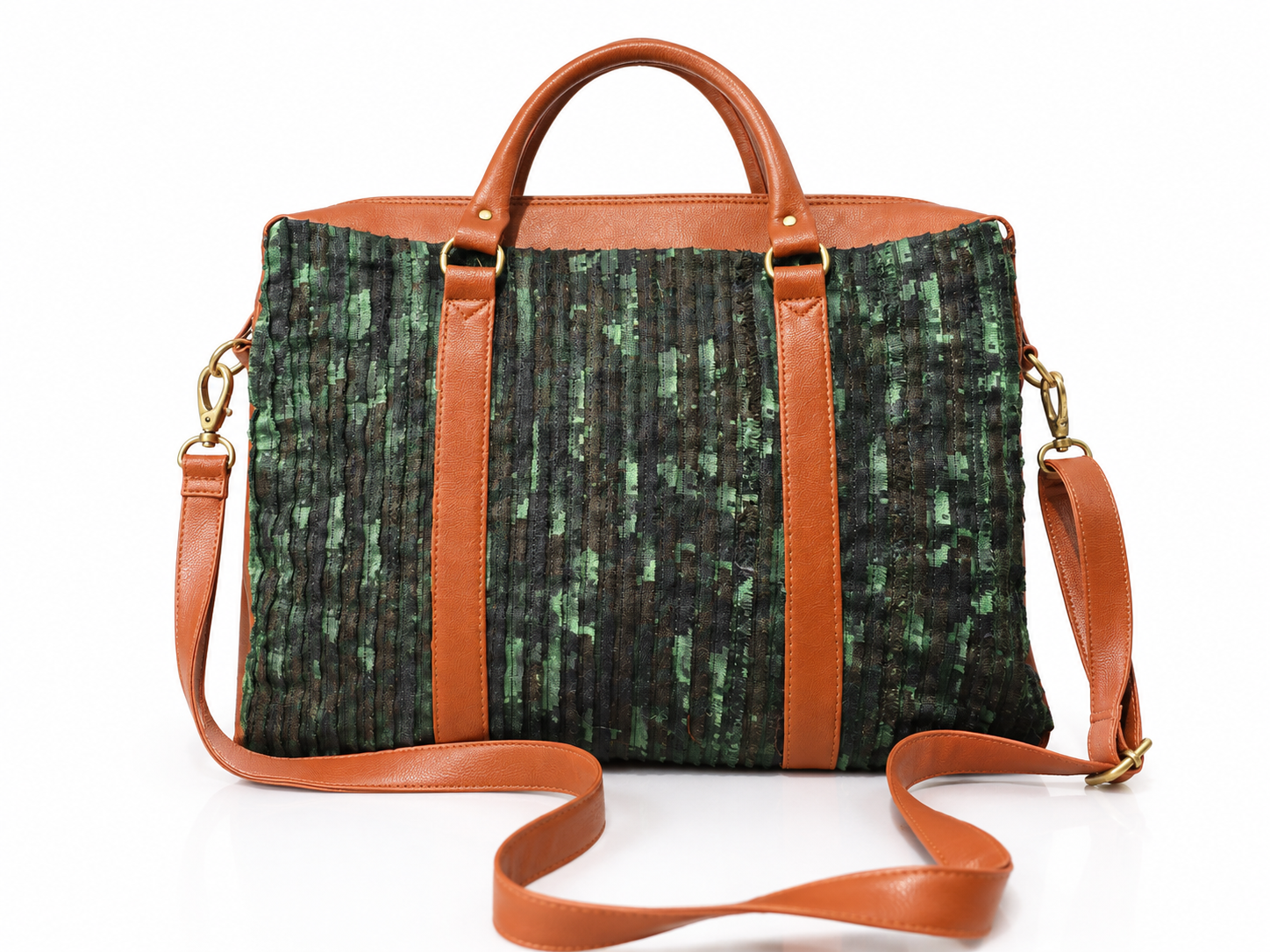
The bag design uses mustus fabric scraps sewn together vertically into a single piece of fabric, using nylon thread instead of ordinary thread, and leaving the fabric edges unfolded to create a novel and interesting texture. The mustus fabric scraps serve as the main material for sewing, selected for widths of 1–1.5 inches and lengths of 1–4 meters, obtained from the lengthwise cutting of the side edges from the marking process of industrial machines. The handles and shoulder strap use faux leather, while the interior is lined with fabric, and additional materials such as D-rings on the sides of the bag for attaching the shoulder strap, zippers, and magnetic snap buttons are used for closing the bag.
The result is an interesting and durable travel bag. By switching from ordinary thread to nylon thread for sewing, the bag’s seams became stronger, reducing tearing, and eliminating the need to fold and tuck the edges of the fabric scraps when joining them together. This allowed the fabric made from mustus scraps to have unfolded, raw edges, creating another interesting design feature to be utilized. In testing, sewing in this manner with ordinary thread caused the fabric to tear and fray, resulting in damage to the bag during use. (The solution tested was replacing Venus-brand thread with nylon thread, which made the sewing much stronger and eliminated the need to sew twice over the same spot or to fold the mustus fabric scraps to increase thickness before sewing them into a single piece.)
On the inside, the zipper was changed to a larger size for easier opening and closing of the interior compartment. The faux leather front flap was re-cut to have a more attractive curved shape rather than sharp angles, while the faux leather handles and shoulder strap were sewn more securely and durably. The bag is fully functional for practical use.
References :
–