KA-NOM-BAG
Faculty of Fine and Applied Arts, Programme in Creative Industrial Crafts Design, Thammasat University, Thailand
Kittipong Keativipak
Abstract :
In carrying out the project, the waste-buying company has no knowledge or expertise in creative design or product prototyping — it operates purely as a factory that buys and sells scrap materials. However, this study aims to take scrap snack bags and colored plastic water bottles and recycle or reuse them, seeking ways to develop them into products or goods that can be sold commercially. (Colored plastic water bottles were chosen because white or opaque-white PET bottles can still be sold as scrap material at a good price, so only colored PET water bottles were used for this purpose.) Bangorn Recycling Group hopes that scrap snack bags and PET water bottles should have more value than they currently do and wants to put these materials to good use by turning them into value-added products. Since snack bags currently sell for only 4 baht per kilogram, the goal is to make 1 kilogram of snack bags worth more than it currently is.
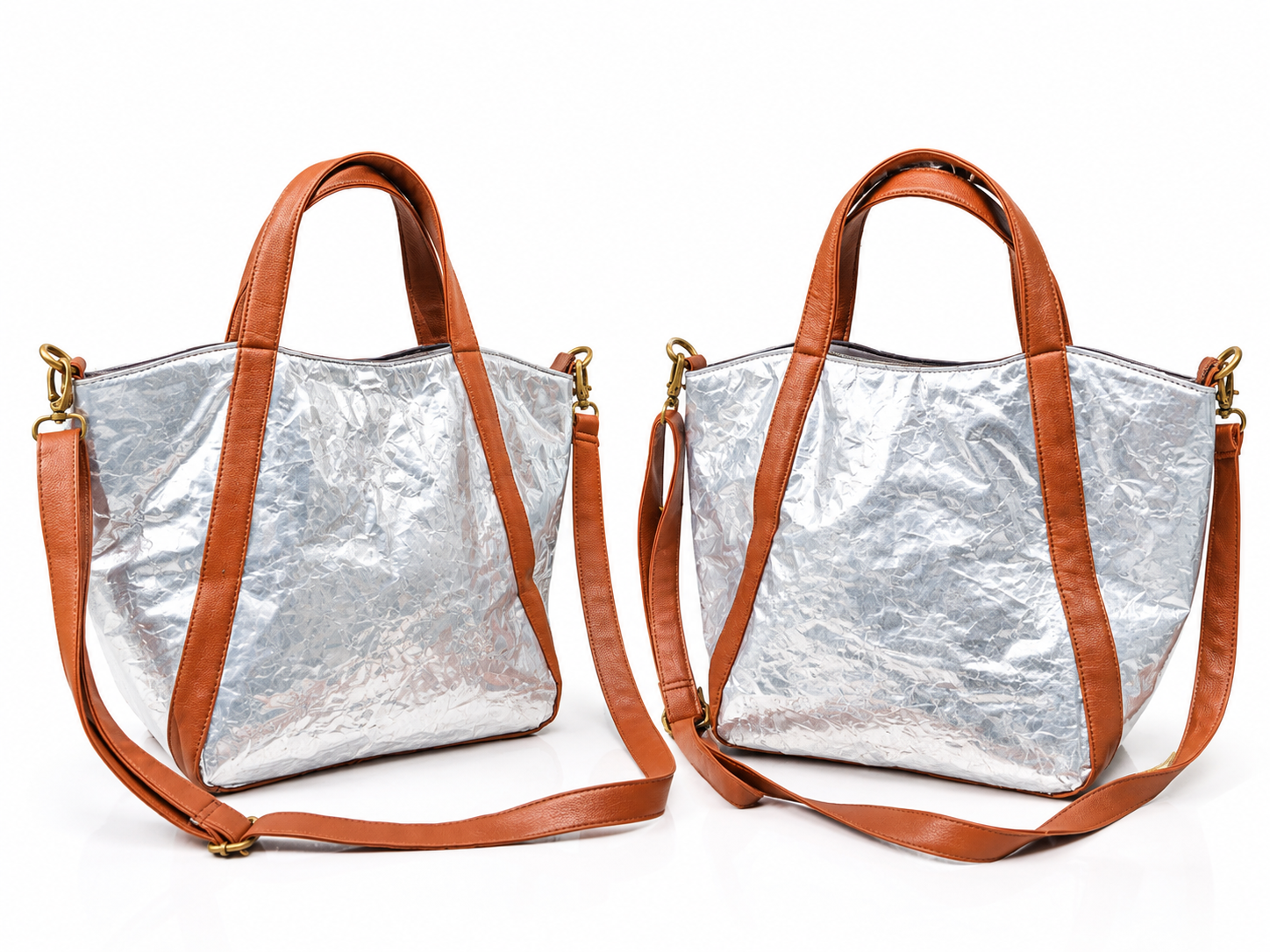
The resulting product is a women’s fashion bag made using scrap snack bags as the main production material. Snack bags and animal feed bags that would otherwise be waste are reprocessed and sewn into new items. Using just 1 kilogram of material (worth 4 baht), the process creates a higher-value product — a fashion bag that can be sold for approximately 600–1,000 baht per piece.
Objectives :
To enhance the competitiveness of businesses in the creative industry, enabling them to apply creativity, innovation, and technology in developing creative products.
Conceptual Framework :
The approach to developing scrap snack bags has yielded two summarized methods for use in creative work:
The first approach, using whole snack bag sheets, requires selecting larger pieces of scrap snack bags, or bringing in dog food or cat food bags — which are larger than snack bags — as supplementary sewing material. These bags are also waste materials, but must be thoroughly cleaned before use.
In this first approach using whole snack bag sheets, the resulting creative design produces a foil-like surface with an overall silver appearance, featuring creases and folds from the bending of the bags. This adds texture and pattern to the designed bag. When consumers encounter it, they become curious and their attention is drawn to the material used in creating the prototype, which clearly displays the character of the snack bags themselves.
With this first approach, the design outcome allows the created bag to appear smooth, uncluttered, and visually clean. The design doesn’t need to build up texture or additional components to give the piece dimension — instead, the beauty comes from the material itself, with its creases, folds, and light reflection serving as the standout features, making the bag’s straps visually interesting as well.
The second approach involves cutting the snack bag along the length of its back seam, unfolding it into a flat sheet, then folding it at least three times to create a width of approximately 1–1.5 inches. These folded strips are then sewn together continuously along their length, after which each piece (prepared as in the first step) is layered and stitched together in a shingle-like (roof-tile) pattern.
When the snack bag material is sewn together in this shingle pattern, the result is visually engaging — the material aligns lengthwise in an organized arrangement. This method of working the material allows even small scraps of snack bags to be used effectively, and the resulting arranged pattern can be applied to cover design surfaces in various ways, whether oriented vertically or horizontally.
In this second approach, the process focuses on manipulating the material itself — there’s no need to worry much about the size of the snack bags, nor is extensive selection of usable bags required. Scrap snack bags can be continuously transformed into material of a fairly consistent width, which can then be used for unlimited design development and diverse creative applications.
Process / Methodology :
1.The creative design work resulted in a women’s fashion bag. The design emphasizes simplicity and a contemporary style suited to today’s society, following a popular bag silhouette, with a size large enough to comfortably hold a woman’s everyday belongings.
2.The scrap snack bag material used incorporates both approaches: using whole cut snack bag sheets with minimal additional stitching, and arranging scrap snack bags into a shingle-pattern stitched construction. This allows the resulting bag to feature both surface textures made from the scrap material, opening up perspectives for further development in the future.
3.In creating the fashion bag prototype, the entire interior will be lined with fabric or synthetic leather, using two color tones — light and dark — to help highlight and enhance the silver, foil-like shine of the scrap snack bag material, making the piece more visually appealing.
4.The handles and shoulder strap will use fabric or synthetic leather materials in the initial design. Other styles of handles or straps may also be incorporated into future creative development to enhance the bag’s aesthetic appeal.
5.Before cutting and sewing the scrap snack bags — used as the main material in both approaches — a layer of fusible interfacing (iron-on adhesive fabric) will first be applied as backing (before the material is sewn into the bag and lined with interior fabric), giving the scrap snack bag material greater rigidity and structural stability.
6.For supporting components, such as the side D-rings/hooks used to attach the shoulder strap, as well as other hardware like straps, zippers, and buttons, commercially available industrial materials can be selected as appropriate for the design.
Techniques and Materials :
Reuse / Snack Bag
Result / Conclusion :
The fashion bag measures 11 inches in width, 12 inches in length, 14 inches at the top width, and 4 inches on the sides. For prototype production, a foam mold will be created to control the shape and ensure the desired size and proportions. For the surface covering material, whole-sheet scrap snack bag material will be used, without using the folded, shingle-pattern stitching method. Large scrap bags (dog and cat food bags) will be used, with piecing/seaming kept to a minimum. For the base, a sheet of para rubber will be cut to fit the bag’s form, allowing the bag to hold its shape and stand upright on its own. Brown synthetic leather will be used for the handles and shoulder strap. The interior will be lined with dark brown or gray fabric, and will include two additional interior storage compartments. The top will open and close with an industrial zipper.
For this round of creative production, the team will experiment with re-sewing the piece, because although the previous production round yielded a complete, finished product, after a period of actual use it was found that tearing occurred at the seams. This was caused by the sewing itself — specifically at the seam joints. Therefore, a new sewing trial will be conducted, switching to nylon thread (replacing the Venus-brand thread used previously).
In the production process, a complete cutting pattern was designed for every section, then cut out using cardboard as the pattern template. This template was then overlaid onto pattern paper again to ensure the size and shape matched exactly without discrepancy. This ensures a precise fit between the front and back panels of the bag during sewing, and also allows for accurate planning of how much cutting area is needed for the scrap snack bag material.
References :
–