
Threshold of Memory
International College, Mahidol University, Thailand
Dr. Supanida Chantarin


Abstract :
This series of artworks explores postmemory through the visual language of liminal space. Postmemory describes the inherited impact of experiences that later generations did not live through directly but that continue to shape their emotions, perceptions, and identities. Such memories may be transmitted through family stories, cultural narratives, images, objects, music, and unspoken emotional responses.
Within this project, liminal space functions as a metaphorical threshold between inherited memory and lived experience. Postmemory is not recalled conventionally; it often remains beneath conscious awareness until traces of the past bring it to the surface. These traces may appear as places, objects, images, sounds, or moments of silence. Encountering them can produce an unsettling familiarity, similar to remembering an event that one never personally experienced.
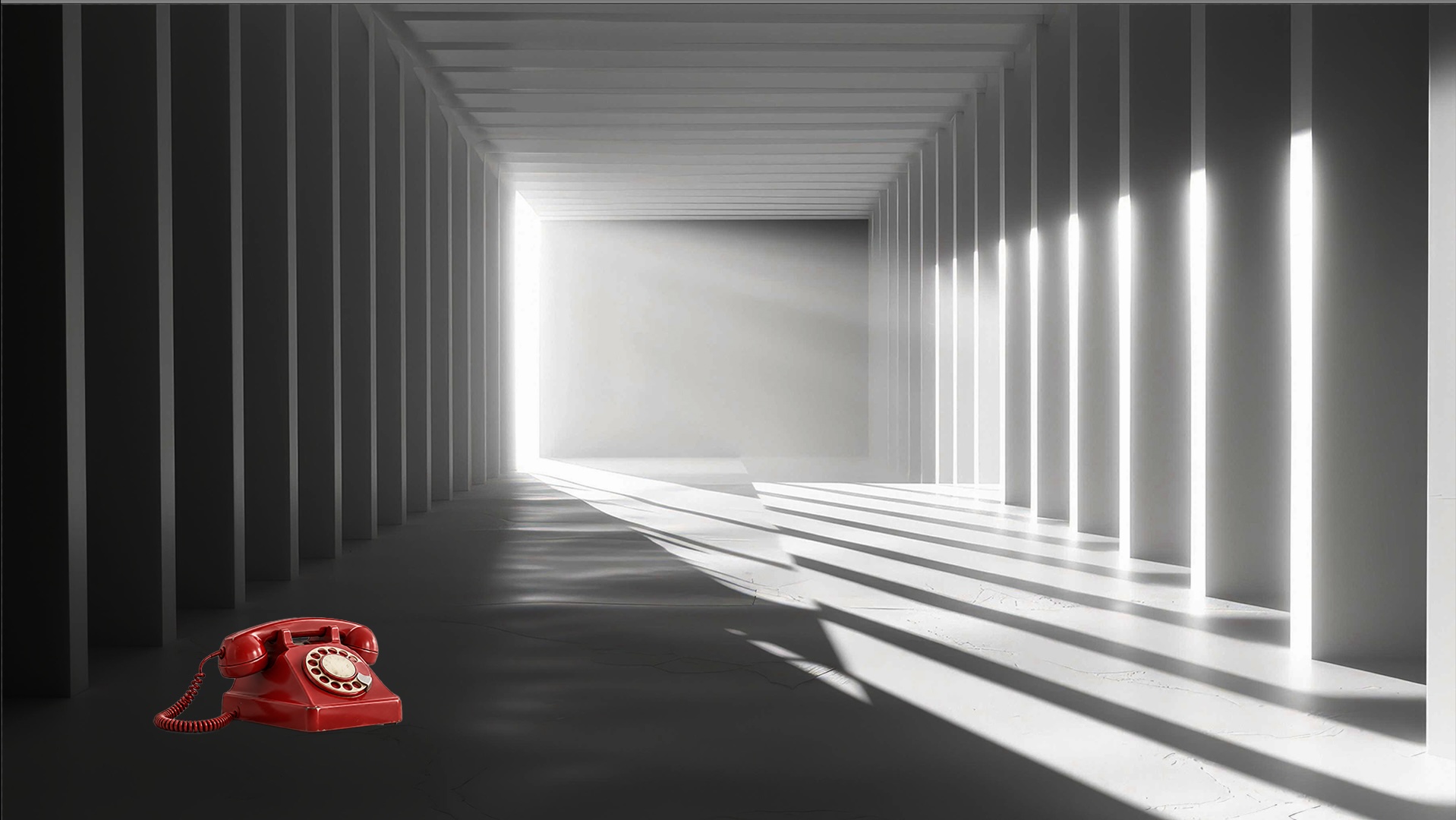
The series visualizes this psychological condition through three antique communication objects: a television, a telephone, and a record player. Each represents a distinct channel through which experiences are preserved and passed on. The television transmits moving images and sound, the telephone carries voices and personal messages across distance, and the record player preserves music, lyrics, and stories from another time. Together, they suggest how earlier generations continue to reach into and influence the present.
Placed along a pathway in a dark, unoccupied hallway, the objects mark stages in a passage between past and present. Their vivid red colour separates them from their surroundings and symbolizes inherited memories that remain emotionally active rather than fading away. The hallway, by contrast, represents a concealed psychological space in which those memories linger. The absence of people leaves the narrative unresolved, encouraging viewers to imagine an unseen presence and connect the scene with their own histories. Through this relationship between object, colour, and space, the artworks invite reflection on how inherited experiences are encountered, interpreted, and carried forward as part of identity.
Objectives :
This project aims to visualize postmemory by combining the aesthetic qualities of liminal space with antique communication objects. Its primary objective is to show how inherited experiences can connect past and present within a single psychological environment. The settings appear suspended in time, creating uncertainty about whether the viewer is encountering a past moment, a present reality, or a space in which both coexist. This temporal ambiguity reflects postmemory itself: an indirect relationship with events transmitted through stories, images, objects, emotions, and other traces left by earlier generations.
A second objective is to create conditions for self-reflection. The deliberate absence of people prevents the artworks from assigning the space to a particular character or fixed story. Instead, viewers can project their own memories, feelings, and associations onto the scenes. The quiet yet unfamiliar environments may prompt questions such as: Where is this place? Why has an old television been left here? Who once used this telephone or record player? What happened, and why has a trace of the past appeared in the present? Such questions turn viewing into an intrapersonal conversation.
The project also aims to investigate how ordinary objects can act as carriers of memory. Although their original owners remain unseen, the television, telephone, and record player imply that people were once present and that their experiences continue to resonate. Their vivid red colour interrupts the stillness of the dark surroundings, making each object a visual and emotional point of contact between absence and presence.
Ultimately, the artworks are intended to do more than illustrate the concept of postmemory. They provide open-ended spaces in which viewers can interpret unexplained traces and reconsider their own relationships with the past. By encouraging this personal engagement, the series seeks to raise awareness of how inherited memories may influence identity, emotion, belief, and perception without always being consciously recognized.
Conceptual Framework :
The conceptual framework for this project brings postmemory and liminal space into dialogue. Postmemory refers to the inherited effects of experiences that continue to shape the emotions, perceptions, and identities of people who did not witness the original events directly (Columbia University Press, 2012). Liminality offers both a conceptual structure and a visual language for exploring this indirect transmission.
French ethnographer and folklorist Arnold van Gennep introduced liminality in Les rites de passage, first published in 1909. He proposed that rites of passage involve three stages: separation from a previous condition, an intermediate or liminal stage, and incorporation into a new social status (Hebling, 2025; van Gennep, 1960). In contemporary usage, “liminal” describes something situated between, or belonging to, two places or states (Cambridge University Press & Assessment, n.d.). This condition parallels postmemory, which occupies thresholds between past and present, personal and inherited experience, and absence and presence.
The artworks translate this relationship into visual form through three antique communication objects: a television, a telephone, and a record player. Each object represents a different means of preserving and transmitting images, voices, music, stories, and emotional traces between generations. Their placement in a transitional hallway suggests that memory does not remain fixed in the past but travels into the present, where it can be encountered and reinterpreted.
Colour and spatial atmosphere strengthen this framework. The objects are red, distinguishing them from the dark environment and signifying inherited memories that remain emotionally active. The empty hallway represents a concealed psychological space where such memories linger without a complete or visible narrative. As a defining characteristic of liminal-space imagery, the absence of people encourages viewers to imagine an unseen human presence. In this way, the setting allows invisible traces of earlier lives to become mentally and emotionally perceptible, creating room for personal reflection on how inherited experience contributes to identity.
Process / Methodology :
After the concept was established, I searched for a stock image of a liminal space with a timeless, minimalist appearance. I avoided settings associated with a recognizable place because the same background needed to connect all three artworks. I also selected the image carefully so that the atmosphere would feel mysterious and contemplative rather than frightening.
AI was then used to generate the three central objects: an antique television, telephone, and record player. It served only as a production tool for creating these basic visual elements; the concept, symbolism, and creative direction were developed independently. Each object was generated in red, viewed mostly from the front, and slightly rotated to create visual consistency across the series.
Techniques and Materials :
| AI-generated prompts are as follows:
– Create an antique red television with black-and-white static on the screen. Position the television facing mostly forward, rotated 15 degrees counterclockwise. Isolate the television on a transparent PNG background. – Create an antique red telephone. Position the telephone facing mostly forward, rotated 15 degrees counterclockwise. Isolate the telephone on a transparent PNG background. – Create an antique red record player. Position the record player facing mostly forward, rotated 15 degrees counterclockwise. Isolate the record player on a transparent PNG background. Finally, I used Adobe Photoshop to integrate the objects into the selected setting. I deepened the background toward black, refined the objects’ shadows and placement, and adjusted brightness, colour, and contrast. These changes created a unified atmosphere while ensuring that each red object remained the main focal point. |
Result / Conclusion :
The completed series communicates postmemory through liminal space without presenting a fixed narrative. Rather than reactivating trauma associated with inherited experiences, the artworks aim to increase awareness of how traces of the past are transmitted and how they may shape beliefs, emotions, perceptions, and identity. The quiet settings and unexplained objects invite intrapersonal communication, allowing viewers to respond through their own memories and associations.
The television, telephone, and record player function successfully as both focal points and symbols of transmission. Their shared red colour visually connects the three works and separates them from the dark, empty hallway. This contrast suggests that inherited memories can remain emotionally vivid even when their original circumstances or owners are absent. The uncluttered composition also gives viewers time and space to consider what each object might contain or communicate.
Because no people or explicit events appear, interpretations can vary. Viewers may wonder where the place is, who used the objects, why they were left behind, or what story has returned from the past. These questions become part of the artwork’s meaning, encouraging an encounter between visible objects and invisible histories, as well as between known experience and uncertain inheritance.
The series therefore concludes that liminal-space aesthetics can provide an effective visual framework for postmemory. By combining ambiguity, absence, symbolic colour, and outdated communication technologies, the artworks make inherited influence perceptible without defining it too narrowly. They invite viewers to recognize that memories from previous generations may continue to operate beneath conscious awareness and to reflect on how those memories are interpreted, reshaped, and carried into the present.
References :
Cambridge University Press & Assessment. (n.d.). Liminal. In Cambridge Dictionary. Retrieved September 10, 2026, from https://dictionary.cambridge.org/dictionary/english/liminal
Columbia University Press. (2012, October 10). Interview with Marianne Hirsch, author of The generation of postmemory. https://cupblog.org/2012/10/10/interview-with-marianne-hirsch-author-of-the-generation-of-postmemory/
Hebling, M. E. (2025). The fog is coming: Semiotic atmospheres and mental decay in internet aesthetics. IMG Journal, 12, 294–317. https://doi.org/10.60923/issn.2724-2463/21432
Hirsch, M. (2012). The generation of postmemory: Writing and visual culture after the Holocaust. Columbia University Press.
Van Gennep, A. (1960). The rites of passage (M. B. Vizedom & G. L. Caffee, Trans.). University of Chicago Press. (Original work published 1909)
Share :
Facebook
Twitter
LinkedIn
WhatsApp
Email
Print