THE UNWORN FUTURE: A Memory of What Never Happened
Bangkok University, Thailand
Dr. Pathitta Nirunpornputta
Abstract :
The Unworn Future is a creative practice project that explores memory, love, absence, and an imagined future through personal objects and visual traces of a shared past. Growing up within a warm family shaped an understanding of love associated with security, commitment, and continuity. Drawing on intergenerational transmission in relation to postmemory, the project considers how inherited understandings of love may influence expectations of relationships and an imagined future. At the centre of the project is a piece of fabric once intended to become a dress for an important future occasion. When that future was no longer possible, the fabric remained uncut, becoming a material trace of something that was imagined but never realised.
Autoethnography and practice-led research are employed as the main research methods. Reflective journaling is used to revisit memories, emotions, and changing interpretations throughout the creative process. Personal photographs and hand-drawn doodles are revisited as visual records of lived experiences, while the original fabric represents an unrealised future. Together, these materials create a dialogue between memories of what happened and traces of what never happened.
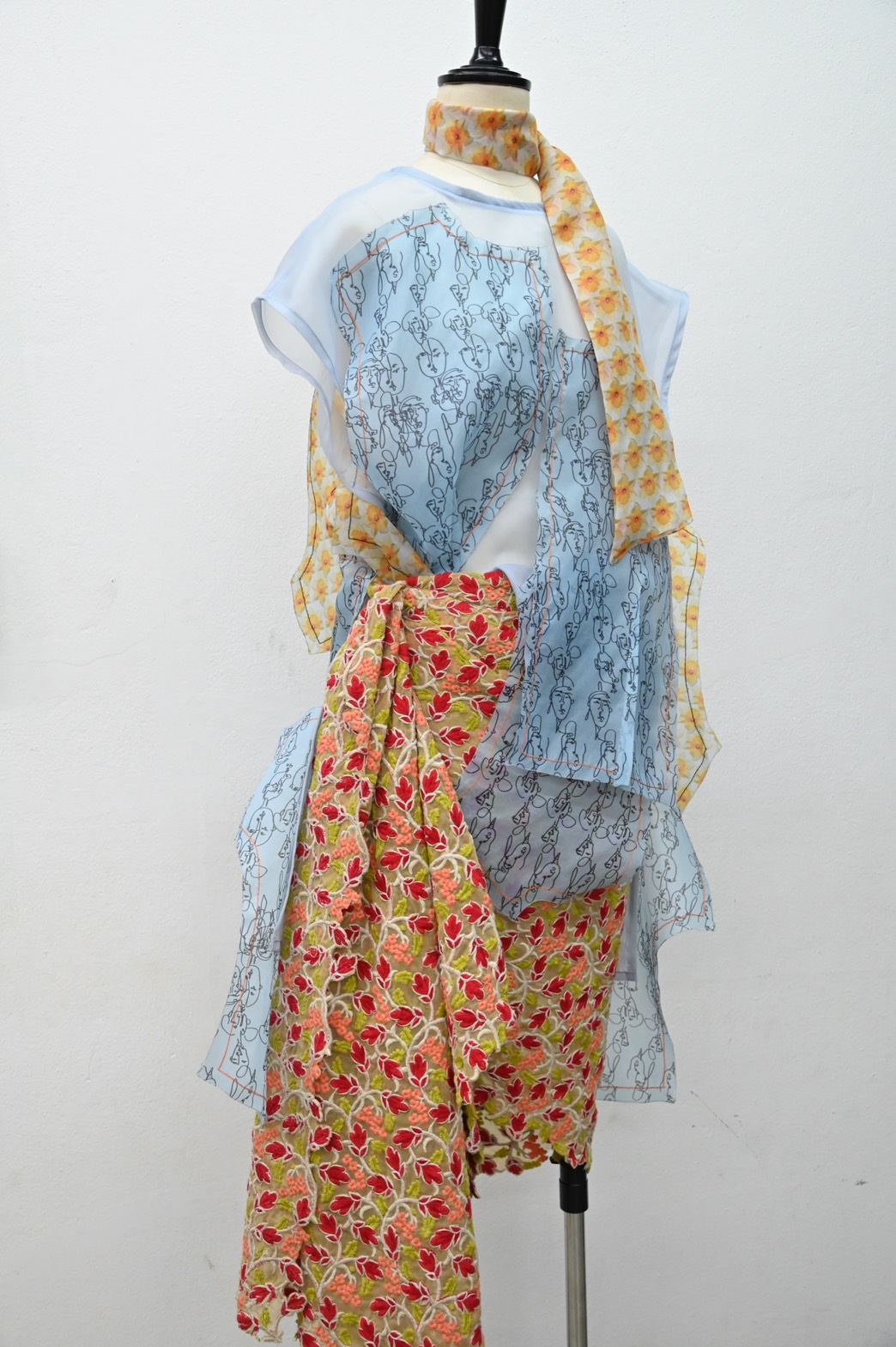
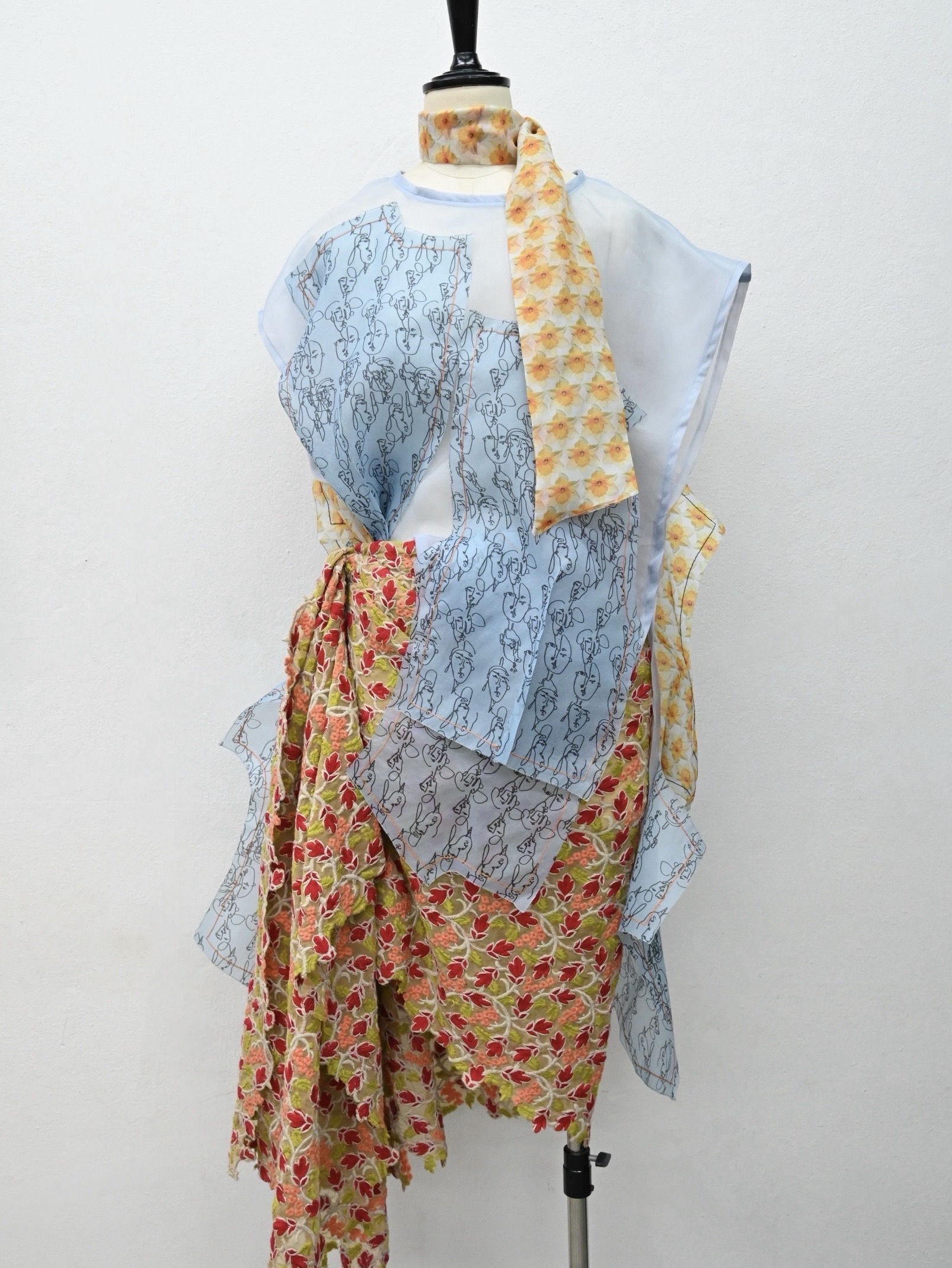
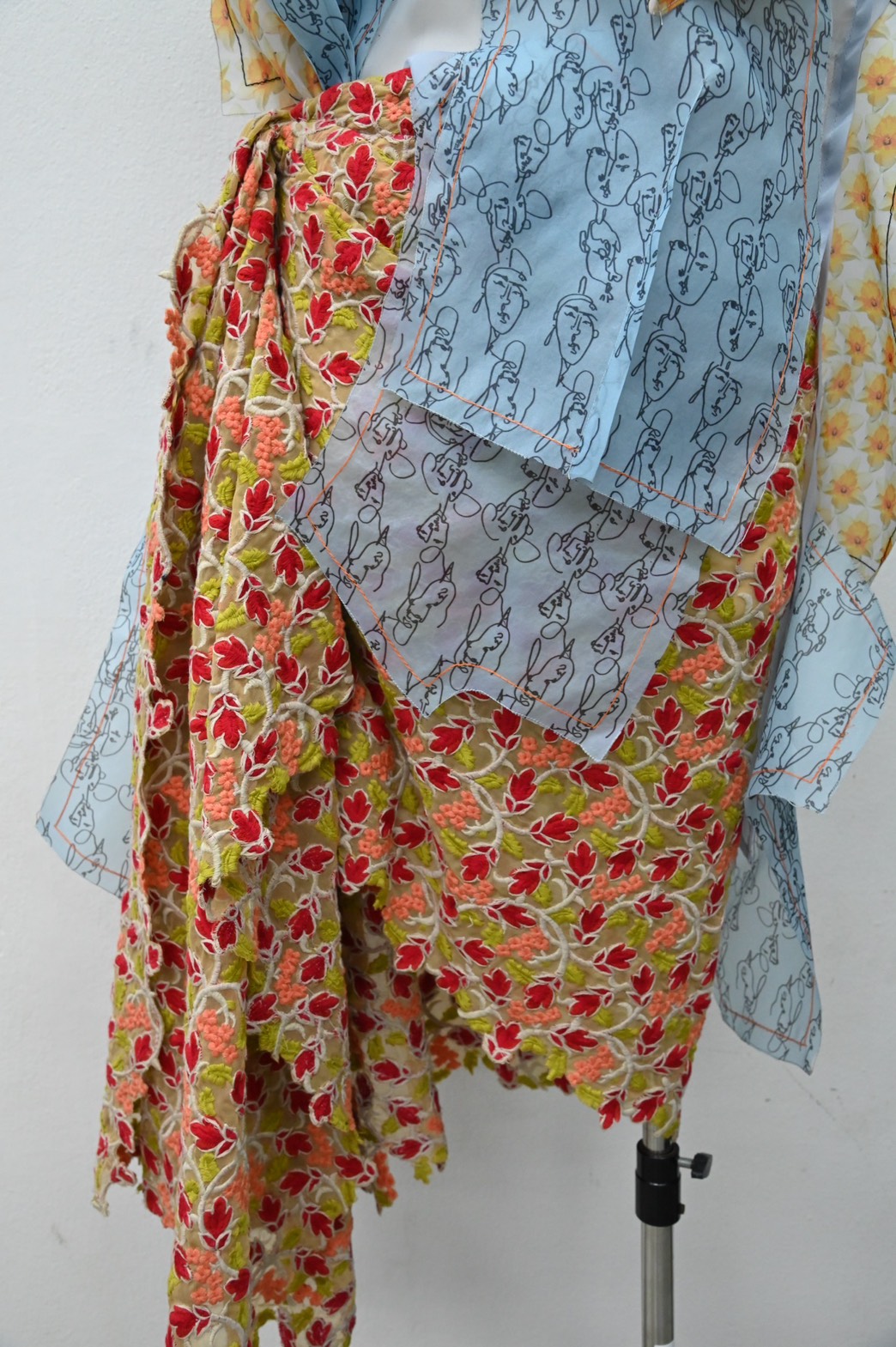
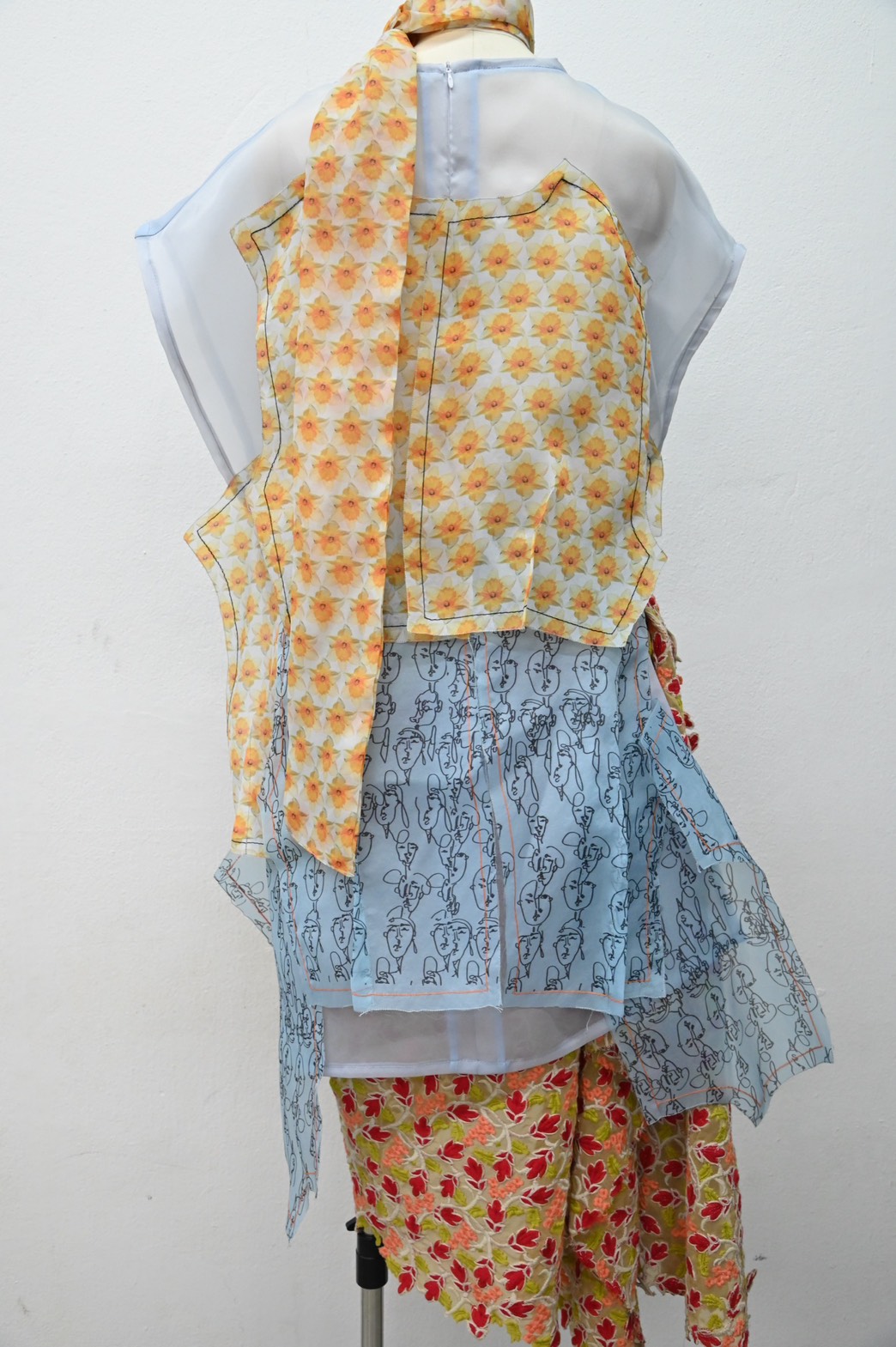
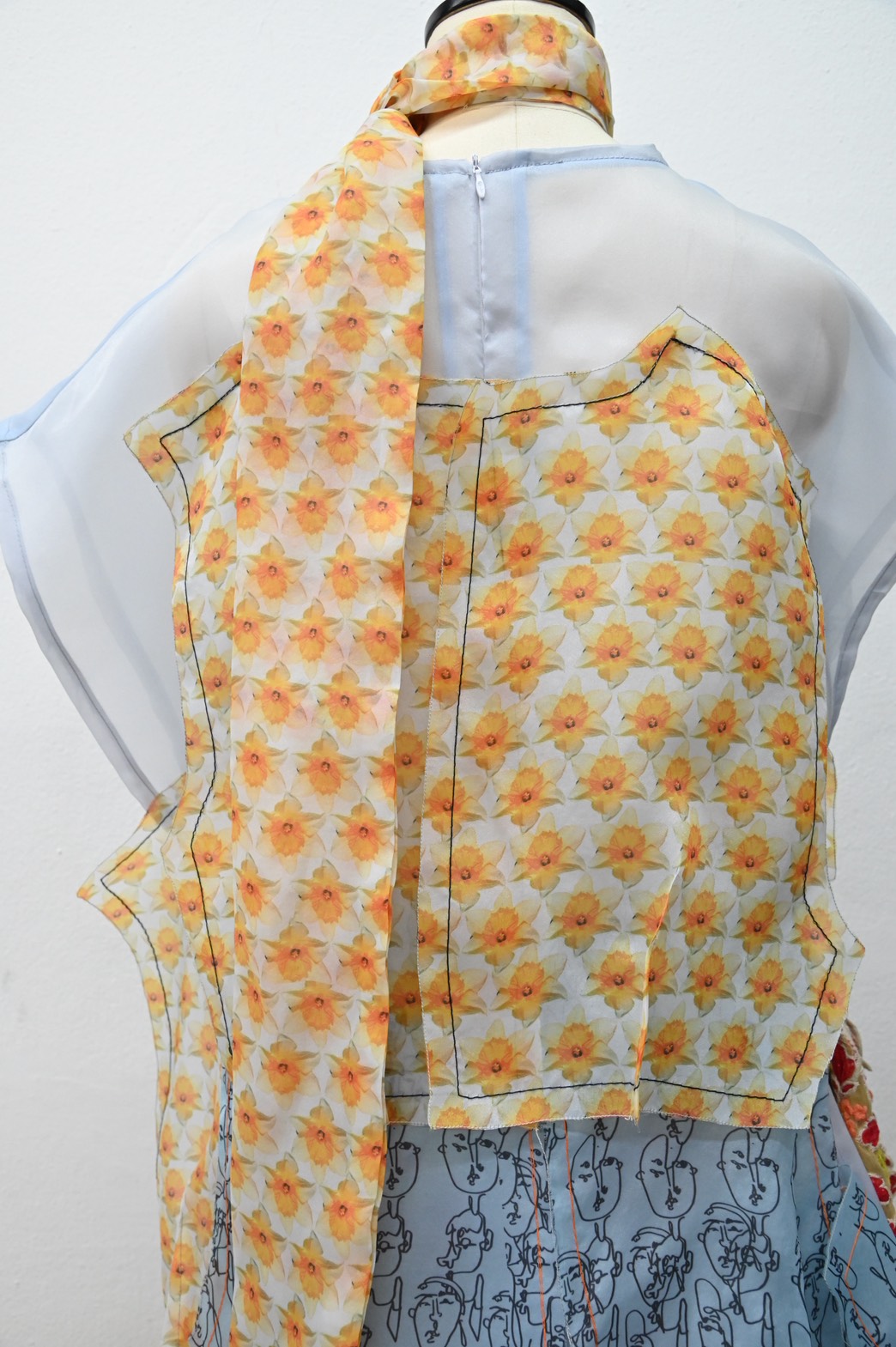
The creative process combines textile print design, drawing, draping, pattern cutting, layering, and textile manipulation. To preserve its original condition, the fabric is draped around the body without being cut into garment pattern pieces. Two personal visual motifs, daffodil flowers and continuous-line portrait doodles, developed into textile compositions printed onto transparent organza. The organza is then cut into garment pattern pieces, layered, and reconstructed over the original fabric. Its transparency suggests possible transformations of the cloth without physically altering it, allowing the garment that could have existed to appear as a trace rather than a completed reality.
The resulting work explores how material and visual objects can carry both lived memories and unrealised possibilities. Rather than removing or destroying the original fabric, the creative process allows its meaning to change. The Unworn Future proposes that what is mourned may not be a memory itself, but an imagined future that never happened.
Objectives :
1. To explore the relationship between inherited understanding, lived memory, and an imagined future.
This objective focuses on how an understanding of love, relationships, security, and commitment may be transmitted from one generation to another. Drawing on the idea of intergenerational transmission in relation to postmemory, the project considers how experiences that were not directly lived may still influence personal understanding and expectations of the future. This inherited understanding is explored alongside lived experiences and the future that was once imagined, creating a connection between the past, present, and a future that was never realised.
2. To examine personal memories and emotional experiences through autoethnographic reflection.
This objective uses autoethnography as a method to revisit and reflect on personal experiences through reflective writing and journaling. Personal objects and visual records, including the original piece of fabric, photographs, and hand-drawn doodles created during a period of shared experience, are used as materials for reflection. The photographs and drawings represent moments that actually happened, while the uncut fabric is connected to something that was expected to happen but never did. Through this process, the project examines how different forms of memory can remain connected to objects and visual materials over time.
3. To translate memories, emotions, and unrealised possibilities into textile-based creative practice.
This objective explores how personal memories and an imagined future can be transformed through textile print design, draping, pattern cutting, layering, and textile manipulation. Two personal visual motifs, daffodil flowers and continuous-line portrait doodles, are developed, repeated, and rearranged into textile compositions printed onto transparent organza. The original fabric is preserved through draping without being cut, while the printed organza is cut into garment pattern pieces and layered over it.
The contrast between the uncut original fabric and the cut transparent layers represents two different conditions: traces of experiences that were lived and the material trace of a future that was imagined but never realised. Through this creative process, the project explores how textile practice can reconstruct personal memories and unrealised possibilities without physically altering the material connected to the original imagined future.
Conceptual Framework :
The conceptual framework of The Unworn Future is developed through the relationship between intergenerational transmission, lived memory, material memory, and an imagined future. Drawing on Hirsch’s (2012) concept of postmemory, the project considers how experiences, values, and understandings may be transmitted across generations. Rather than applying postmemory directly to personal experience, it provides a point of departure for considering how an inherited understanding of love, security, commitment, and continuity may influence expectations of relationships and future life.
The framework also considers the relationship between memory and materiality. Schlunke (2013) suggests that memory and materiality are interconnected, while Plate (2025) examines how things and materials participate in processes of remembering. Within textile practice, Hunt (2014) considers clothes and textiles as archives through which memories and knowledge can be carried. Brody et al. (2020) further demonstrate how managing meaningful possessions and traces of a past relationship can be connected to memory, nostalgia, holding on, and letting go. Together, these perspectives support the original fabric as more than an object from the past; it becomes a material through which changing relationships with memory can be explored.
Visual reflexivity also contributes to the framework. Drawing on Pink (2001), visual materials are understood not simply as records but as part of a reflexive process of interpretation. Personal photographs and hand-drawn doodles are revisited as visual records of lived experiences, while selected visual motifs are developed and reconstructed through creative practice.
The project brings these ideas together through a distinction between memories of what happened and traces of what never happened. Photographs and doodles represent lived experiences, while the uncut fabric carries the possibility of an imagined future that was never realised. Through reflection and textile practice, these materials are given new relationships and meanings in the present.
Process / Methodology :
1. Reflective and Contextual Research
The project employs autoethnography to examine personal memory, emotional experience, and relationships with material objects. Reflective writing and journaling are used throughout the creative process to record memories, emotions, and changing interpretations. Personal photographs, hand-drawn doodles, and the original fabric are revisited as visual and material records, connecting lived experiences with an imagined future.
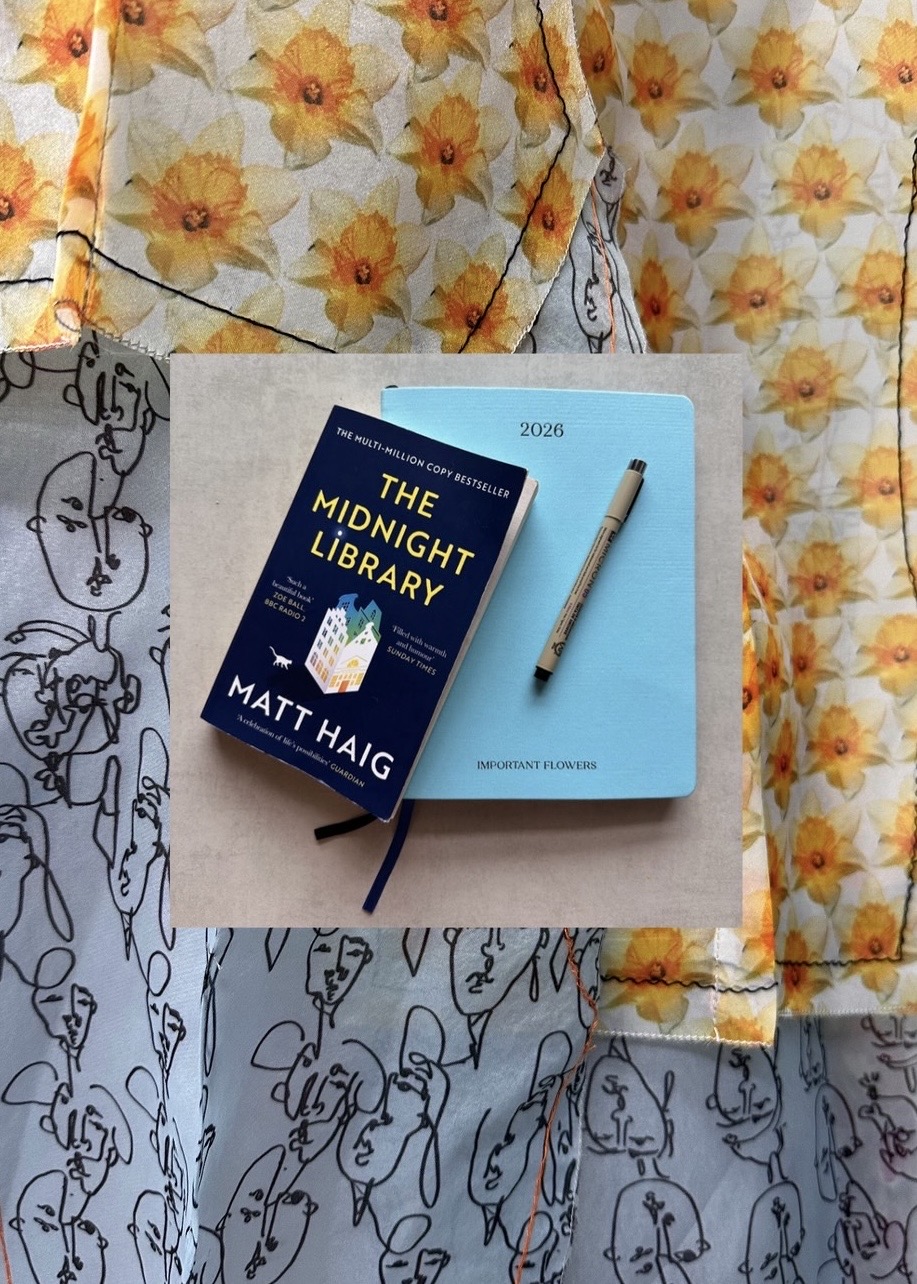
Relevant literature on postmemory, intergenerational transmission, and material memory provides the theoretical context. Matt Haig’s The Midnight Library is also used as a literary reference. Its exploration of alternative lives and possibilities that were never lived provides a point of reflection on choices, regret, and imagined futures.
2. Creative Practice Process
The creative process begins with the original fabric, once intended to become a dress for an occasion that would never take place. To preserve its original condition, draping is used to construct the skirt without cutting the fabric into pattern pieces.
For the upper garment, transparent organza is printed with two personal visual motifs: daffodil flowers and continuous-line portrait doodles. Daffodils were chosen because they were flowers shared in the memories of both individuals and associated with the beginning of spring in the UK, connecting the motif to a specific time, place, and shared experience. The portraits are drawn without lifting the pen, creating continuous lines that overlap, loop, and become entangled without a clear ending. Together, these motifs transform personal memories into textile compositions.
The printed organza is cut into garment pattern pieces, layered, and stitched together. Its transparency allows the original fabric to remain visible underneath, while the pattern pieces suggest a transformation of the original cloth that was imagined but never realised.
The contrast between the uncut original fabric and the cut transparent layers brings together two conditions: traces of experiences that were lived and the material trace of a future that was imagined but never realised. The final work preserves the original cloth while allowing its meaning to be transformed through creative practice.
Techniques and Materials :
The creative work combines textile print design, continuous-line drawing, digital textile printing, draping, pattern cutting, layering, stitching, and textile manipulation. The main material is the original piece of fabric, which carries a personal connection to an imagined future. The fabric is used almost in its entirety and draped directly on the body to construct the skirt, without being cut into conventional garment pattern pieces. Only excess fabric along the hem is trimmed where necessary, allowing the original form of the cloth to remain largely unchanged.
Transparent organza is used for the upper garment and printed with two personal visual motifs: daffodil flowers and continuous-line portrait doodles. The daffodils are connected to shared memories and the beginning of spring in the UK, while the portraits are drawn without lifting the pen, creating continuous lines that overlap, loop, and become entangled. These motifs are developed into textile compositions through digital textile printing.
In contrast to the original fabric, the printed organza is cut into garment pattern pieces, layered, and stitched together to construct the upper garment. Its transparency allows the original fabric underneath to remain visible. The contrast between the draped, almost entirely uncut original fabric and the cut transparent organza expresses two different material conditions: what remains from the past and a possible transformation that was imagined but never realised.
Result / Conclusion :
The project began with reading Matt Haig’s The Midnight Library (2021), which explores alternative lives and possibilities created by different choices. This raised a personal question: if a different decision had been made, would life have taken another form? Further reading on postmemory and intergenerational transmission (Hirsch, 2012) encouraged reflection on how understandings of love may be shaped across generations. Growing up within a warm family, where love was associated with security, commitment, and continuity, influenced expectations of relationships and an imagined future. When that future was no longer possible, the loss involved not only the relationship itself, but also something that had been expected to happen.
Autoethnography (Chang, 2016) was used to examine these experiences through reflective journaling, personal photographs, hand-drawn doodles, and material objects. Journaling documented thoughts, emotions, and changing interpretations throughout the process (Ortlipp, 2008). The original fabric became particularly significant. Once intended to become a dress for an important future occasion, it remained uncut when that future no longer existed.
During the creative process, the fabric was repeatedly draped, wrapped, removed, and repositioned on the mannequin. Cutting it would permanently change its form and original purpose, while there was also a strong reluctance to physically alter the material. This led to the question: Could the fabric become a garment without being cut? Draping therefore became a way of preserving the cloth while allowing it to take another form. Transparent organza pattern pieces were then repeatedly positioned, overlapped, and reconstructed over the fabric, representing transformations that were imagined and tested but would never occur on the original cloth.
One year after the experience, returning to this fabric became both personally challenging and unexpectedly healing. Through making and reflection, its meaning gradually changed. The fabric remained physically uncut, but was no longer only a reminder of an unrealised future. Perhaps what needed to be mourned was not a memory, but an imagined future. Once that future was acknowledged, the material could remain while its meaning was allowed to change.
References :
Brody, N., LeFebvre, L., & Blackburn, K. (2020). Holding on and letting go: Memory, nostalgia, and effects of virtual possession management practices on post-breakup adjustment. Journal of Social and Personal Relationships, 37(7), 2229–2249. https://doi.org/10.1177/0265407520921460
Chang, H. (2016). Autoethnography as method. Routledge.
Haig, M. (2021). The midnight library. Canongate Books.
Hirsch, M. (2012). The generation of postmemory: Writing and visual culture after the Holocaust. Columbia University Press.
Hunt, C. (2014). Worn clothes and textiles as archives of memory. Critical Studies in Fashion & Beauty, 5(2), 207–232. https://doi.org/10.1386/csfb.5.2.207_1
Ortlipp, M. (2008). Keeping and using reflective journals in the qualitative research process. The Qualitative Report, 13(4), 695–705. https://doi.org/10.46743/2160-3715/2008.1579
Pink, S. (2001). More visualising, more methodologies: On video, reflexivity and qualitative research. The Sociological Review, 49(4), 586–599. https://doi.org/10.1111/1467-954X.00349
Plate, L. (2025). Remembering things: The materiality of memory and the memory of materials. In A. Erll, S. Knittel, & J. Wüstenberg (Eds.), Dynamics, mediation, mobilization: Doing memory studies with Ann Rigney (pp. 245–250). De Gruyter. https://doi.org/10.1515/9783111439273-035
Schlunke, K. (2013). Memory and materiality. Memory Studies, 6(3), 253–261. https://doi.org/10.1177/1750698013482864