The Matrixial Border-Stream: Reconstructing the Funerary Journey of Nakorn-Sawan through Multi-Media Installation Practice
Mahidol University International College, Thailand
Dr. Bryan Ott and Supawan Supaneedis

Abstract :
The Matrixial Border-Stream is an immersive, multi-media art installation prototype that translates cinematic representations of bereavement, natural cycles, and generational absence into a contemplative spatial environment. Inspired by Puangsoi Aksornsawang’s independent feature film Nakorn-Sawan (2018; produced by Diversion), the creative work reconstructs a daughter’s funerary journey downriver to disperse her mother’s remains at Pak Nam Pho in Nakhon Sawan Province. Historically recognized as the gateway to the north, Nakhon Sawan literally translated as the “City of Heaven”, establishing the geographical confluence of Ping and Nan rivers as a liminal threshold between the earthly human town and the celestial realm. Departing from genre conventions that sensationalize death as a centralized spectacle of shock or an entity to be ritually expelled, the installation engages the slow, unhurried temporality of nature to examine how physical waterways operate as living archives of memory. By blending historical analogue technology with contemporary digital mapping, the installation invites viewers into an active mode of ethical reflection, against the erosion of memory through the current of historical forgetting.
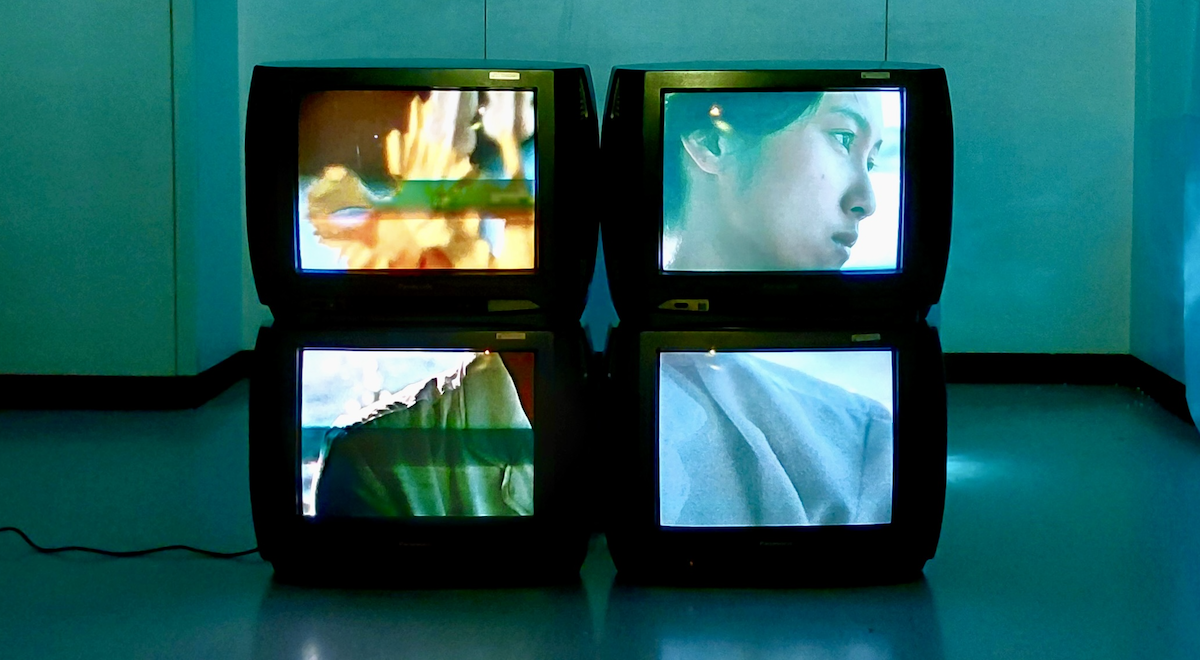
The project employs a practice-led research (PLR) methodology to investigate the intersection of obsolete analogue hardware and synthetic digital environments. Contrasting to a traditional, singular screen that enforces a conventional viewing hierarchy, a sculptural core composed of four vintage cathode-ray tube (CRT) television monitors stacked in a two-by-two grid presents synchronized, quadrant-edited perspective of the river voyage. Operationalizing Bracha L. Ettinger’s concept of the matrixial borderspace, the decentralized display aims to distribute the viewer’s gaze across concurrent, fragmented phenomena. Simultaneously, ambient digital projection wraps the surrounding gallery walls, creating an artificial metaspace invoking the natural water current through sensory realism ((De Luca, 2014) while acknowledging its status as a technologically mediated simulation.
Integrating Laura Mulvey’s concept of the pensive spectator, the technical looping of the media players suspends narrative finality, transforming the journey into an enduring, contemplative circle grounded in Heraclitean flux and cyclical impermanence. The installation engages the Postmemory theme, demonstrating how the generation after inherits, reconstructs, and sustains ancestral absences through the interplay of physical hardware, simulated landscapes, and natural flows.
Objectives :
The primary objective of this project is to translate the cinematic and philosophical experience of Nakorn-Sawan (2018) into an immersive spatial media installation that engages the theme of Postmemory.
1. To enable the spectator to wit(h)ness the contemplative funerary journey downriver with Aey, the daughter of the family, as she travels to disperse her mother’s remains at the confluence of the rivers at Pak Nam Pho in Nakhon Sawan. Allowing viewers to experience how an alternative, non-hierarchical gaze functions as an active conduit for carrying collective and generational memory.
2. To move beyond the centralized focus of genre cinema. By testing a multi-channel, two-by-two CRT monitor configuration that displays synchronized, quadrant-edited perspectives of the voyages across multiple screens simultaneously, reflecting the de-centered, organic nature of ambient phenomena where events unfold without a single dominant focal point.
3. To juxtapose the tactile, physical presence of CRT hardware, which evokes the domestic media archive of the recent past, against the ambient, simulated horizon of digital wall projections. Examining how the generation after inherits and reconstructs natural landscape and ancestral absences through contemporary simulated environments.
4. To utilize slow pacing, environmental stillness, and continuous looping to move the viewer from passive consumption into an active mode of reflection. Presenting the river journey not as an exercise in conventional narrative of shock or resolution, but as a continuous cycle of departure, transition, and natural impermanence.
Conceptual Framework :
This project adopts a “Matrixial” framework to examine how multi-media art can materialize intergenerational mourning and spatialized memory. Evolving from our previous textual analysis of contemporary Thai non-horror cinema (Supaneedis & Ott, 2026), the creative work counters commercial screen conventions that standardize death as a sensationalized spectacle of shock or an entity requiring ritual expulsion. The installation reappropriates the funerary journey as an archive of shared recollection.
The project utilizes Bracha L. Ettinger’s (2006) concept of matrixial borderspace. The installation functions as a shared “transport station” of memory. In this space, the multi-channel displays and ambient projection dissolve boundaries, allowing the viewer to engage in an active mode of wit(h)nessing and borderlinking. Through these matrixial mechanisms, the spectator does not just observe a character’s pain, their consciousness can interweave with the historical and emotional traces in the relational landscape where the self (I) and the other (non-I) co-emerge without entirely merging.
The orientation operates through Laura Mulvey’s (2006) concept of the pensive spectator. By employing the environmental stillness, stilled time, and narrative delay, the installation aims to subvert the rapid, consumption-oriented temporality of mainstream media. The CRT television stack breaks apart the traditional spectatorship of conventional cinema, distributing the visual field across concurrent, fragmented screens, to mimic the non-hierarchical experience.
In dialogue with Puangsoi Aksornsawang’s Nakorn-Sawan (2018), the camera transforms the river at Pak Nam Pho from a scenic backdrop into a site of relational co-emergence. In the Heraclitean paradox of the river of non-return, the installation treats the current as a manifestation of impermanence and cyclical flux, engaging what Song Hwee Lim (2016) conceptualizes as a temporal aesthetics of drifting. The slow boat journey, with looping analogue/digital set up, creates a pensive space where the daughter’s personal grief merges fluidly with collective, historical memory. Concurrently, Marianne Hirsch’s (2012) framework of postmemory illuminates how the generation after inherits and reconstructs absences that cannot be directly remembered. Ultimately, the work activates the matrixial gaze as a central structure for preserving a fragile collective memory against currents of historical forgetting.
Process / Methodology :
The physical environment transforms a gallery space into a fluid, real-time journey along the convergence of rivers at Pak Nam Pho in Nakhon Sawan Province, Central Thailand, adapting Puangsoi Aksornsawang’s film Nakorn-Sawan (2018). The methodology bridges analogue material constraints with synthetic digital environments through two distinct spatial registers.
The Analogue Core: A central sculptural block consisting of four stacked 1990s CRT television monitors arranged in a two-by-two grid. This display presents tightly framed, fragmented perspectives of human labor and grief, anchoring the installation in tangible, domestic memory.
The Digital Horizon (Metaspace): Large-scale digital projection mapping spans the surrounding gallery covering the walls, floor, and ceiling. Grounded in Tiago de Luca’s (2014) framework of sensory realism, this projection envelops the viewer in an artificial, simulated atmosphere of flowing water currents, ambient forest imagery, and synchronized acoustic soundscapes.
The technical process was a hybrid workflow bridging physical hardware and digital calibration. To play digital video files through legacy analogue displays, custom LZX Andor 1 looping media players were integrated with Mini HDMI-to-AV (composite RCA) converter units. Since each CRT monitor operated independently, the source video was edited and sliced into four distinct quadrant files (25% segments each) to ensure frame-accurate synchronization across all four screens. Simultaneously, short-throw projectors were mapped to the dimensions of the surrounding gallery fabric using Adobe After Effects to achieve alignment. The technique fractures the unified viewing hierarchy of traditional cinema, distributing the visitor’s gaze across a de-centered, multi-focal field of visual memory.
Techniques and Materials :
Result / Conclusion :
The Matrixial Border-Stream successfully demonstrates how cinematic film theory can be translated into an experiential practice-based spatial installation. By juxtaposing the heavy, tangible material constraints of vintage 1990s CRT TV monitors with the expansive, fluid nature of digital projection, the work bridges personal domestic mourning and collective public memory.
The installation operates as an active site of postmemory, utilizing Bracha L. Ettinger’s matrixial borderspace and Laura Mulvey’s pensive spectator. Contrasting the single, commercial focal point of death, the de-centered four-screen grid invites viewers into a mode of wit(h)nessing and borderlinking. In the Heraclitean paradox of the river of non-return, the installation treats the continuous technical video loop as an spatial experience of impermanence and cyclical flux.
Ultimately, the work preserves fragile human traces against the washing of memory and historical forgetting. It presents how multi-channel art and design can re-spatialize cinematic archives into meditative sanctuaries, offering audiences a space to negotiate absence and sustain generational continuity.
References :
Aksornsawang, P. (Director). (2018). Nakorn-Sawan [Motion picture]. Diversion.
De Luca, T. (2014). Realism of the senses in world cinema: The experience of physical reality. I.B. Tauris.
Ettinger, B. L. (2006). The matrixial borderspace (B. Massumi, Ed.). University of Minnesota Press.
Hirsch, M. (2012). The generation of postmemory: Writing and visual culture after the Holocaust. Columbia University Press.
Lim, S. H. (2016). Temporal aesthetics of drifting: Tsai Ming-liang and a cinema of slowness. In T. de Luca & N. B. Jorge (Eds.), Slow cinema (pp. 87–98). Edinburgh University Press.
Mulvey, L. (2006). Death 24x a second: Stillness and the moving image. Reaktion Books.
Supaneedis, S., & Ott, B. (2026). Familial feels: Contemplating death, grief, and absence in contemporary Thai non-horror cinema. Silpakorn International Conference in Total Art and Science (SICTAS 2026) Proceedings.
Share :
Facebook
Twitter
LinkedIn
WhatsApp
Email
Print