
Applying the Buddhist concept of "defilements" (*kilesa*) and Japanese aesthetics to the creation of conceptual fashion designs.
College of Design, Rangsit University, Thailand
Asst. Prof. Supreeya Suthamtarikul
Abstract :
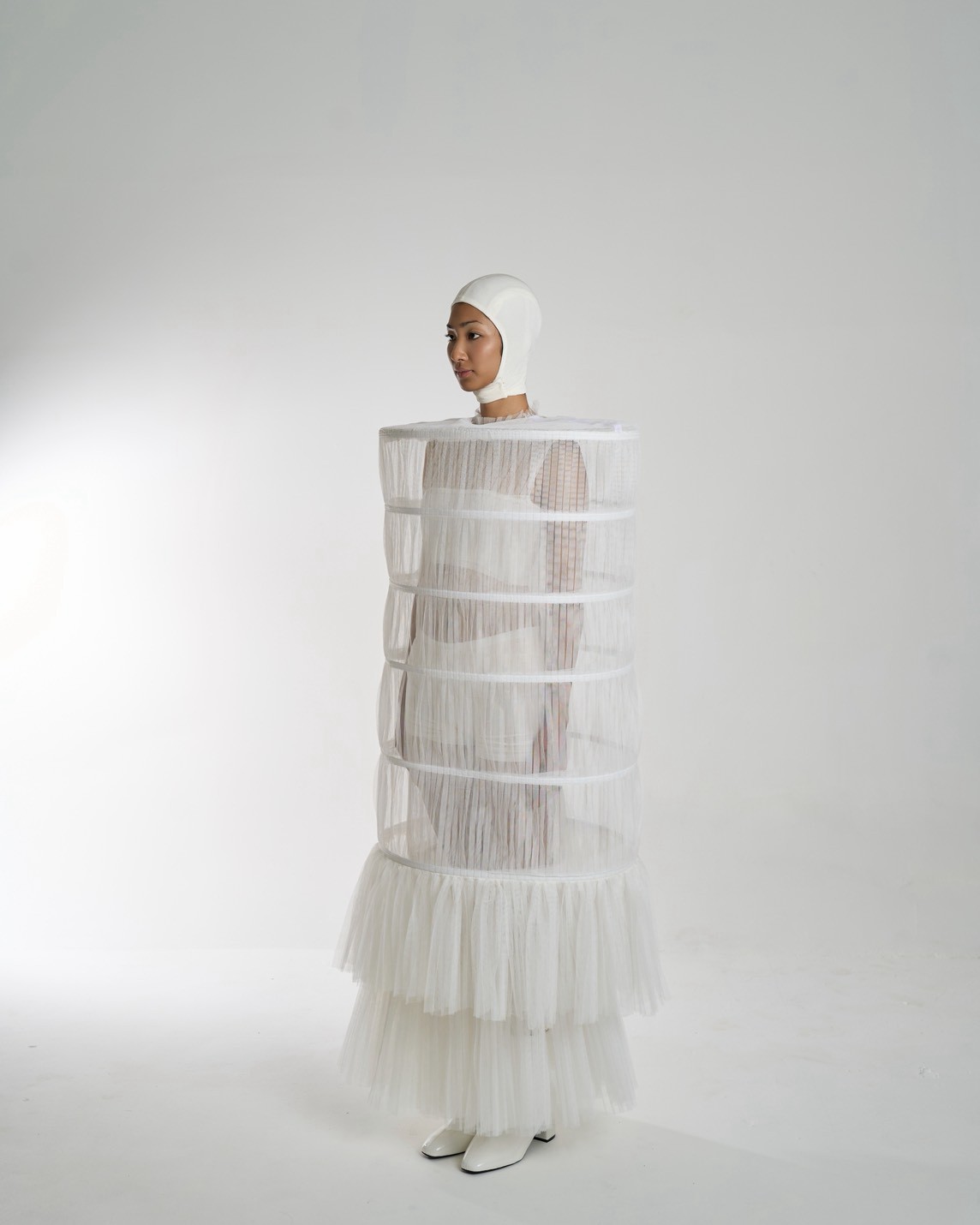
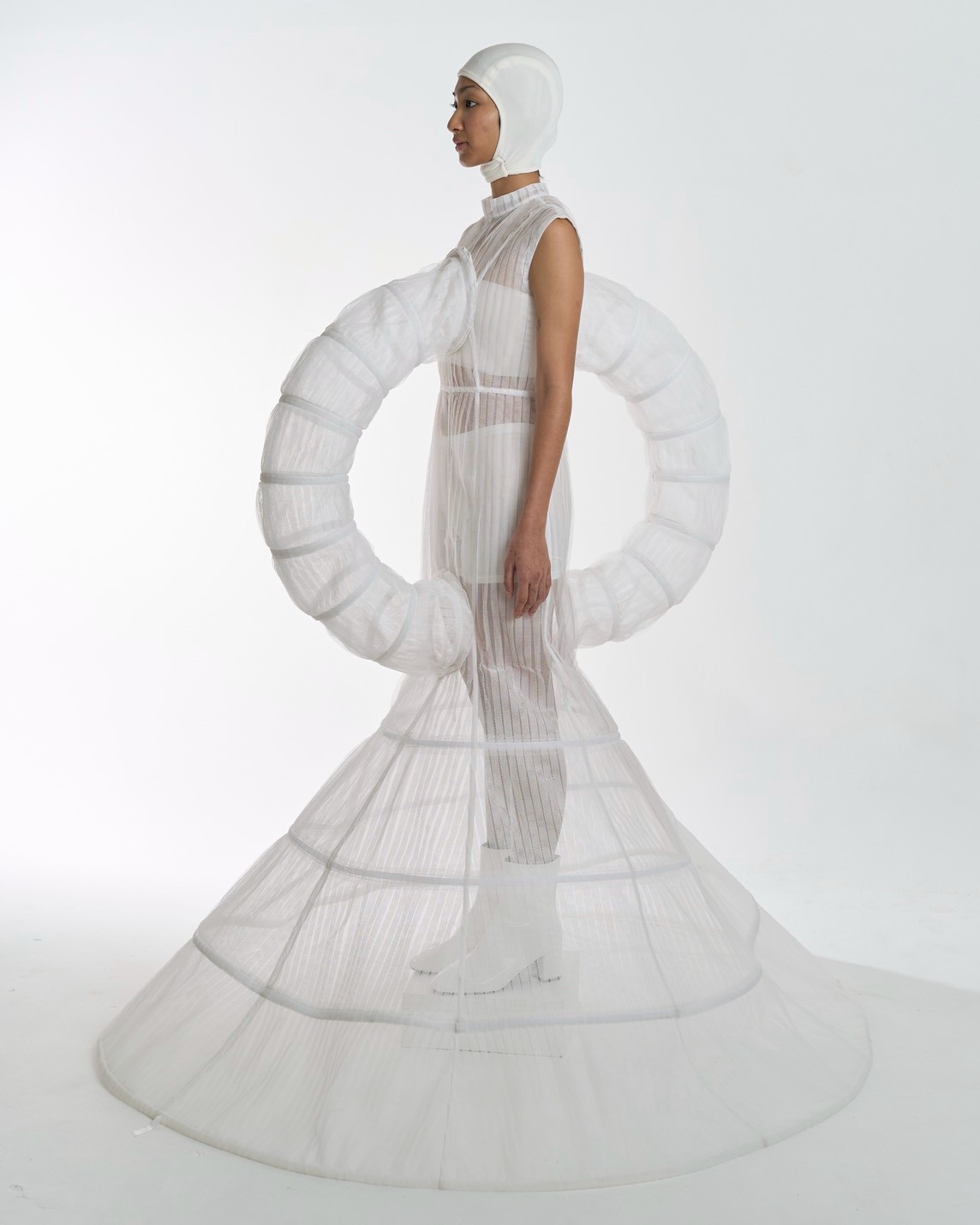
The Buddhist concept of *kilesa* (mental defilements) and Japanese aesthetics (*Bi* *So* *Ki*etc.) are studied, analyzed and synthesized these insights to create conceptual fashion design. Japanese aesthetic concepts are utilized as design principles. The fashion language employed aims to convey experiences related to *kilesa*—encompassing mental turbidity as well as states of satisfaction, dissatisfaction, and neutrality which dominated human being- across three age groups: 1. Childhood: represented by a short dress with the elongated tubular form of headdress, symbolizing *kilesa* influencing the mind and thoughts; 2. Adulthood: represented by a long evening gown with tubular shapes embedded deep within the garment, symbolizing *kilesa* that has taken deep root and is difficult to cast off; and 3. Old Age: represented by a loose-fitting dress enveloped by *kilesa* forms, symbolizing the mental defilements that cling to the mind despite attempts to let go. The resulting works will be served as case studies for disseminating knowledge to interested individuals.
Objectives :
- To study, research, compile, and analyze Japanese aesthetic concepts for application as design principles.
- To study, research, and analyze Buddhist principles regarding “Kilesa” (mental defilements) to serve as a foundation for storytelling.
- To synthesize information and utilize symbolism to convey meaning.
- To create conceptual fashion designs based on the theme of “Kilesa.”
Conceptual Framework :
This trio of conceptual fashion designs integrates the Buddhist concept of *kilesa* (mental defilements)—and the methods for overcoming them—with design principles influenced by Japanese aesthetics. Through using of symbolic forms, structures, color and material, the collection conveys the narratives of greed (*lobha*), anger (*dosa*), and delusion (*moha*)—states corresponding to satisfac-tion, dissatisfaction, and neutrality—that dominate the human mind.
Process / Methodology :
This research employs Japanese aesthetic concepts as the core principles of the design process. It begins with symbolism expressed through structure, form, materials, and an all-white color palette to signify new beginnings and allow the viewer’s imagination to roam freely. Tulle is utilized to convey delicacy, fragility, and profound, multi-dimensional emotions, reflecting the concept of *Bi* (subtle/deep sensitivity). The design emphasizes simplicity by stripping away superfluous ornamentation, focusing instead on raw, natural beauty and a serene life force—or *So* (simplicity/purity)—as well as the energy, spirit, and atmosphere of the surrounding environment, known as *Ki* (life force/spirit). The silhouettes reflect harmonious coexistence—*Hei* (peace/harmony). Furthermore, the designs convey the concepts of transformation (*Ha*) and the hidden or mysterious (*Hi*) to capture the unique allure of Japanese aesthetics. These design principles are applied to three garment sets representing different stages of human life—youth, adulthood, and old age—as appeared in the abstract above.
Techniques and Materials :
Three outfits reflect the different stages of human life—youth, adulthood, and old age—through distinct structural forms: an elongated cylinder for the youth ensemble, a circular cylinder integrated into the adult garment, and an elliptical shape enveloping the body for the elderly stage. Hoop-based structural techniques were employed to create these cylindrical forms across all three outfits. Additionally, tulle fabric was selected to convey qualities of grace and fragility, as well as profound, multi-dimensional emotions.
Result / Conclusion :
Conclusions process: The conceptual fashion design process regarding the theme of “Defilements: Domination” involved the following:
- The use of representation and symbolism to convey the narrative, as well as form, shape, and materials.
- A study of *kilesa* (defilements)—summarizing concepts from Buddhist teachings regarding their nature as mental impurities, specifically greed, hatred, and delusion.
- Interpretation of the content, distilled into the core concept of “Domination.”
- Categorization of humans into three groups—children, adults, and the elderly—represented by specific garment styles: short dresses, evening gowns, and loose-fitting dresses. Tube-like structures symbolizing defilements were incorporated into the designs to visualize the concept of domination.
- Application of Japanese aesthetic concepts for design principles regarding the color white—specifically the nuances of
微 (Bi) — The Aesthetic of Subtlety
The character 微 (Bi) means “subtle,” “delicate,” or “faint.” In the context of Japanese aesthetics, 微(Bi) conveys a heightened sensitivity to elements that are barely perceptible—the quiet, nearly invisible details that often go unnoticed unless one deliberately slows down and pays close attention.
氣 (Ki) — Sensing the InvisibleThe character 氣 (Ki) refers to energy, spirit, or atmosphere.
It is a concept deeply rooted in East Asian philosophy, often described as the invisible life force that flows through people, objects, and spaces.
In Japanese aesthetics, 氣 (Ki) is not associated with loudness or dramatic movement. Rather, it refers to a subtle presence—a quiet, felt energy that can be sensed even in the absence of words or action. It is the stillness in a room, the unspoken feeling between individuals, or the atmosphere that envelops a moment.素 (So) The Essence of the Unadorned
The character 素 (So) means “plain,” “unadorned,” or “raw.”
In Japanese aesthetics, it reflects the idea that the most beautiful things are those preserved in their natural state. Ideally, nothing unnecessary is added; instead, each element exists as part of a larger, balanced, and harmonious whole.
破 (Ha) — Breaking to BecomeThe character 破 (Ha) means “to break,” “to tear apart,” or “to disrupt.”
In Japanese aesthetics, it signifies the moment when an established form is intentionally broken—not as an act of rebellion, but as a way to transcend tradition and create something new.
This idea is grounded in the belief that one can only break a form meaningfully after fully understanding it. In other words, tradition must first be studied and mastered. Only then can it be challenged and transformed with integrity.
秘 (Hi) — Seeing Without SeeingThe character 秘 (Hi) means “secret” or “hidden.”
In Japanese aesthetics, 秘 (Hi) refers to the deliberate act of concealing part of something in order to spark the viewer’s imagination and creative engagement.
Rather than revealing everything openly, 秘 (Hi) embraces mystery, suggestion, and subtlety. It creates space not only for interpretation but for personal participation.
間 (Ma) — The Space Between ThingsThe concept of Ma may already be familiar to some readers. This distinctive idea is deeply embedded in Japanese culture and appears even more frequently than Wabi Sabi (侘寂). The character 間 (Ma) is often translated as “space,” “gap,” or “pause.”
However, in Japanese aesthetics, 間 (Ma) refers to more than mere emptiness. It is the meaningful interval between things—what gives structure, rhythm, and emotional resonance to the world around us.並 (Hei) — The Beauty of Coexistence
The character 並 (Hei) means “side by side” or “in parallel.”
In Japanese aesthetics, 並 (Hei) reflects a cultural disposition to allow multiple elements—even those that appear contradictory—to coexist without conflict.
破 (Ha) — Breaking to BecomeThe character 破 (Ha) means “to break,” “to tear apart,” or “to disrupt.”
In Japanese aesthetics, it signifies the moment when an established form is intentionally broken—not as an act of rebellion, but as a way to transcend tradition and create something new. This idea is grounded in the belief that one can only break a form meaningfully after fully understanding it. In other words, tradition must first be studied and mastered. Only then can it be challenged and transformed with integrity.—as well as the interplay of white tones, including light and shadow.
Results: Japanese aesthetics served as the guiding design principle. This involved interpreting and utilizing materials, forms, and symbols to embody these principles and convey a narrative that the audience could understand. Furthermore, a discussion with a critic may also be necessary.
References :
กิิเลส. Available from https://shorturl.at/wXKfP
ป.อ. ปยุุตุุโตุ (2546).พจนานุกิรมพุทธศาสตุร์ ฉบัับัประมวลธรรม ISBN 974-8357-89-9 สำานักิงานร่าชบััณฑิิตุยุสภา. (8 กิันยุายุน 2552). กิิเลส. Available from https://shorturl.at/lVRKH พระอาจารยุ์ชยุสาโร(2568.06.15) “กิิเลส ๑๐๘ ชนะได้้” ปฏิิบััตุิธรรมบั้านบัุญ (Online) Available from https://www.youtube.com/watch?v=xIUeXL0yCqU
พระอาจารยุ์ชยุสาโร (23 กิรกิฎาคม 2569) ‘สละ Teddy Bear’ ปฏิิบััตุิธรรมบั้านบัุญ (Online) Available from https://www.youtube.com/watch?v=KtjdVN-S2Q4&t=45s
พระอาจารยุ์ชยุสาโร( no date) “เราเห็็นเจ้าแล้ว”ปฏิิบััตุิธรรมบั้านบัุญ (Online) Available from https://www.youtube.com/watch?v=HrZizIOuqik
De Mente, Lafayatte Boye. (2006). Elements of Japanese Design. Key terms for Understanding & Using Japan’s Classic Wabi-Sabi-Shibui Concepts. Tokyo: Tuttle. Posner, Harriet. (2015) Marketing Fashion. 2 ed. London: Lawrence King.
Japanese aesthetics History. (November 21, 2019) Available from https://www.interactiongreen.com/japanese-aesthetics-history/
Dan Le Gris. (no date#1). 8 Japanese aesthetics that might change how you see beauty. (online) Available from https://www.youtube.com/watch?v=PdXz1HNKz9A
Dan Le Gris. (no date#2). 5 Hidden principles that make Japanese design feel different. Available from https://www.youtube.com/watch?v=deXuK374EHI
Dan Le Gris. (no date#3). Ikebana explained: 7 key principles of flower arrangement. https://www.youtube.com/watch?v=FJK-fzYLYzM
Dan Le Gris. (no date#4). Japanese Zen and Garden explained Hidden Symbolism & Meaning. Available from https://www.youtube.com/watch?v=tlOEpe06mx0
Dan Le Gris. (no date#5). Ma. Available from https://www.youtube.com/watch?v=9Q7hxgDlkGA
Dan Le Gris. (no date#6). No Masks: The Hidden Story of Japanese Theatre Masks. Available from https://www.youtube.com/watch?v=seFGdhN3Xjc.
Dan Le Gris. (no date#7). Why Japanese design embraced Shadow. (Online) Available from https://www.youtube.com/watch?v=0sMSS25h41E
Symbolism. (online) Available from https://en.wikipedia.org/wiki/Symbolism_(movement)
Share :
Facebook
Twitter
LinkedIn
WhatsApp
Email
Print