State of Growth
College of Design, Rangsit University
Asst. Prof. Poraphon chinwannachot
Abstract :
State of Growth
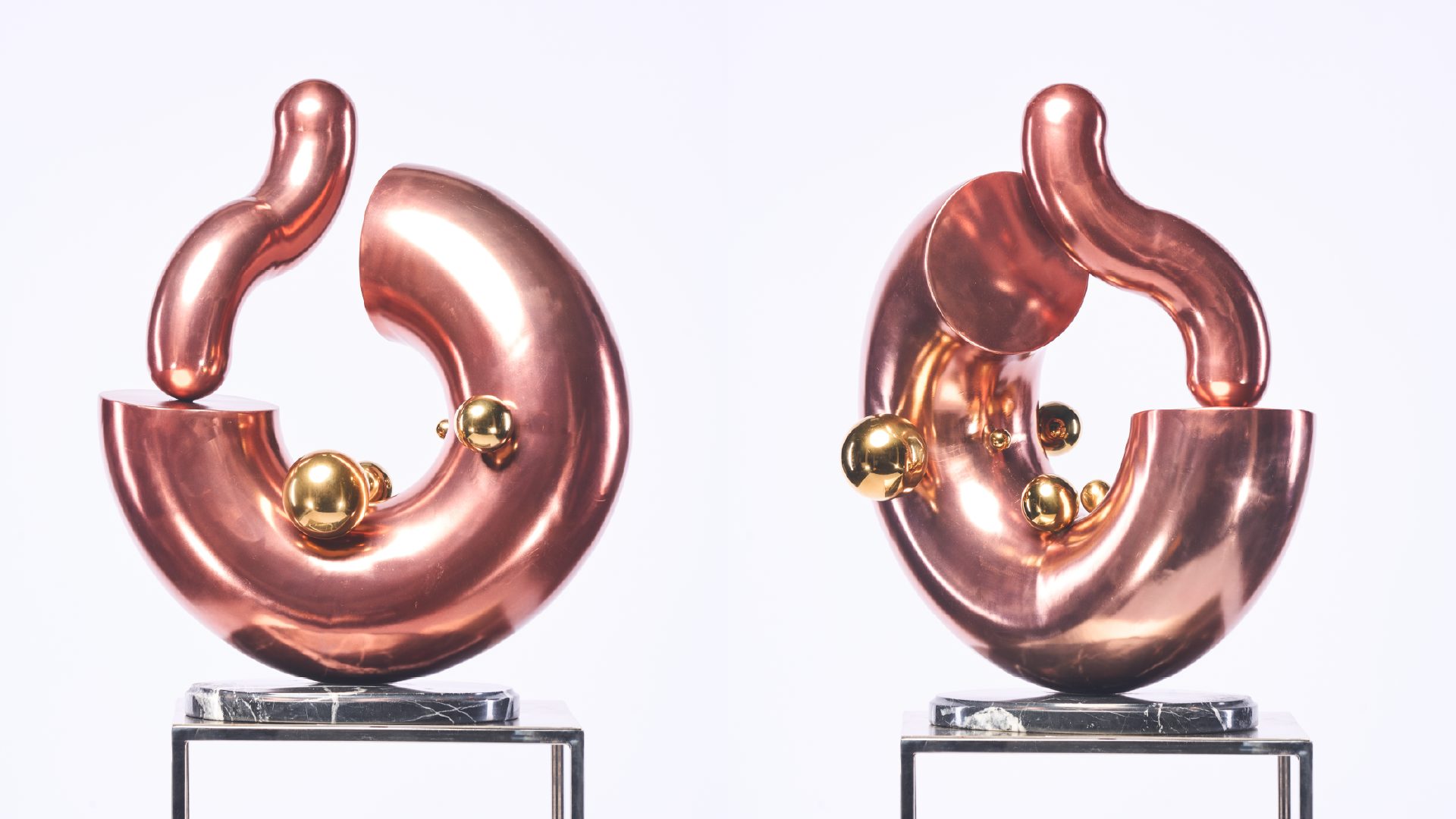
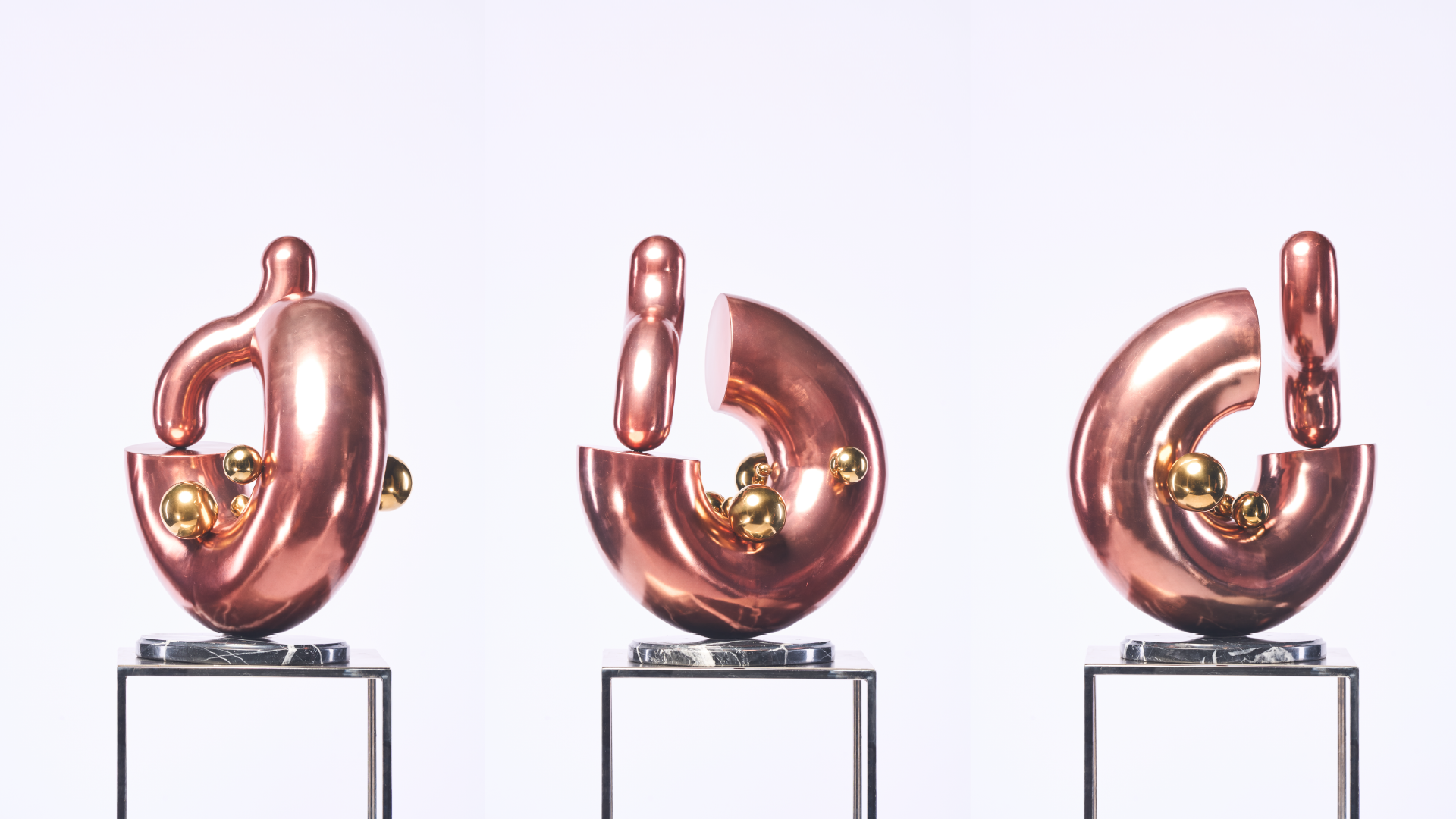
The creative work State of Growth is inspired by the processes of growth and transformation that occur within all things. Growth is not limited to physical development, but also encompasses processes of emergence, expansion, movement, transformation, and continuous change. These processes reflect the dynamic conditions of existence, in which every form is constantly evolving, adapting, and becoming something new. The artist explores these qualities through abstract sculptural forms, moving beyond the direct representation of specific natural objects or living organisms.
The creative process begins with the observation of forms and structures found in nature and the surrounding environment. Their visual characteristics are then simplified and reduced, removing unnecessary details while retaining essential elements that can evoke the sensation of growth. Structure, rhythm, repetition, expansion, movement, and negative space become important components in the development of the sculptural forms. Through this process of reduction, natural references are transformed into contemporary abstract forms that communicate the emotional and perceptual qualities of growth rather than depicting growth literally.
The sculptures are developed through an exploration of the relationships between mass, form, space, and negative space. The artist employs processes of reduction, repetition, extension, and arrangement to create a sense of continuity and movement within each composition. The interaction between solid forms and empty spaces allows the sculptures to appear as if they are expanding, emerging, shifting, or transforming beyond their existing boundaries. These relationships create a visual rhythm that suggests growth as an ongoing and dynamic process rather than a fixed state.
The sculptural forms therefore do not function as representations of any particular object or organism. Instead, they serve as visual manifestations of a “state of growth” that can occur within all things. The work seeks to encourage viewers to perceive growth not simply as an increase in size or physical development, but as a continuous process of emergence, transformation, and becoming.
Ultimately, State of Growth aims to convey the energy and emotional essence of growth through the language of abstract sculpture. By reducing recognizable forms to their fundamental structures, rhythms, and spatial relationships, the work invites viewers to experience growth through form, movement, and feeling, leaving behind only the essential qualities of emotion and sensation.
Objectives :
1.To investigate the processes of growth, transformation, emergence, expansion, and movement that occur within all things, and to use these characteristics as a conceptual foundation for artistic creation. Growth is viewed as a continuous and dynamic process of change rather than merely the physical development of living organisms. It is understood as a fundamental condition of existence reflected through changes in form, structure, relationships, and states of being.
2.To explore and develop abstract sculptural forms inspired by structures and characteristics found in nature and the surrounding environment. The creative process emphasizes simplification, reduction, and the elimination of unnecessary visual details in order to retain the essential qualities of form. These qualities are transformed into contemporary sculptural forms that communicate growth and transformation without directly imitating specific natural objects.
3.To experiment with the relationships between mass, form, space, and negative space through repetition, extension, continuity, expansion, and movement. These elements are organized to create visual rhythm and dynamism, allowing the sculptures to express a sense of continuous growth, development, and transformation.
4.To develop an abstract sculptural language that expresses the “state of growth” through emotional and sensory experience. Rather than relying on literal representation, the work communicates the qualities of growth through the interaction of form, proportion, rhythm, movement, and spatial relationships.
Conceptual Framework :
State of Growth
Growth is a continuous process that occurs within all things, encompassing nature, living organisms, human thoughts, and existence itself. It is not limited to physical development or an increase in size, but also involves emergence, expansion, movement, adaptation, transformation, and the transition from one state to another.
This body of work takes the characteristics of growth as a source of inspiration for creating abstract sculptures. Rather than directly representing specific living organisms or natural forms, the work employs a process of reduction, removing unnecessary details and visual elements in order to
discover the essential structures, rhythms, and forces within forms that can evoke the sensation of growth.
The sculptural forms are developed through processes of expansion, repetition, continuity, and movement, creating relationships between mass and negative space. These relationships generate visual rhythm and dynamism, suggesting forms that appear to be continuously growing, emerging, and transforming.
The sculptures therefore do not function as representations of any particular object. Instead, they express a “state of growth” through abstract form, allowing the viewer to experience growth as an emotional and perceptual condition. By reducing recognizable forms to their essential qualities, the work seeks to reveal the underlying energy, movement, and feeling of growth through the language of contemporary sculpture.
Process / Methodology :
The creative process begins with the observation and study of growth and transformation occurring in nature and the surrounding environment. Particular attention is given to structure, direction, rhythm, expansion, branching, and movement. These characteristics are examined and interpreted as fundamental information for developing sculptural forms.
The collected information is then analyzed to identify and extract the essential elements that contribute to the communication of meaning. Through a process of reduction and simplification, unnecessary details are removed, while the forms are transformed into simple abstract and geometric structures. This process aims to discover the underlying structure, energy, and visual dynamics capable of expressing the sensation of growth.
Once the formal direction has been established, sketches and three-dimensional models are developed to explore proportion, rhythm, repetition, continuity, expansion, and the arrangement of negative space. The selected forms are then translated into the final sculptures using stainless steel as the primary material. Individual components are cut and shaped according to the developed designs before being assembled and joined through stainless steel welding techniques. The welded structures are subsequently refined through surface grinding, polishing, and finishing to achieve continuity and precision in the overall form.
Techniques and Materials :
Stainless steel
Result / Conclusion :
The creative work State of Growth has resulted in the development of abstract sculptural forms that reflect the concepts of growth, expansion, movement, and transformation. The forms are developed through a process of reducing unnecessary details from forms observed in nature and the surrounding environment, retaining only essential structures, rhythms, directions, and visual energy that can convey the sensation of growth in an abstract manner.
Stainless steel is used as the primary material through processes of cutting, shaping, assembling, and welding, allowing the artist to construct continuous forms and establish clear relationships between mass and negative space. In the final stage, color is applied to the stainless steel surfaces to enhance the visual qualities of the sculptures, emphasizing dimension, rhythm, and the relationships among the various elements. The resulting works present a contemporary sculptural language that communicates the “state of growth” as a process of emergence, expansion, and transformation through form, material, surface, color, and visual emotion.
References :
1.Arnheim, R. (2004). Art and Visual Perception: A Psychology of the Creative Eye (2nd ed.). University of California Press.
2. Read, H. (1956). The Art of Sculpture. Princeton University Press.
3.Nimsemer, C. (2016). Elements of Art. Bangkok: Amarin.
4.Zahner, L. W. (2019). Stainless Steel Surfaces: A Guide to Alloys, Finishes, Fabrication and Maintenance in Architecture and Art. Wiley.