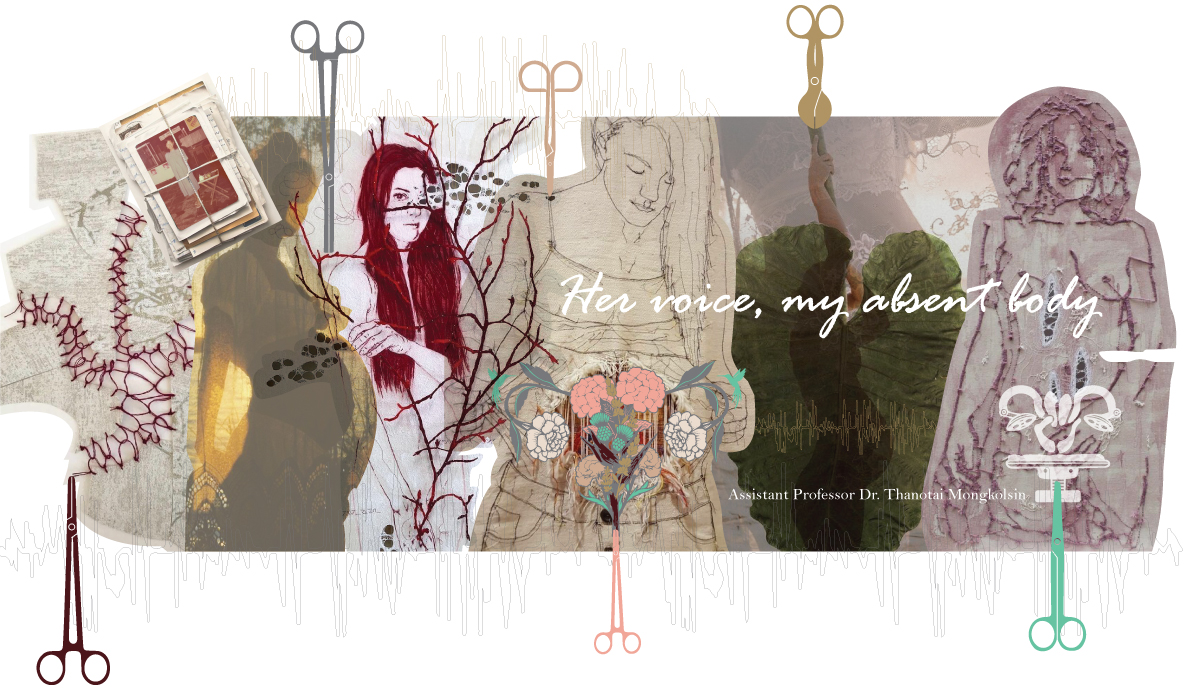
Her Voice, My Absent Body: Postmemory of an Impossible Future in Creative Womenswear Design Reflections on a Maternal Interview on the Experience of Pregnancy
Bangkok University
Asst. Prof. Dr. Thanotai Mongkolsin
Abstract :
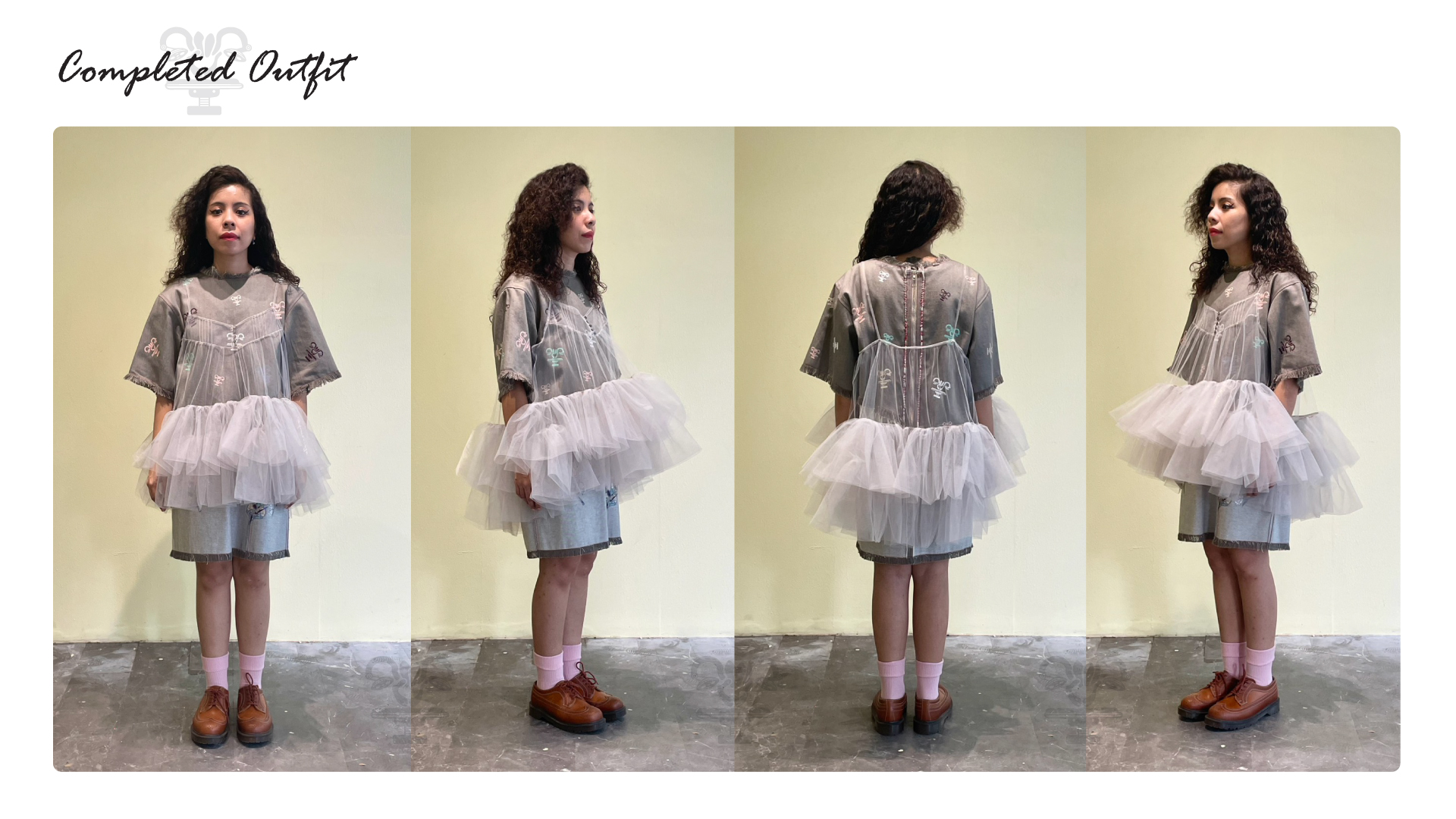
This practice-based research extends Marianne Hirsch’s concept of postmemory into a casespe-cific framework, “Postmemoryof an Impossible Future,” describing the inheritance of a mother’s profound feelings during pregnancy by a recipient permanently unable to experience it herself due to a hysterectomy. Drawing on the medical concept of phantom memory, the study reframes memory transmission around voice and oral testimony rather than photography, positioning an in-depth interview with the researcher’s mother as the primary point of memory. The research followed five phases: theoretical review, in-depth interview and verbatim transcription, thematic analysis mapping the testimony onto four conceptual pillars, iterative design development, and reflective evaluation. These pillars- silhouette, colour, detail and technique, and material- were translated into a creative streetwear prototype titled “Her Voice, My Absent Body.” An asymmetric silhouette with interrupted seams expresses inheritance cut short; a desaturated palette of Skin & Void, Clinical, and Scar & Trace tones renders memory as faded yet still marked by pain; embroidered interview text in faded gold print, a womb-inspired print, a transparent swelling belly structure, and exposed surgical-style seams give physical form to voice, absence, and scar; and raw-edged washed denim, cotton, and mesh construction reinforces a lineage that is pieced together yet visibly severed. Evaluated against its initial framework, the collection does not attempt to reconstruct pregnancy, an impossibility, but instead records the distance between what was told and what the body will never feel. Each technique consistently supports the thesis that what is usually concealed, whether a scar or a silence, can be structurally foregrounded rather than disguised. This research contributes theoretically by extending postmemory into the register of a foreclosed future rather than only the past, and methodologically by offering a replicable process for translating oral testimony and bodily loss into fashion design. It suggests further application to other forms of impossible inheritance, such as infertility, illness, or migration, positioning creative streetwear as a vehicle for articulating experiences that resist conventional representation.
Objectives :
- To study and synthesize Marianne Hirsch’s concept of postmemory together with the researcher’s personal experience, developing a case-specific theoretical framework “Postmemory of an Impossible Future” to serve as the theoretical foundation for the fashion design.
- To translate the memories gathered from an in-depth interview with the researcher’s mother regarding her experience of pregnancy into a design language of structure, technique, and material, expressed through creative womenswear.
- To design and develop the prototype dresses under the concept “Her Voice, My Absent Body,” communicating themes of inherited memory, loss, and the bodily identity of a woman who is unable to bear children, through a fashion design process.
Conceptual Framework :
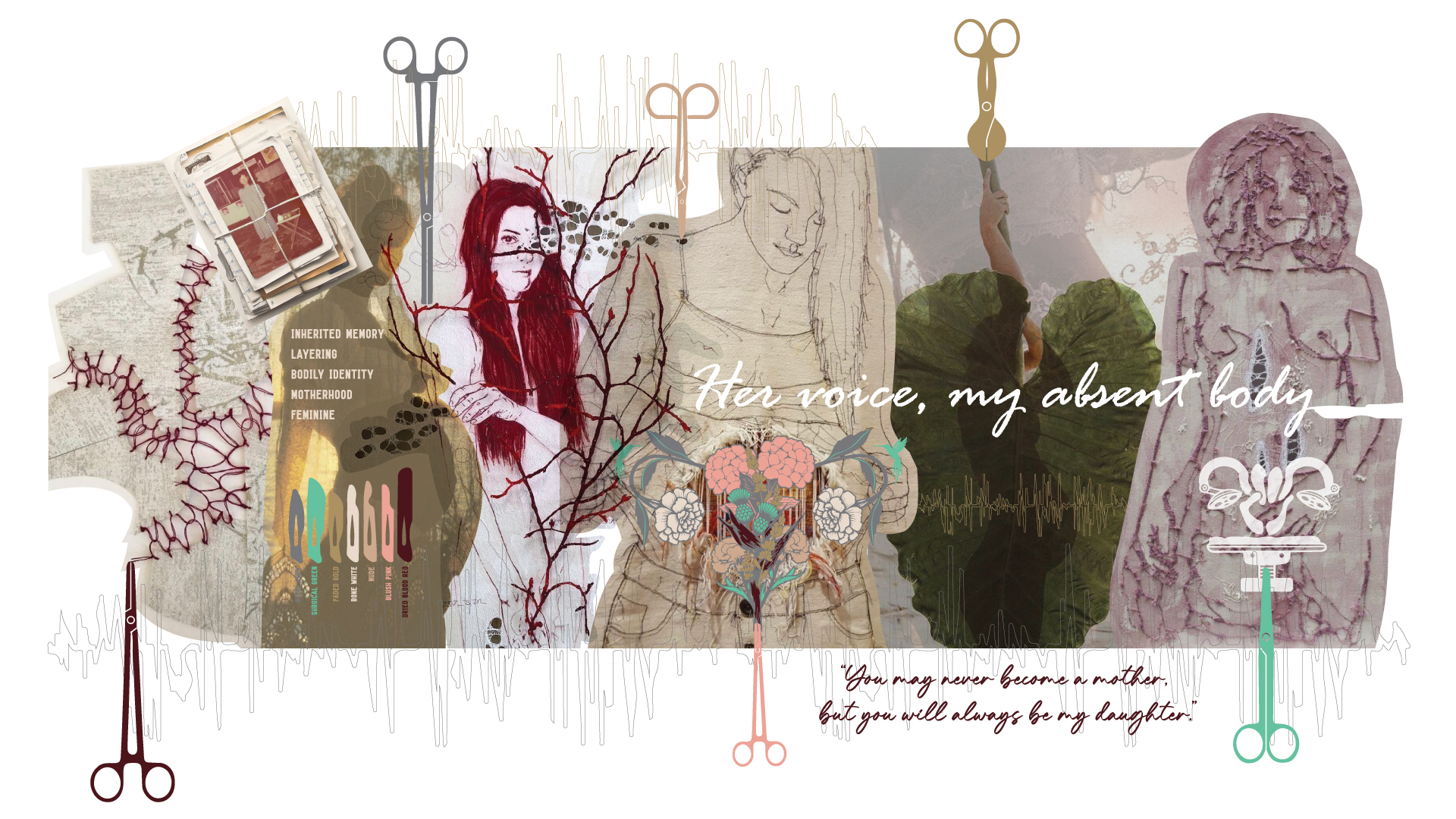
This work, titled “Her Voice, My Absent Body,” condenses its concept into one phrase: the mother’s voice, still echoing, against a body that will never feel that experience itself. It builds on Marianne Hirsch’s postmemory, which describes later generations inheriting the “trauma of the past” through inherited stories and photographs (Hirsch, 2008). The researcher proposes a case-specific extension, “Postmemory of an Impossible Future”, the inheritance of a mother’s profound feelings during pregnancy, recounted through an interview, by a recipient permanently unable to ever experience it herself due to a hysterectomy.
The concept of phantom memory from medicine is borrowed to express a body yearning for an experience its organs can no longer hold (Brainerd et al., 2003). Unlike Hirsch’s photography-based framework, memory here is anchored in voice and oral testimony, “Her Voice,” with no visual evidence, requiring pure imagination, while the body itself remains an empty vessel that can never truly hold that memory, “My Absent Body.”
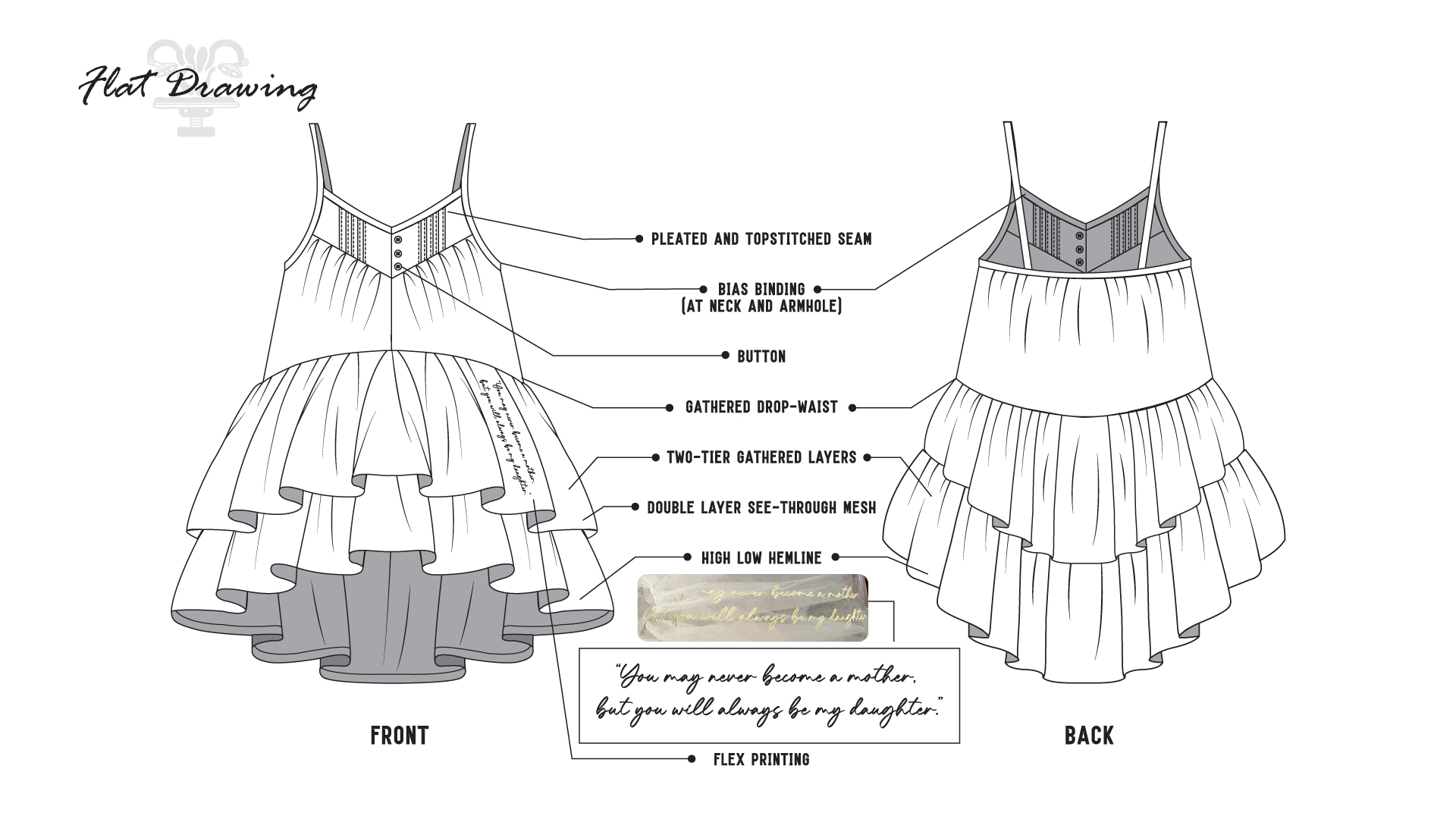
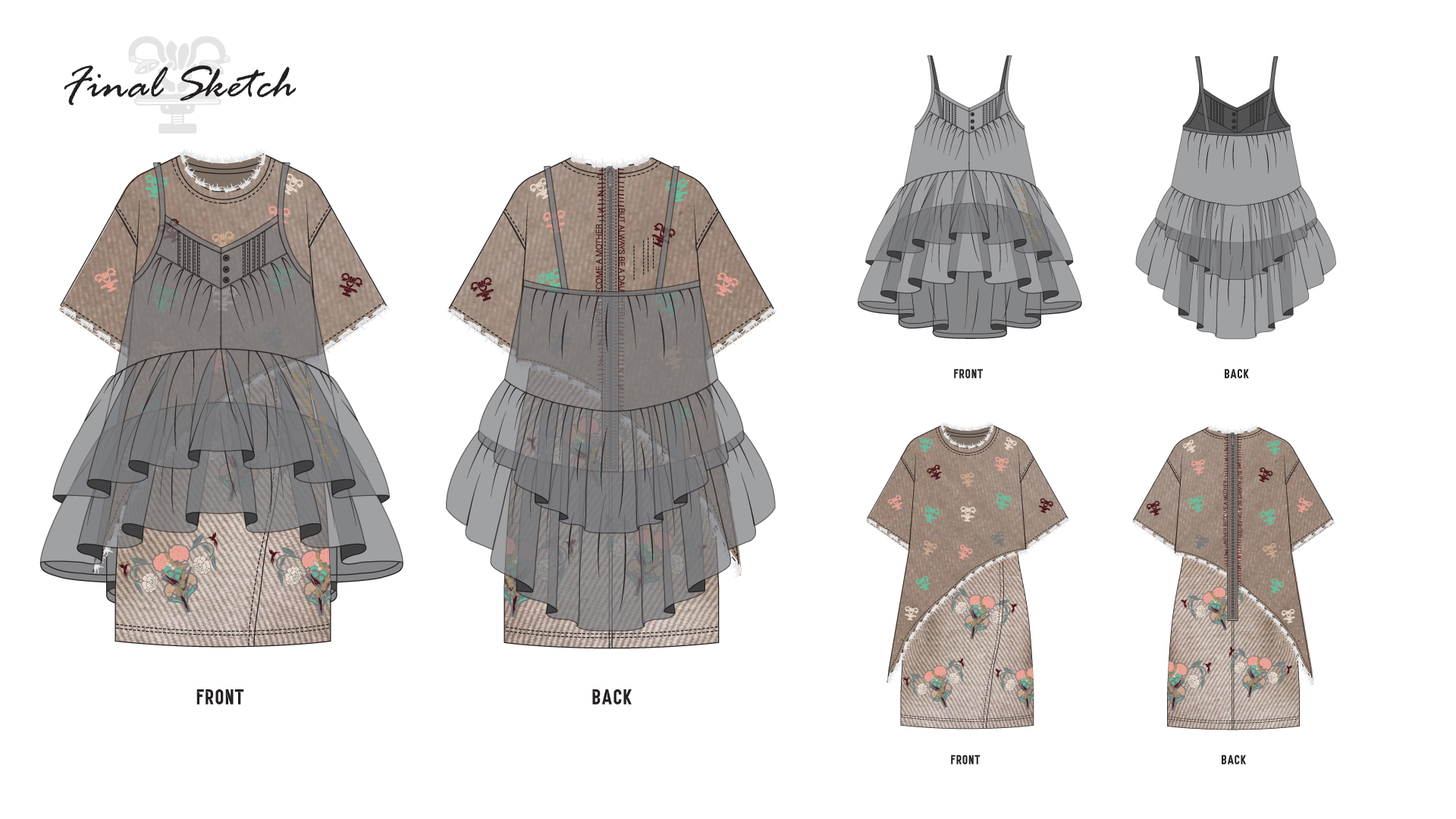
The concept translates into four design directions (Seivewright, 2012). First, silhouette: asymmetric forms and seams cutting across the midsection, expressing interrupted inheritance. Second, colour scheme: Skin & Void tones – nude, blush, bone white and sand dominate at 50–60%; medical tones of steel grey and surgical green make up 20–25%; Scar & Trace tones of maroon, dried blood, and rust serve as 10–15% accents; and faded gold print represents Voice. All colours stay desaturated to evoke fading memory, except the deliberately vivid scar accents. Third, detail and technique: print interview text in faded gold as a trace of voice, prints interpreting the womb and an impossible motherhood, a transparent swelling belly structure standing in for an absent organ, and exposed seams with repurposed medical hardware, treating the surgical scar as structure rather than concealment. Fourth, fabric: washed denim pieced with cotton, edges left frayed to suggest a severed lineage, layered under a soft mesh ruffled skirt swelling at the belly.
The collection does not reconstruct pregnancy, an impossibility, but records the distance between what was told and what the body will never feel, echoing Hirsch’s claim that postmemory is an imaginative act that knows it can never be complete.
Process / Methodology :
This research adopts a Practice-based Research methodology, in which knowledge is generated through an actual design-making process alongside theoretical synthesis. The study unfolds across five phases.
Phase 1: Literature & Theoretical Review
This phase reviews Marianne Hirsch’s concept of postmemory (2008) alongside the medical concept of phantom memory (Brainerd et al., 2003), synthesizing them into a case-specific theoretical framework, “Postmemory of an Impossible Future,” which serves as the foundation for all subsequent stages.
Phase 2: Data Collection: In-depth Interview
An in-depth interview is conducted with the researcher’s mother, focusing on her feelings at the moment she first recognized her own motherhood and on her bodily experience during pregnancy. The interview is recorded as a verbatim transcript to preserve her original voice and wording for later use in the design process, such as printed text.
Phase 3: Concept Translation
The interview content is analyzed through thematic coding to extract key themes, which are then mapped onto four conceptual pillars; Silhouette, Colour, Detail & Technique, and Material. Each theme is translated into tangible design language through a moodboard and the concept.
Phase 4: Design Development
This phase includes ideation and sketching of multiple silhouette and structural options; material experimentation, such as leaving fabric edges frayed, printing text in faded gold, and testing boning structures with transparent fabric; toile fitting using muslin to verify proportions before final cutting; and final prototyping, constructing the actual garment using the specified materials; washed denim, mesh, and repurposed zipper.
Phase 5: Reflection & Evaluation
The completed work is evaluated against the initial conceptual framework, examining whether the design elements successfully communicate “the distance between what was told and what the body will never feel.” A reflective journal is maintained throughout the process to support analysis in the research’s concluding discussion.
Techniques and Materials :
Techniques
The collection employs five core techniques that translate the postmemory concept into the physical form of the garment.
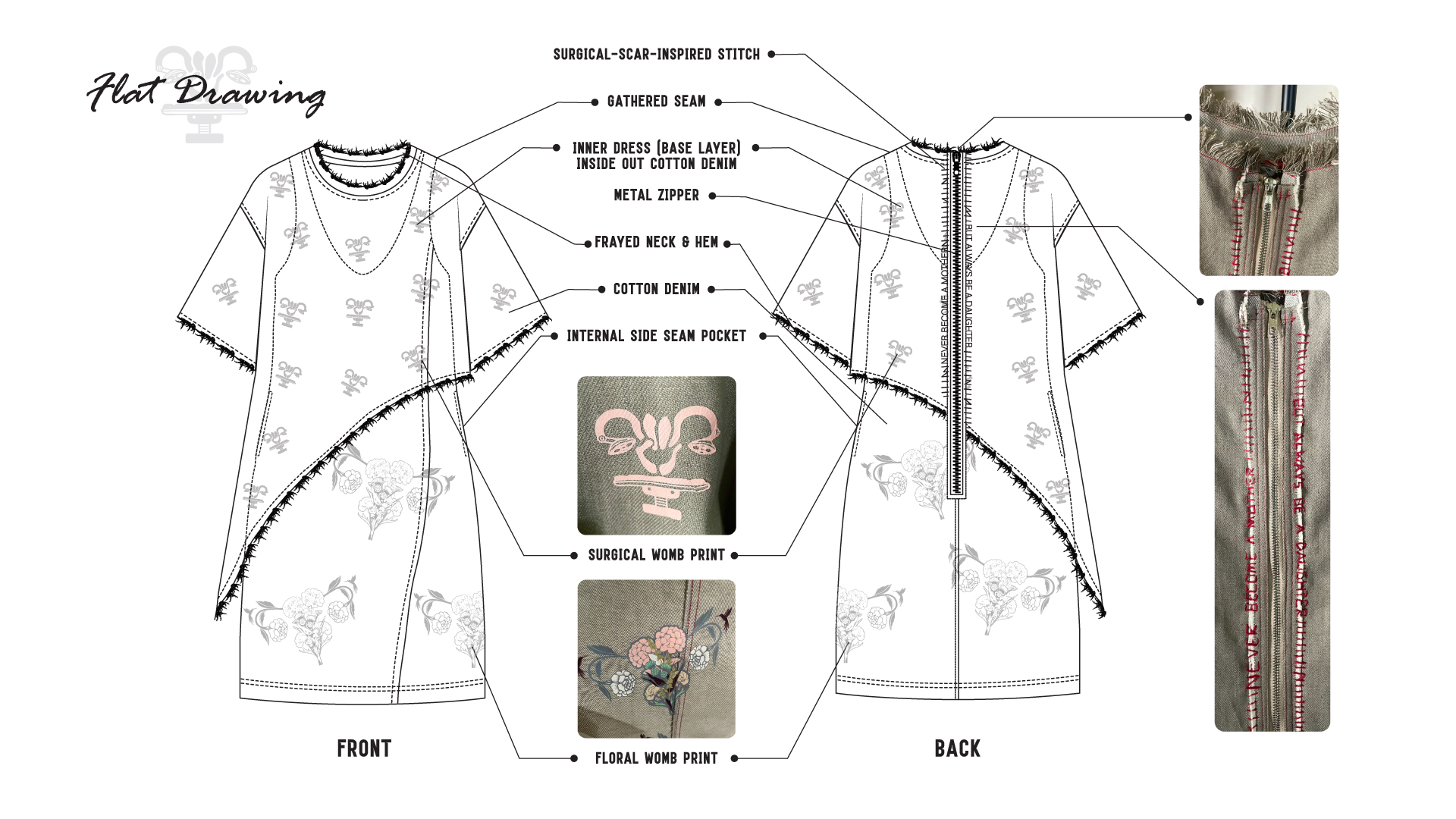
1) Raw-edge construction on denim
The washed denim is left with naturally frayed, unfinished edges at the seams of the asymmetric silhouette, expressing a line of inheritance cut off mid-way rather than a neat, complete ending.
2) Surgical-scar-inspired detailing
Decorative stitch lines in red tones are worked across the fabric, spaced irregularly to mimic medical suturing, representing the hysterectomy scar as part of the garment’s structure rather than something to be concealed.
3) Creative womb-inspired print
An abstract print interpreting the form of the womb is combined with visual elements suggesting a motherhood that could never occur, rendered using screen-printing technique.
4) Printed text from the mother’s testimony
Selected a passage from the interview is printed onto soft mesh fabric in faded gold colour, using free-motion fonts so the lettering appears uneven, like handwriting, representing the mother’s voice as a point of memory with no visual evidence to support it.
5) Inside-out seam construction
Seams are sewn in reverse, exposing the threads and lining normally hidden inside the garment, paired with contrasting topstitching. This expresses the idea that processes or traces usually kept hidden, such as surgery, should instead be seen and accepted as part of the structure of life, rather than disguised.
Together, these five techniques work to translate abstract memory, voice, and loss into tangible surface, structure, and detail on the garment itself.
Materials
Washed denim, soft mesh, Scar red thread and repurposed metal zipper
Result / Conclusion :
This research successfully developed and applied a case-specific theoretical framework, “Postmemory of an Impossible Future,” extending Marianne Hirsch’s concept of postmemory beyond the inheritance of past trauma to encompass the inheritance of a possibility permanently foreclosed to the recipient’s own body. By anchoring memory transmission in voice rather than photography, and by drawing on the medical concept of phantom memory, the study demonstrated that oral testimony can function as an equally potent, if more ephemeral, point of memory, one that demands imaginative reconstruction precisely because it leaves no visual trace.
The resulting collection, “Her Voice, My Absent Body,” translates this theoretical position into a coherent design language across four pillars: silhouette, colour, detail and technique, and material. The asymmetric, interrupted silhouette embodies inheritance cut short; the desaturated Skin & Void, Clinical, and Scar & Trace palette renders memory as something faded yet still marked by pain; the embroidered testimony, womb-inspired print, transparent swelling belly structure, and exposed surgical-style seams give physical form to voice, absence, and scar as structural rather than concealed elements; and the raw-edged denim and mesh construction reinforces a lineage that is pieced together yet visibly severed.
Evaluated against the initial conceptual framework, the garment succeeds in communicating not the experience of pregnancy itself, but the distance between a mother’s told memory and a daughter’s embodied absence. Each technique, from raw-edge fraying to inside-out seaming, consistently reinforces the central thesis that what is usually hidden, whether a scar or a silence, can instead be structurally foregrounded and honoured rather than disguised.
Beyond its practical output, this research contributes theoretically by proposing that postmemory can extend into the register of the future, not only the past, and methodologically by offering a replicable process for translating oral testimony and bodily loss into fashion design. Future work could expand this framework to other forms of foreclosed inheritance, infertility, chronic illness, or migration, and explore how creative womenswear, as a genre rooted in visibility and self-expression, can continue to serve as a vehicle for articulating experiences that resist conventional representation
References :
Brainerd, C. J., Payne, D. G., Wright, R., & Reyna, V. F. (2003). Phantom recall. Journal of Memory and Language, 48(3), 445–467. https://doi.org/10.1016/S0749-596X(02)00501-6
Hirsch, M. (2008). The generation of postmemory. Poetics Today, 29(1), 103–128. https://doi.org/10.1215/03335372-2007-019
Rajendran, M. (2012). The development of streetwear and the role of New York City, London, and Supreme NY. Development, 1, 1-2012.
Seivewright, S. (2012). Basics fashion design 01: Research and design (2nd ed.). AVA Publishing SA.