Coated Memory: Translating an Inherited Salted-Egg Practice into Packaging as a Carrier of Postmemory
Faculty of Fine and Applied Arts, Thammasat University, Thailand
Asst. Prof. Dr. Teerasak Sakon
Abstract :
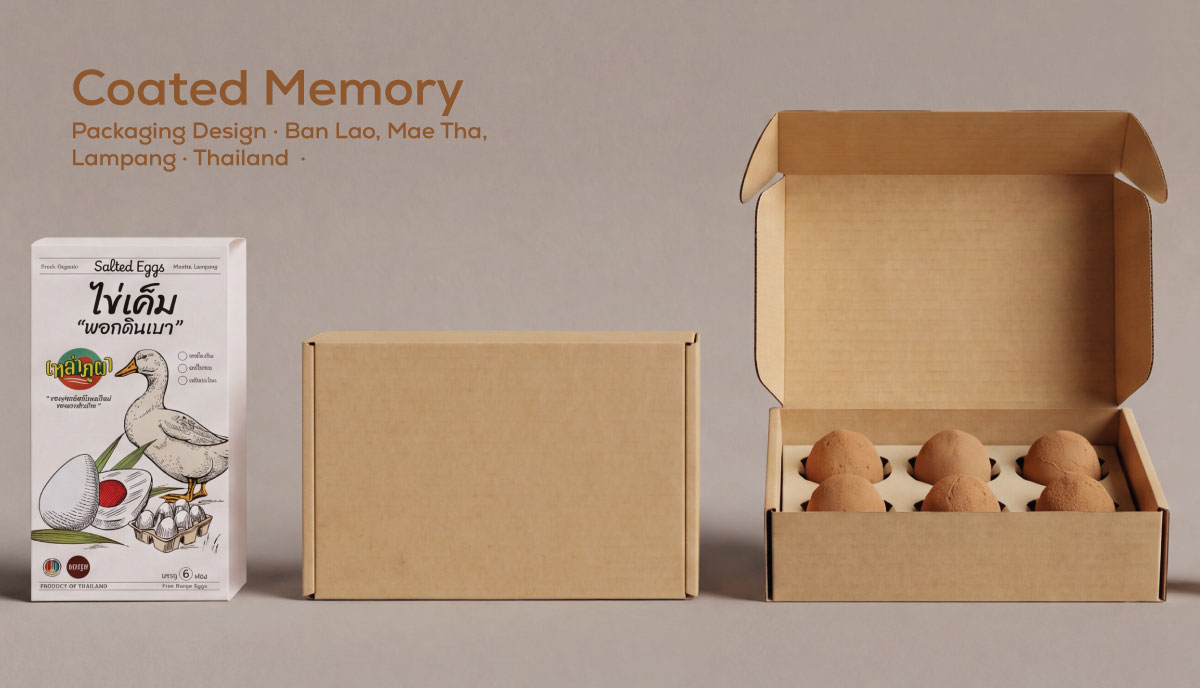
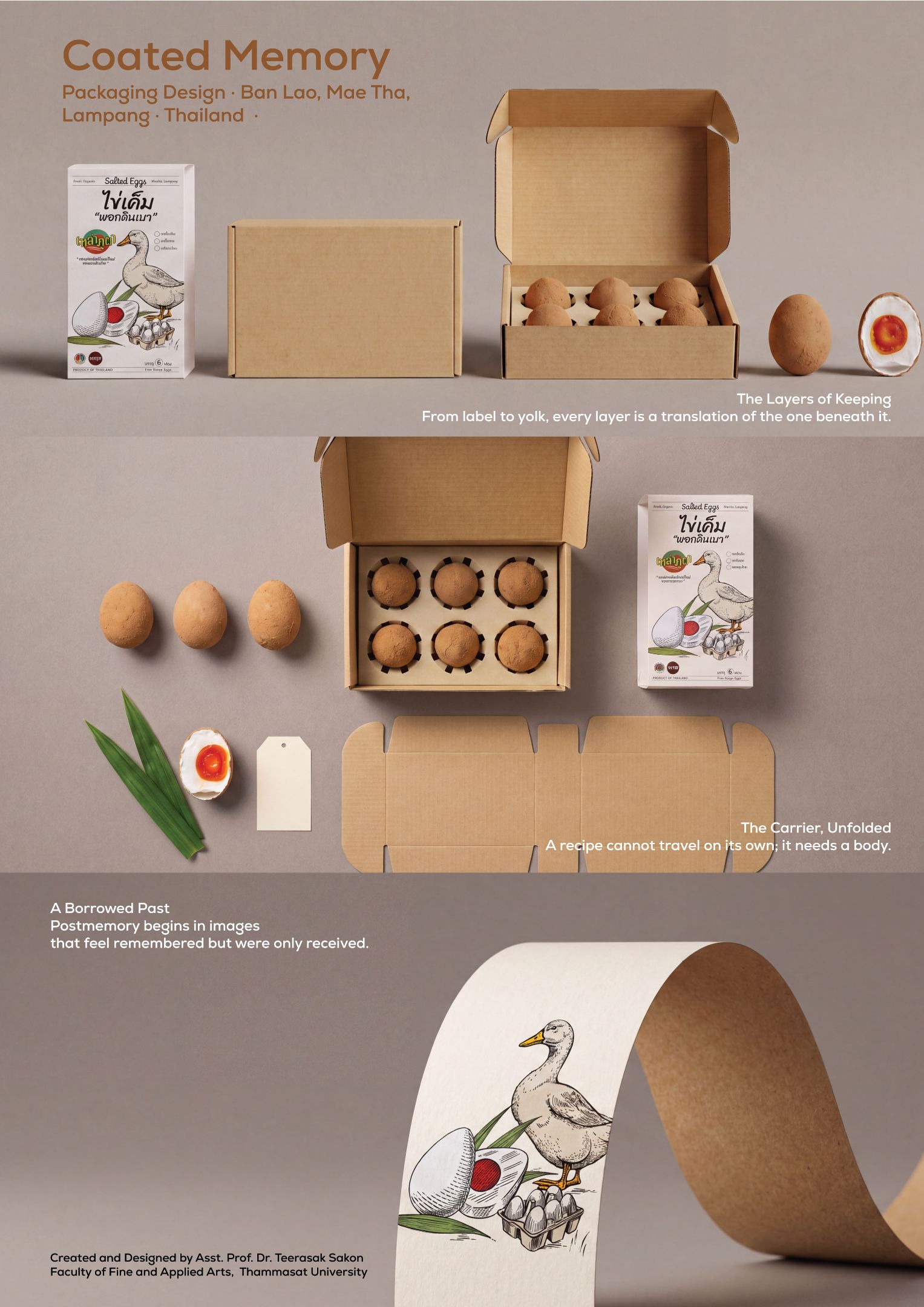
Coated Memory is a packaging design project developed with the Ban Lao Housewives Economic Revival Community Enterprise in Mae Tha District, Lampang, Thailand. The community preserves duck eggs by coating them in diatomaceous clay, a practice passed down through generations of local households. In 2025, under the OTOP product development programme for Quadrant D groups of the Lampang Provincial Community Development Office, the group reformulated its recipe into a lighter-salted, pandan-scented egg, and the designer created a recycled kraft flip-top carton for six eggs together with an engraving-style label depicting a duck, a halved egg and a paper egg tray.
The creative work revisits this completed package through the lens of postmemory, the term Marianne Hirsch uses for the relationship that later generations hold with experiences they did not live but received through images, stories and objects. The project argues that food packaging is one of the most ordinary carriers of such inherited experience. A buyer who has never visited Ban Lao encounters the village only through the carton, and the designer, too, drew on a nineteenth-century engraving vocabulary that belongs to a past he never lived.
To make this transmission visible, the work treats the package as a series of coatings: the yolk as the recipe of an earlier generation, the clay as the act of preserving, the carton as the object that travels, the engraving as a borrowed visual past, and the photograph as memory received at a distance. The core of the new work is a sequence of five generations of the original vector label. With each generation, colour, then line, then contour are removed through a fixed and reproducible procedure, until only the red yolk remains.
The presentation combines the original product photograph, studio views and the five-generation label sequence. The project proposes that packaging can be read as a medium of memory translation, and that the method is transferable to other community products whose value depends on inherited knowledge.
Objectives :
First, it aims to reinterpret a completed community package as a creative work that addresses the theme of postmemory. The original carton was designed to solve practical problems of the Ban Lao community enterprise: protecting six clay-coated eggs, allowing easy carrying, and communicating freshness, free-range farming and safety to buyers. This project asks what else the package carries beyond these functions, and proposes that it carries a transmitted form of local memory that reaches people who have never taken part in the practice of coating eggs in clay.
Second, it aims to make the process of transmission visible. Memory that passes from one generation to another is never delivered whole; it is simplified, reframed and partly lost. The project gives this process a visual form by producing five generations of the original label artwork, each derived from the one before by removing a defined layer of information. The sequence allows viewers to see how a detailed image can shrink into a single symbol and still hold meaning.
Third, it aims to examine the role of borrowed visual styles in community packaging. The label uses an engraving style associated with European print culture of the nineteenth century. This style gives a new product the appearance of age and inheritance. The project asks viewers to consider how designers construct a sense of the past that neither they nor the buyer experienced directly, and how this constructed past is received as authentic.
Conceptual Framework :
The work is built on Marianne Hirsch’s concept of postmemory, which describes how the experiences of one generation are received by the next through images, objects and stories rather than through direct recollection (Hirsch, 2008, 2012). Hirsch emphasises that such memories are mediated and reconstructed; they are powerful precisely because they are inherited at a distance. The project extends this idea from family photographs to an everyday commercial object.
Three further ideas support the framework. Jan Assmann’s account of cultural memory explains how practices and forms are stabilised and passed on through material carriers (Assmann, 2011). Paul Connerton’s study of how societies remember highlights bodily and habitual practices, such as preparing food, as vehicles of memory (Connerton, 1989). Svetlana Boym’s distinction between restorative and reflective nostalgia helps to read the engraving style on the label as a designed longing for a past that is imagined rather than recovered (Boym, 2001). Arjun Appadurai’s work on the social life of things supports the view that an object changes meaning as it moves from producer to buyer (Appadurai, 1986).
From these sources, the project defines the package as five layers of transmission: yolk (origin), clay (practice), carton (carrier), engraving (image) and photograph (reception). Each layer is a translation of the one beneath it. The five-generation label sequence turns this translation into a visible process, in which loss is not a failure but the condition under which memory continues to travel.
Process / Methodology :
The project was carried out in four stages.
Stage 1: Field context and original design (2025). The designer worked with the Ban Lao community enterprise within the OTOP product development programme for Quadrant D groups. The group’s knowledge of clay-coated salted eggs and its new pandan-scented recipe were documented. The designer then developed a recycled kraft flip-top carton with a carrying handle for six eggs, a neutral cream colour scheme, and an engraving-style label showing a duck, a halved egg, grass and an egg tray. The package was produced and delivered to the community. Permission to use the design in this creative work was obtained from the community.
Stage 2: Layer analysis (2026). The completed package was analysed as a set of coatings around the egg: yolk, clay, carton, engraving and photograph. This analysis became the structure for the presentation boards.
Stage 3: Five-generation label sequence (2026). The original vector artwork was processed through a scripted procedure with fixed parameters so that the result is reproducible. Generation I is the label as printed, with institutional logos removed. Generation II removes the green and gold colour layers and the brand mark. Generation III removes about 45 percent of the remaining line elements. Generation IV removes about 85 percent. Generation V keeps only the red yolk. All remaining elements stay as editable vectors.
Stage 4: Photography and presentation (2026). The designer photographed the finished carton. Additional studio views were produced with AI-assisted image tools, using only the designer’s own photograph and original label artwork as references, and are declared in Section 8. The final presentation consists of one cover image and four content images in a restrained studio-grey layout.
Techniques and Materials :
Packaging design and mixed digital techniques. The physical package consists of a recycled kraft paperboard flip-top carton with a carrying handle, a kraft paperboard insert holding six clay-coated salted eggs in black paper cups, and a printed white paperboard label box. The label artwork was developed as an engraving-style vector illustration in Adobe Illustrator. The five-generation label sequence was produced by processing the original vector file with a Python script using fixed, reproducible parameters that remove colour, line and contour layers step by step. The finished carton was documented through digital photography. Additional studio views were produced with AI-assisted image tools (Magnific, Nano Banana Pro, 4K), using only the designer’s photograph and original label artwork as references. Final layouts were composed in Adobe Illustrator.
Result / Conclusion :
The result is one cover image and four content images. Image 1, The Layers of Keeping, presents the label box, the closed and opened cartons, a clay-coated egg and a halved egg in a single studio lineup. Image 2, The Carrier, Unfolded, lays out the carton, its flat die-cut net, loose eggs and pandan leaves. Image 3, A Borrowed Past, shows the engraving-style illustration printed on a curling paper strip. Image 4 presents the five-generation label sequence, the central creative contribution of the project.
The five-generation sequence shows that a label can lose most of its information and still be recognised through one element, the red yolk. This supports the project’s central claim: what survives transmission is not the full image but the symbol that a community and its buyers have learned to read. In the language of postmemory, the yolk becomes the point where an inherited practice is still felt by people who never took part in it.
The project also shows that community packaging can be a site of critical reflection, not only a commercial tool. By describing the carton as layers of translation, the work offers designers a way to discuss how they construct the past for local products, and offers communities a way to see what their packaging carries beyond price and product information.
The method is reproducible and transferable. Future work will test the same five-layer framework with other Lampang community products and in design studio teaching, where students can repeat the procedure and compare how different products lose and keep their memory.
References :
Appadurai, A. (Ed.). (1986). The social life of things: Commodities in cultural perspective. Cambridge University Press.
Assmann, J. (2011). Cultural memory and early civilization: Writing, remembrance, and political imagination. Cambridge University Press.
Boym, S. (2001). The future of nostalgia. Basic Books.
Connerton, P. (1989). How societies remember. Cambridge University Press.
Hirsch, M. (2008). The generation of postmemory. Poetics Today, 29(1), 103–128. https://doi.org/10.1215/03335372-2007-019
Hirsch, M. (2012). The generation of postmemory: Writing and visual culture after the Holocaust. Columbia University Press.
Share :
Facebook
Twitter
LinkedIn
WhatsApp
Email
Print