Echoes of Thin Shell: Reinterpreting Architectural Memory through Parametric Synthesis
Faculty of Architecture, Rangsit University, Thailand
Asst. Prof. Apiwat Pattanasirimongkol
Abstract :
Apiwat“Khurusamanakarn” is a reinforced-concrete thin-shell structure in the form of a hyperbolic paraboloid, located at Rajamangala University of Technology Isan and standing for more than 66 years. Its remarkable architectural form, together with spaces for meetings, performances, and student activities, has allowed the building to accumulate experiences and meanings that have been passed from one generation to the next. Just as knowledge and experience are transmitted from earlier generations for later generations to reinterpret and develop, architecture from the past can likewise convey its concepts, formal principles, structural logic, and construction processes for contemporary reinterpretation.
This project asks how parametric design can serve as a medium for transmitting and reinterpreting such architectural memory. Rather than preserving the original form as a fixed image, the project transforms the memory of “form” into a set of geometric and spatial rules for exploring alternative architectural configurations.
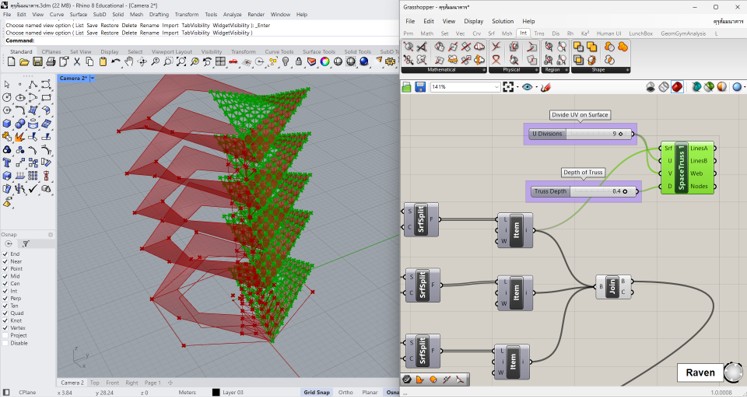
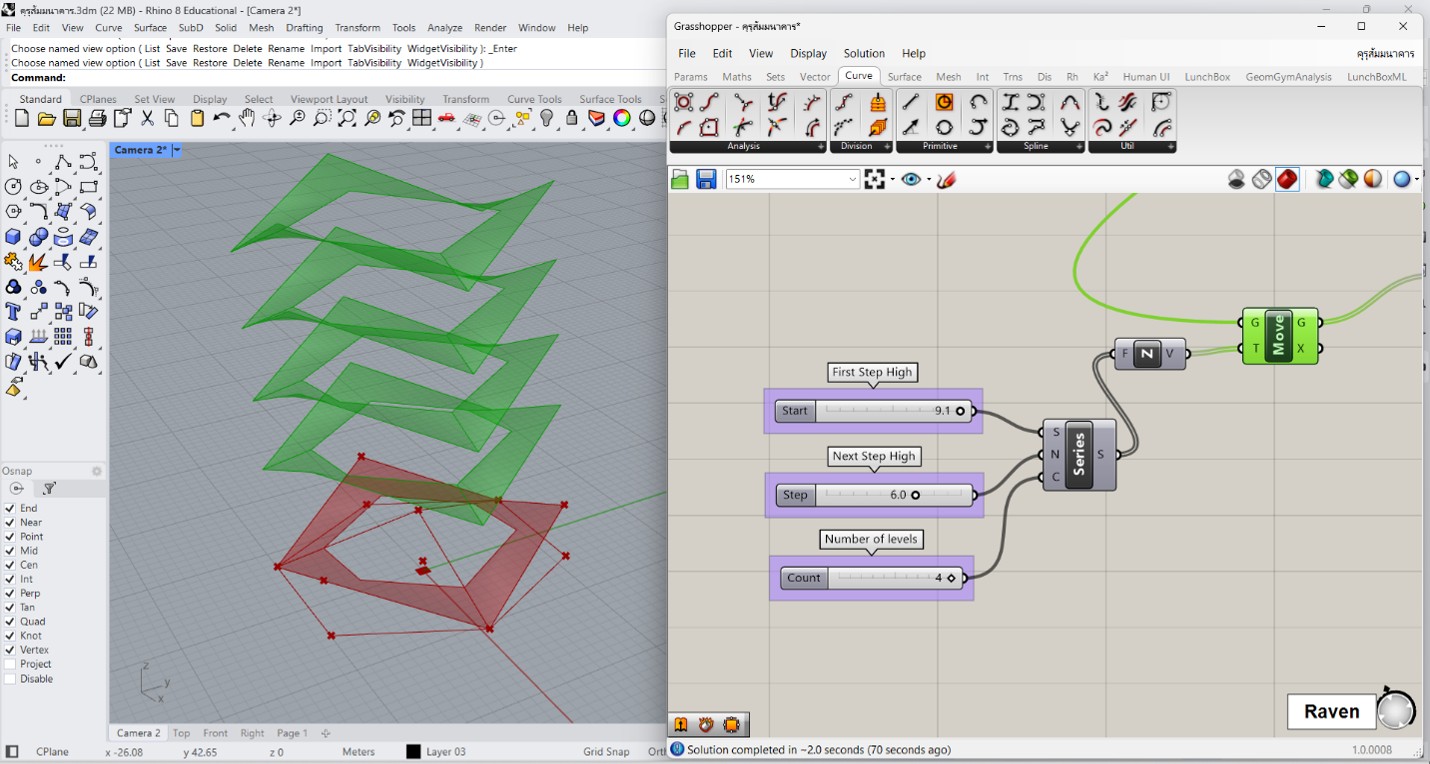
“Echoes of Thin Shell” is a parametric definition developed from the architectural memory of Khurusamanakarn. It extracts key characteristics of the original building, including its hexagonal geometry, hyperbolic paraboloid form, structural logic, and spatial openness, and translates them into adjustable parameters through Grasshopper in conjunction with Rhinoceros. These parameters include the width of the hexagon, with the height of the hyperbolic paraboloid adjusting proportionally; the number of stacked levels and the height between them; building rotation; the depth of the space-frame system and member sizes; and the proportion of enclosed wall area.
Three representative variations were compared qualitatively in terms of formal composition, spatial enclosure, and structural configuration. The comparison demonstrates how parameter adjustments generate distinct configurations while retaining the essential hexagonal and hyperbolic paraboloid geometry. The translation is documented through a table of inherited characteristics and a parameter hierarchy. The proposed space-frame reinterpretation remains conceptual and requires further structural and environmental evaluation.
“Echoes of Thin Shell” therefore presents a reusable form-generating system through which architectural memory can be reinterpreted rather than replicated.
Objectives :
This creative work aims to investigate how parametric design can serve as a medium for transmitting, reinterpreting, and transforming architectural memory from the past into a flexible design system, using “Khurusamanakarn” as the primary architectural precedent for the study.
Khurusamanakarn is characterized by its hexagonal geometry, reinforced-concrete thin-shell structure in the form of a hyperbolic paraboloid, spatial openness, and environmental responsiveness through natural ventilation. Rather than replicating or preserving the original form as a fixed image, this work seeks to identify the underlying logic of the precedent and translate that logic into a set of rules, relationships, and adaptable variables.
- The main objectives are as follows: To analyze the formal, structural, spatial, and environmental characteristics of Khurusamanakarn in order to identify the elements that constitute its architectural identity.
- To translate these elements into a parametric definition developed using Grasshopper in conjunction with Rhinoceros.
- To experiment with adjustable variables, including the size of the hexagon, number of levels, spacing between levels, building rotation, space-frame depth, member size, and proportion of wall area, in order to explore alternative architectural configurations and examine their formal, spatial, and structural characteristics.
The work distinguishes the geometric characteristics retained from the precedent from those that can be transformed. It then examines three representative configurations through a preliminary qualitative comparison of their formal composition, spatial enclosure, and structural expression. This exploration focuses on the capacity of the parametric system to generate variations, rather than on developing a site-specific architectural proposal or evaluating structural, environmental, and functional performance. The findings are therefore interpreted as design exploration rather than performance validation.
The overarching goal is to demonstrate that architectural memory can be transmitted not only through the preservation of original form, but also through the continuation of its underlying logic, rules, and design system, allowing it to be reinterpreted and further developed over time.
Conceptual Framework :
Architectural memory is not limited to the preservation of an original form; it can also be transmitted through a design system that allows reinterpretation and further development. “Echoes of Thin Shell” adopts this idea as the conceptual framework for studying Khurusamanakarn, viewing the building’s key characteristics—including its hexagonal geometry, hyperbolic paraboloid surface, structural logic, and passive design principles—as components of architectural memory. These characteristics are then translated into rules, relationships, and variables within a parametric definition, allowing the resulting forms to adapt to different contexts and contemporary needs while maintaining a recognizable connection to the original architectural precedent.
Process / Methodology :
The process began with a study of Khurusamanakarn through historical data, photographs, and architectural documentation in order to analyze its key characteristics in terms of form, structure, spatial organization, and environmental responsiveness (สิงห์น้อย, 2017; พระวงค์, 2551; FOTO-MOMO, 2020). These characteristics were then translated into rules, relationships, and variables for developing a parametric definition using Grasshopper in conjunction with Rhinoceros.
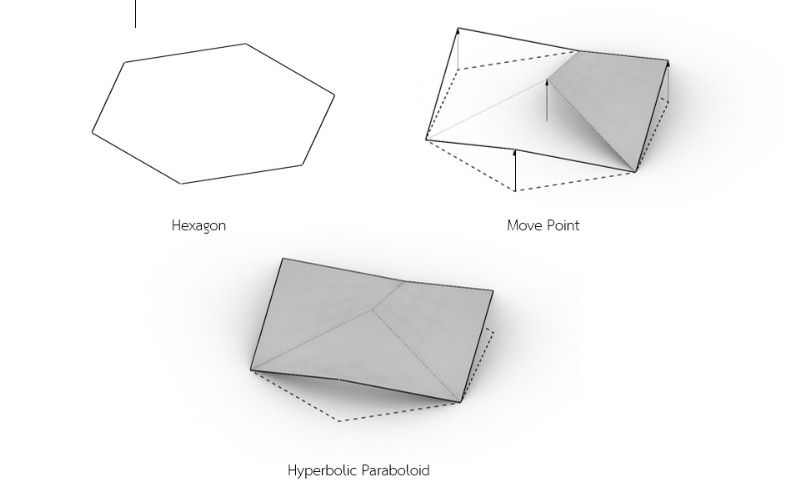
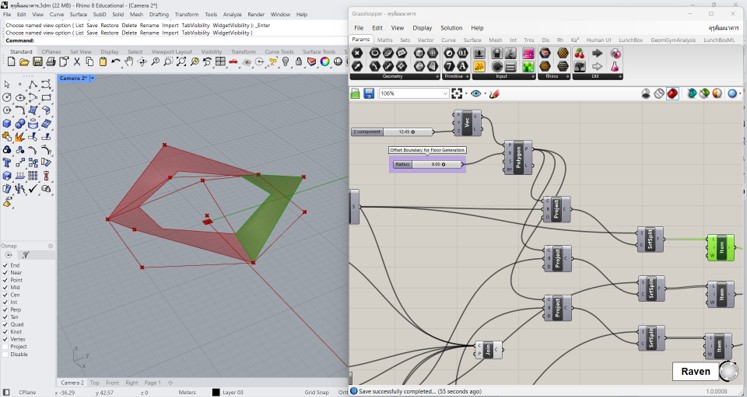
The system began with a hexagonal geometry and the definition of high and low points to generate a hyperbolic paraboloid surface. It was then extended through additional parameters, including overall size and proportion, number of levels, spacing between levels, rotation and orientation, space-frame depth, member size, and wall-area proportion.
The principal form-generating rules are: (1) retain the six-sided geometric basis; (2) define high and low points to construct a hyperbolic paraboloid surface; (3) adjust stacking and rotation; (4) generate the space-frame geometry; and (5) control the degree of wall enclosure.
Although thin-shell architecture is not limited to reinforced concrete, the curved geometry of the original structure can be reinterpreted through a space-frame system configured as a reticulated shell. This approach can preserve the visual character of a thin shell while offering alternative structural and construction possibilities. Prefabricated hollow tubular members may reduce structural self-weight compared with reinforced concrete, subject to structural verification. Such a dry-assembly system could also accommodate various roofing and flooring materials. Furthermore, MERO-type ball-node connections offer potential advantages in modular assembly, maintenance, and localized member replacement. However, the suitability of these materials and connections requires further structural evaluation and detailed design.
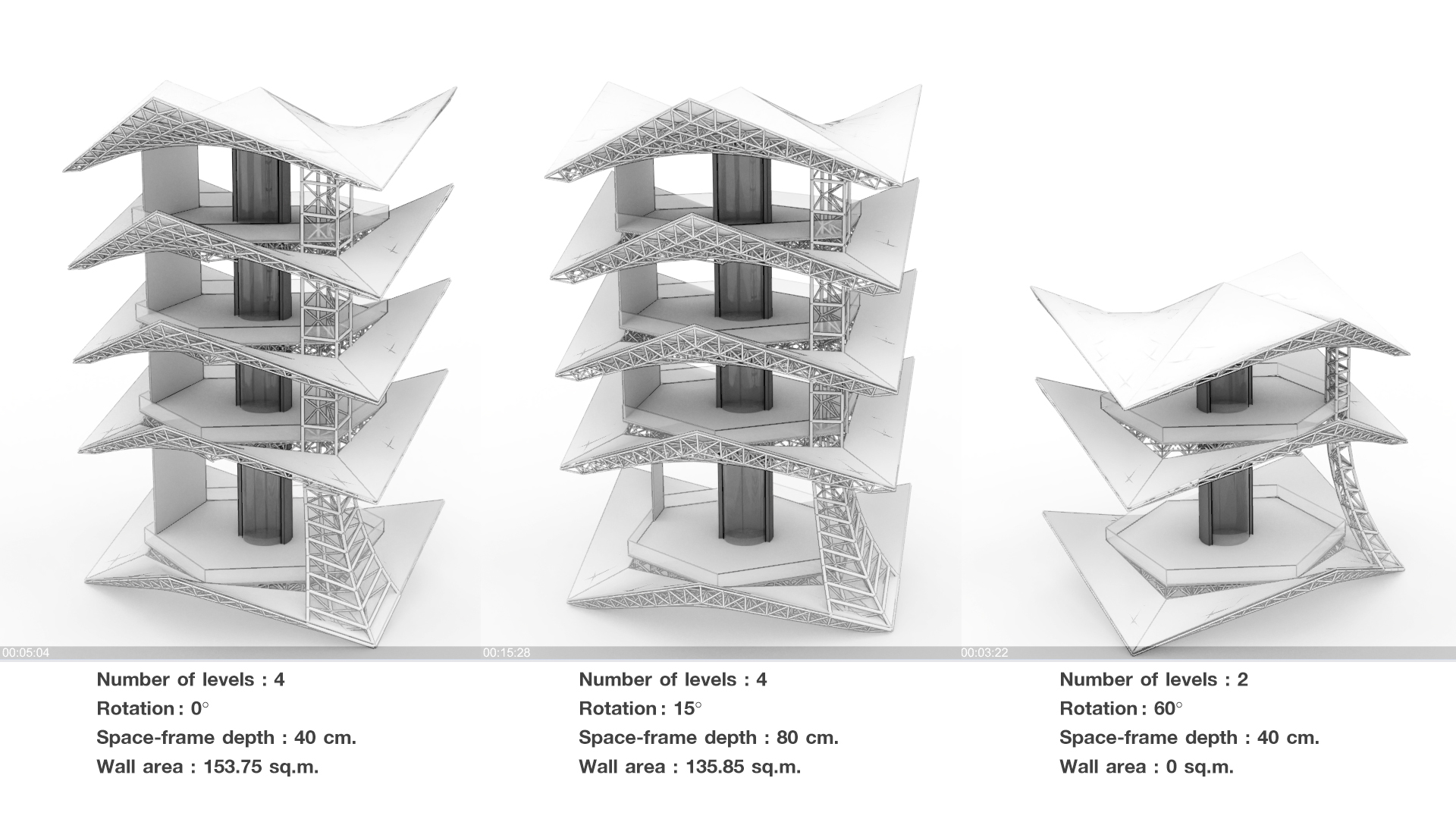
Following the development of the parametric definition, three representative architectural variations were selected to examine how changes in the number of levels, rotation, space-frame depth, and wall area affect architectural form and spatial characteristics. These variations were compared in terms of formal composition, spatial openness, enclosure, and structural configuration. The comparison serves as a preliminary qualitative evaluation of the system’s form-generating potential and its ability to maintain a recognizable connection to the architectural identity of Khurusamanakarn, rather than as a detailed structural or environmental performance assessment.
AI-generated prompts must be indicated below.
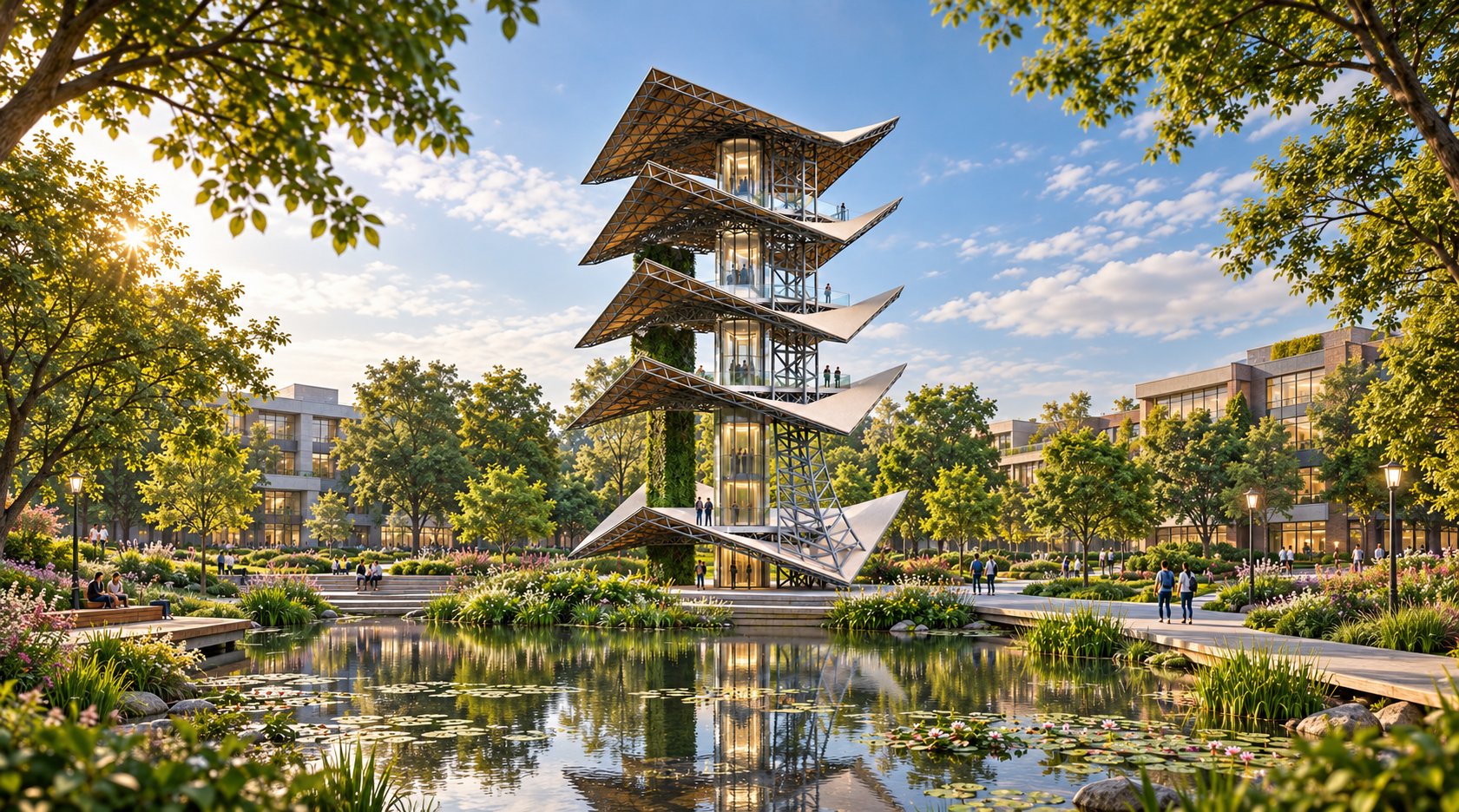
Edit the provided architectural rendering by adding trees, people, and a small number of surrounding low-rise buildings. Keep the central core of the building as a glass elevator. Enhance the image to create a visually appealing educational campus atmosphere with abundant greenery and a pond.
Generate another perspective of the same design while maintaining the same campus atmosphere, including trees, people, a pond, and a limited number of low-rise surrounding buildings. Preserve the glass elevator core and the overall architectural character.
Techniques and Materials :
Result / Conclusion :
The result of “Echoes of Thin Shell” is a parametric definition developed not as a proposal for a single architectural form, but as a system capable of generating multiple architectural configurations while maintaining a recognizable relationship with the key characteristics of Khurusamanakarn.
The system allows the adjustment of variables including overall size, hyperbolic paraboloid proportions, number of levels, spacing between levels, building rotation, structural depth, member size, and wall-area proportion. These parameters enable the exploration of different architectural forms and spatial configurations.
The comparative study of three representative variations reveals distinct architectural qualities. The first variation maintains a vertically aligned, four-level composition with the greatest wall area. The second variation introduces a 15-degree rotation and increases the space-frame depth, creating a more articulated structural expression. The third variation reduces the number of levels to two and eliminates wall enclosure, producing a more open, pavilion-like spatial character. These variations demonstrate how changes in parametric settings influence formal composition, spatial enclosure, and structural configuration.
At this stage, the design remains at a preliminary level and is intended for further development, particularly in relation to structural performance, material selection, and spatial functionality. Studies on gridshell design and GFRP elastic gridshell structures offer points of reference for future investigations into structural systems and materials (Bruno et al., 2023; Kookalani & Aung, 2023). The exploration of vertically stacked hyperbolic paraboloid forms also reveals rhythmic layering, projecting edges, and tiered spatial arrangements that create a visual association with certain characteristics of traditional Asian architecture.
The results demonstrate that architectural memory does not need to be preserved solely through physical conservation or the replication of an original form. It can also be transmitted through rules, relationships, and computational processes. “Echoes of Thin Shell” therefore proposes a shift from architecture as an “object” to architecture as a “form-generating system” that can be adapted, transformed, and further developed over time, allowing architectural values from the past to remain active and open to reinterpretation.
References :
ASA CREW. (2017, July–August). คุรุสัมมนาคาร มหาวิทยาลัยเทคโนโลยีราชมงคลอีสาน จังหวัดนครราชสีมา. ASA CREW, 5(5), 24–25.
Bruno, L., Gabriele, S., Grande, E., Imbimbo, M., Laccone, F., Marmo, F., Mele, E., Raffaele, L., Tomei, V., & Venuti, F. (2023). Exploring new frontiers in gridshell design: The FreeGrid benchmark. Structures, 58, 105678. https://doi.org/10.1016/j.istruc.2023.105678
Díaz Valdés, M., & Geremia, L. C. (2026). Geometric and sustainable analysis of the hyperbolic paraboloid of Félix Candela’s concrete shell structures. Journal of Construction Engineering Innovations and Research, 3(1). https://doi.org/10.37155/3060-8716-3-1-2
FOTO-MOMO. (2020, May 24). Kurusammanakarn. https://foto-momo.com/kurusammanakarn/
Kookalani, S., & Htayaung, H. (2023). GFRP elastic gridshell structures: A review of methods, research, applications, opportunities, and challenges. Journal of Civil Engineering and Materials Application, 7(2), 71–94. https://doi.org/10.22034/jcema.2023.401834.1111
พระวงค์, ส. (2551). คุรุสัมมนาคาร. วารสารอาษา, 06:51–07:51.
Share :
Facebook
Twitter
LinkedIn
WhatsApp
Email
Print