Cyanomotion - Sk8Style
Gisela Anindita, and Sebastian Advent / Indonesia

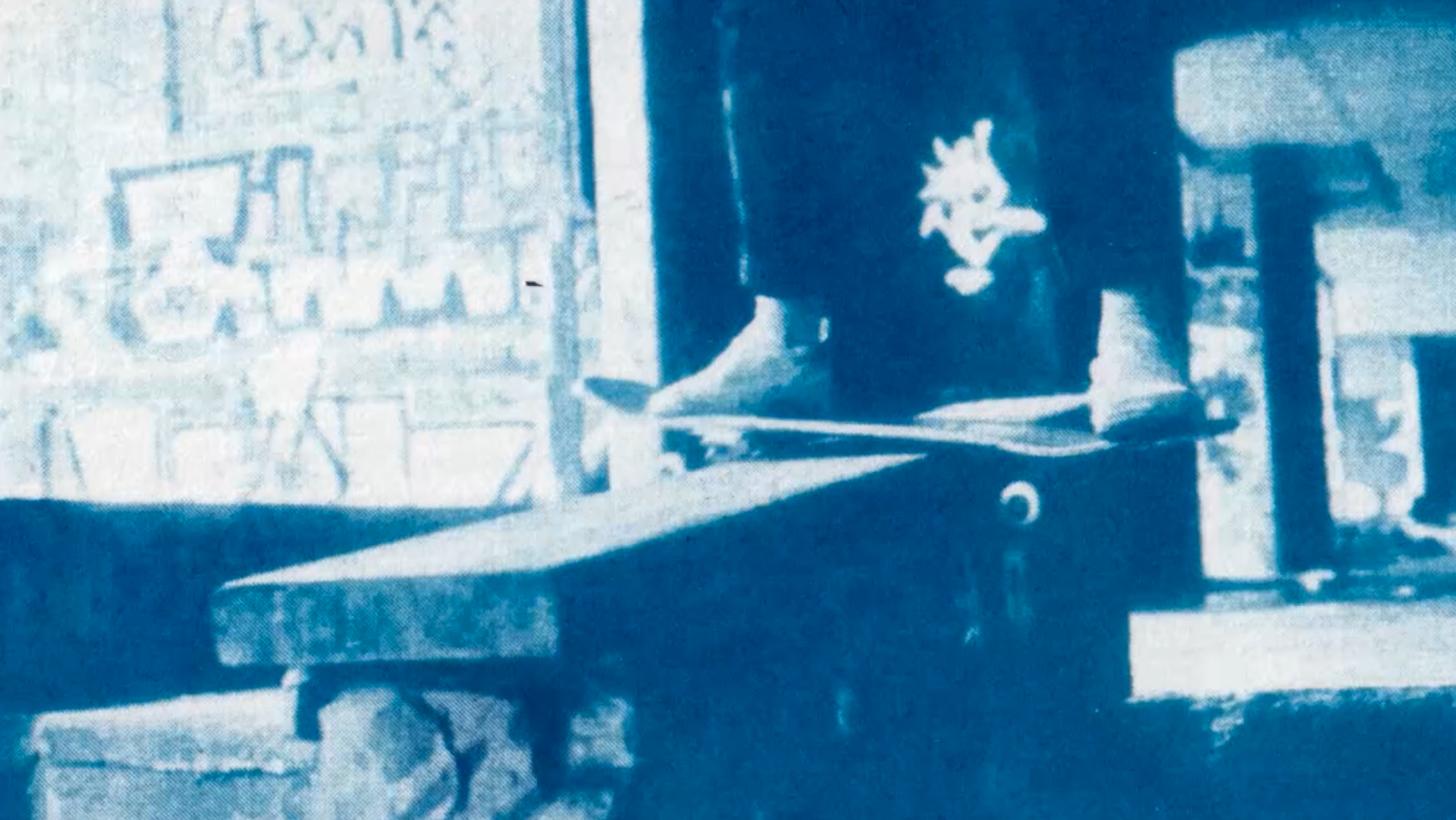
This work explores cyanotype, a nineteenth-century alternative photographic printing process, as a medium for stop-motion animation. The animation runs for approximately 20 seconds at 12 frames per second and is composed of 250 single frames, each produced as an individual cyanotype print. Cyanotype is commonly associated with contemplative still images. This project tests whether a process that is slow, manual, and sensitive to environmental conditions can support repetitive production that demands visual consistency from frame to frame.
The emphasis lies on technical execution and experimentation. Every frame follows the same sequence: mixing and coating the sensitizer onto paper, UV exposure, washing, and drying. The solution is prepared from ferric ammonium citrate at 20 g/100 ml and potassium ferricyanide at 10 g/100 ml. This ratio is slightly lower than the classic formula, an adjustment made because chemicals are difficult to source locally, so material limitation becomes part of the experiment. Producing 250 sheets demands procedural discipline. Variables such as coating thickness, exposure time, and paper absorbency are closely observed because they affect the depth of the Prussian blue, tonal gradation, and sharpness of detail. A difference barely visible on a single sheet becomes a flicker when the frames play in sequence.
Once dry, each print is scanned individually and reassembled digitally into a moving image sequence. This process brings together two opposing qualities: slow, hand-made work that can never be fully controlled, and the continuous rhythm of digital animation. Inconsistencies between prints, such as tonal variation, traces of coating, and paper fiber texture, are not treated as failures. They become the visual character that distinguishes this work from the seamlessness of digital animation.
Through this work, cyanotype is extended from a medium of still images into a medium of moving images, opening new possibilities for experimental print practice. The result is an animation that carries the traces of hand, light, and time in every frame.
Share :
Facebook
Twitter
LinkedIn
WhatsApp
Email
Print