Skull Beat
Faculty of Digital Art, Rangsit University, Thailand
Chinatip Tangsiripat

Abstract :
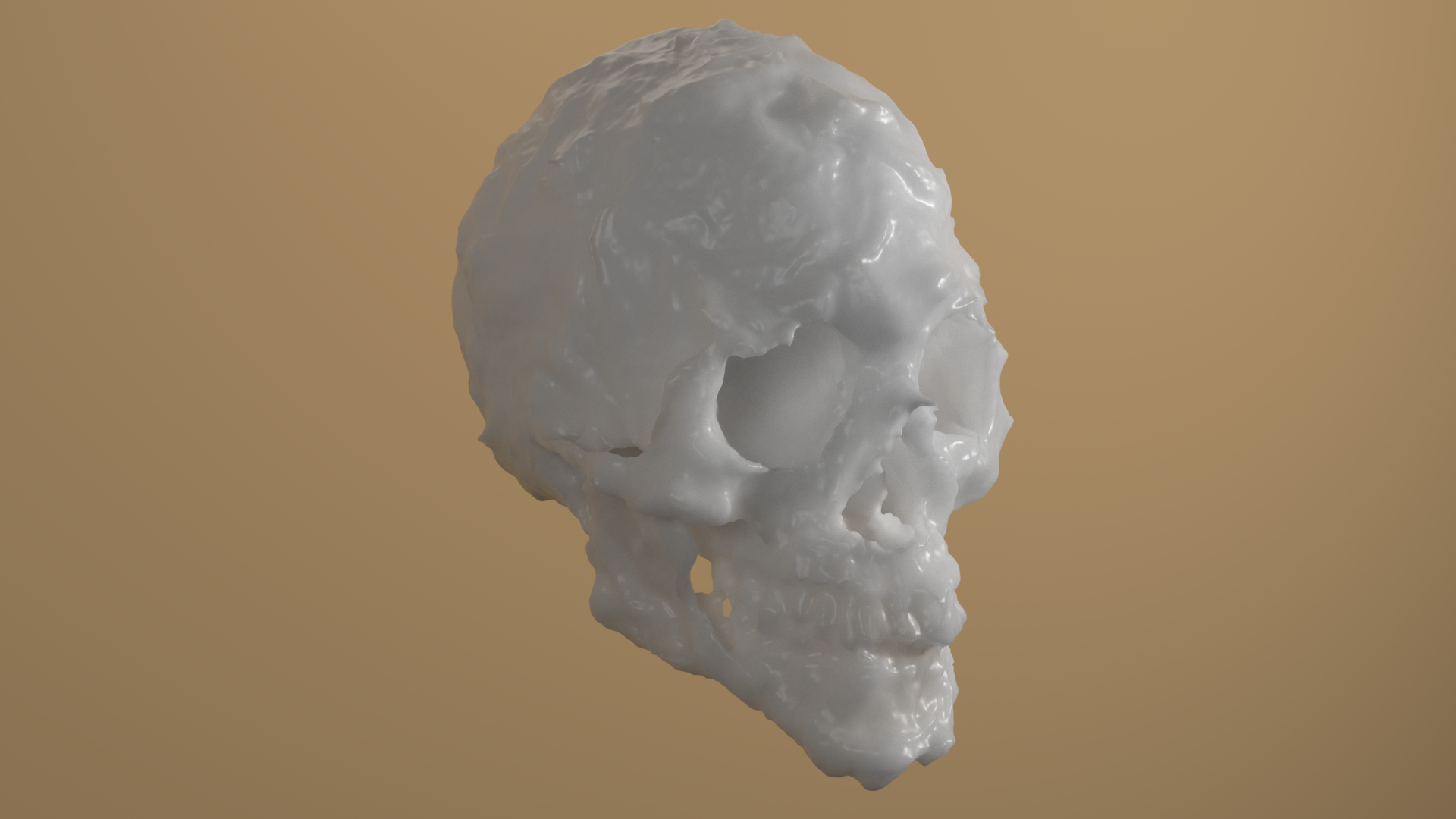
This video artwork presents a three-dimensional rendered animation in which a human skull, composed entirely of simulated fluid, repeatedly disperses and reforms in a continuous rhythmic cycle. Created in SideFX Houdini using the FLIP (Fluid-Implicit Particle) solver, the work treats liquid not as a transparent, familiar element but as a living body. Every two seconds, a noise-driven force is introduced into the simulation, causing the fluid to burst outward from the skull. As the force subsides, the liquid is gradually drawn back toward its original shape, reconstructing the skull until the next impulse arrives. Two ideas shape the work. First, the skull stands for the human being. Rather than appearing as clear water, the fluid is given a white subsurface scattering (SSS) material that simulates how light penetrates and diffuses beneath human skin. The result is a surface that behaves like water but glows like flesh, positioned between the anatomical and the elemental, the living and the dead. Second, the recurring burst functions as a heartbeat. The two-second interval, noticeably slower than a resting human pulse, stretches the familiar rhythm of life into something more deliberate and contemplative, allowing the viewer to observe each moment of rupture and recovery in detail.
Drawing on the memento mori tradition, in which the skull reminds the viewer of mortality, the work reinterprets this symbol through the logic of simulation. Here the skull is not a fixed relic of death but an unstable form that must be continuously rebuilt. Because fluid behaves chaotically, no two cycles are ever exactly alike; each re-formation carries subtle traces of the disturbance that preceded it. The work thus proposes that human identity is not a permanent structure but a dynamic equilibrium, sustained through rhythm, repetition, and constant renewal.
Through this project, the artist explores how physically based simulation, commonly used as a technical tool in visual effects production, can become an expressive medium for addressing questions of life, fragility, and impermanence.
Objectives :
The primary aim of this work is to investigate how a physically based fluid simulation can be shaped into a visual metaphor for the human condition. The project is guided by the following objectives: To represent the human being through the symbolic form of the skull. The skull is one of the most endur-ing images of human identity and mortality in art history. By constructing it from fluid rather than bone,
the work seeks to present the human being as something soft, changeable, and alive, rather than as a static remnant of death.
- To translate the rhythm of the heartbeat into visual motion. The periodic burst every two seconds is designed to evoke the pulse of a living body. By slowing this rhythm, the work aims to make the viewer conscious of a process that is usually felt rather than seen, and to invite a meditative mode of viewing.
- To explore the tension between order and chaos. Each cycle moves from a recognizable form to dispersal and back again. The objective is to examine how identity can be maintained through a balance of disruptive and restorative forces, and to visualize the fragile moment at which a form is on the verge of dissolving.
- To experiment with material as a carrier of meaning. Applying a white subsurface scattering material to a liquid challenges the viewer’s expectation of water as clear and reflective. This objective focuses on how a shading decision can shift the perceived identity of a substance from element to body.
- To demonstrate the artistic potential of simulation technology. Tools such as the FLIP solver in Houdini are primarily developed for realism in film and visual effects. This project aims to reposition them as instruments of artistic expression, showing how simulation parameters such as force, timing, and noise can be composed with the same intention as brushstrokes or sound.
Together, these objectives frame the work as both a technical investigation and a contemplative reflection on life, fragility, and renewal.
Conceptual Framework :
This work is built on three interrelated ideas: the skull as the human being, water as the body, and the pulse as time.
The Skull as the Human Being. In the memento mori and vanitas traditions, the skull reminds the viewer that all life is finite. This work retains that symbolic weight but alters its material logic. The skull is given a white subsurface scattering material that recalls human skin, yet lacks the warmth of blood. It therefore occupies an ambiguous state, neither fully alive nor entirely dead.
Water as the Body. The human body is composed largely of water, and life depends on its con-stant circulation. By forming the skull from liquid, the work suggests that the self is not a solid object but a fluid arrangement, held together only temporarily by the forces acting upon it.
The Pulse as Time. The heart alternates between systole, when it contracts and expels blood, and diastole, when it relaxes and refills. The work translates this cycle into motion: the noise-driven burst corresponds to systole, and the gradual re-formation of the skull corresponds to diastole. Set at a two-sec-ond interval, slower than a resting heart rate, the pulse transforms a biological rhythm into a measure of contemplation.
Together, these ideas frame the human being as a form that exists only through continuous re-newal, in which every loss of shape is followed by an effort to become whole again.
Process / Methodology :
The work was produced entirely in SideFX Houdini through five main stages.
- Form preparation. A three-dimensional skull model was converted into a volumetric signed distance field (SDF) using VDB. This volume served two purposes: it defined the initial body of fluid, and it acted as the target shape to which the fluid would return.
- Fluid simulation. The skull volume was filled with particles and simulated using the FLIP solver. A custom attraction force, calculated from the SDF, continuously pulled stray particles back into the skull volume, allowing the liquid to hold a recognizable form while still behaving as water.
- Pulse control. A time-based expression triggered an impulse every two seconds. At each trigger, a noise-driven velocity field was added to the simulation while the attraction force was momentarily weakened, causing the fluid to burst outward. The attraction was then gradually restored, drawing the liquid back into the shape of the skull. Adjusting the noise amplitude, frequency, and the rate of recovery allowed the character of each “heartbeat” to be refined.
- Surfacing. The resulting particles were converted into a polygonal surface through VDB-based meshing, with filtering and smoothing applied to retain fine splashes while producing a clean, continuous skin.
- Look development and rendering. The surface was assigned a white subsurface scattering material, with scattering depth tuned so that light appeared to glow from within, similar to human skin. Lighting was designed to emphasize this translucency, and the sequence was rendered using a physically based renderer.
Techniques and Materials :
Result / Conclusion :
The result is a rendered video in which a luminous white skull repeatedly bursts apart and re-forms at a steady two-second rhythm. The subsurface scattering material gives the liquid a soft, flesh-like glow, so the skull reads less as bone or water and more as a living body caught between states. The slowed pulse creates a calm yet tense viewing experience: each burst arrives with a sense of inevitability, and each recovery invites the viewer to wait for the form to become whole again.
Because the simulation is driven by physical forces rather than fixed keyframes, every cycle unfolds with subtle variations in splash, flow, and surface detail. This quality reinforces the central idea of the work, that life is not a static state but a rhythm of loss and recovery, and that identity is continually reconstructed rather than simply preserved.
In conclusion, the project demonstrates that FLIP fluid simulation, typically employed to achieve realism in visual effects, can function as an expressive artistic medium. By combining a symbolic form, a meaningful material choice, and a rhythmic structure derived from the heartbeat, the work transforms
a technical process into a meditation on mortality and renewal. It also suggests further possibilities for artistic research in which simulation parameters such as force, timing, and turbulence are treated as compositional elements, opening new ways for digital artists to explore the relationship between the body, time, and impermanence.
References :
Share :
Facebook
Twitter
LinkedIn
WhatsApp
Email
Print