KATA DARI RUMAH (Words From Home)
Faculty of Art and Design, Universitas Multimedia Nusantara, Indonesia
Ghossan Handaru, Biyane Kalyca, and Grace Joycelyn
Abstract :
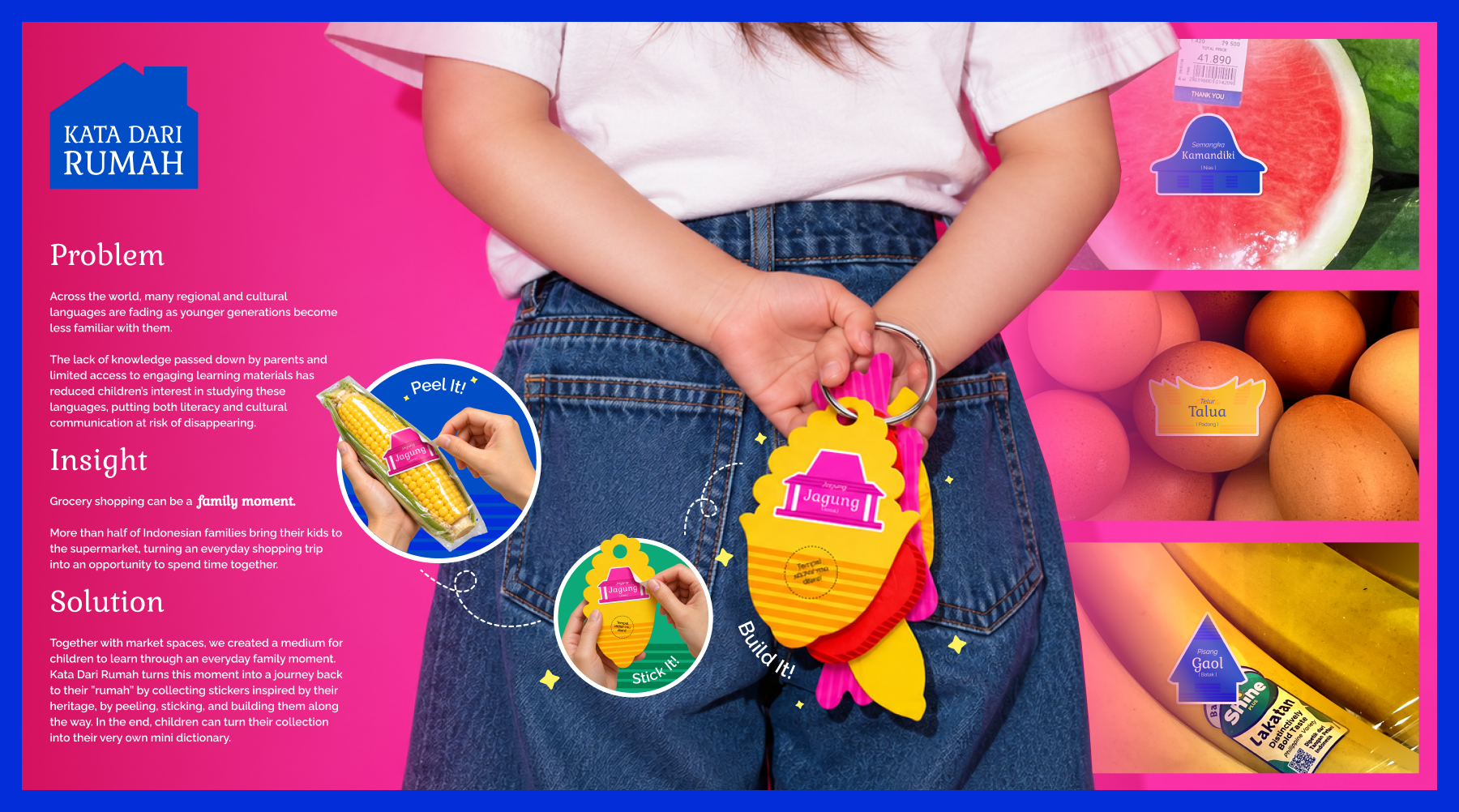
Indonesia is home to 718 local languages, making it one of the most linguistically diverse countries in the world. However, many of these languages are gradually disappearing as younger generations become less familiar with their linguistic heritage. The lack of knowledge passed down within families, combined with limited access to engaging learning materials has reduced children’s interest in learning these languages, putting both literacy and cultural communication at risk of disappearing. As fewer children encounter these languages in their daily lives, local languages risk becoming history rather than living forms of communication, which can lead to a weakened cultural identity.
KATA DARI RUMAH (WORDS FROM HOME) explores how a simple design intervention can encourage not only families but also a wide audience to reintroduce local languages and reconnect children with their linguistic heritage through everyday interactions and daily activities. The project is based on past studies that has shown parents, family members, and close social environments play an important role in shaping children’s attitude towards maintaining local languages, while the declining use of local languages within households contributes to language shift among younger generations. Rather than positioning language learning as a formal educational activity, the project integrates it into a familiar activity for children: grocery shopping. This activity has the potential to facilitate informal learning and intergenerational interaction.
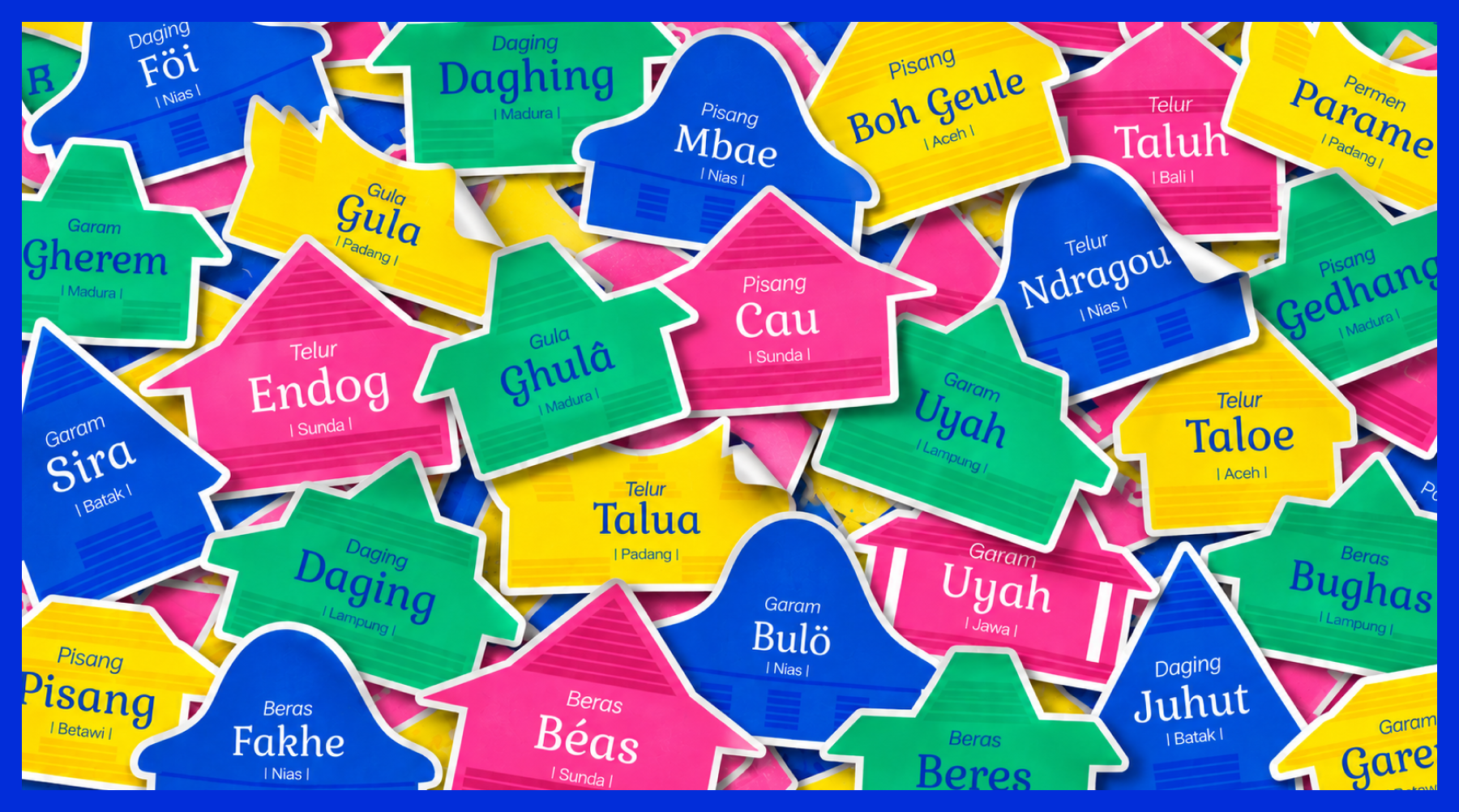
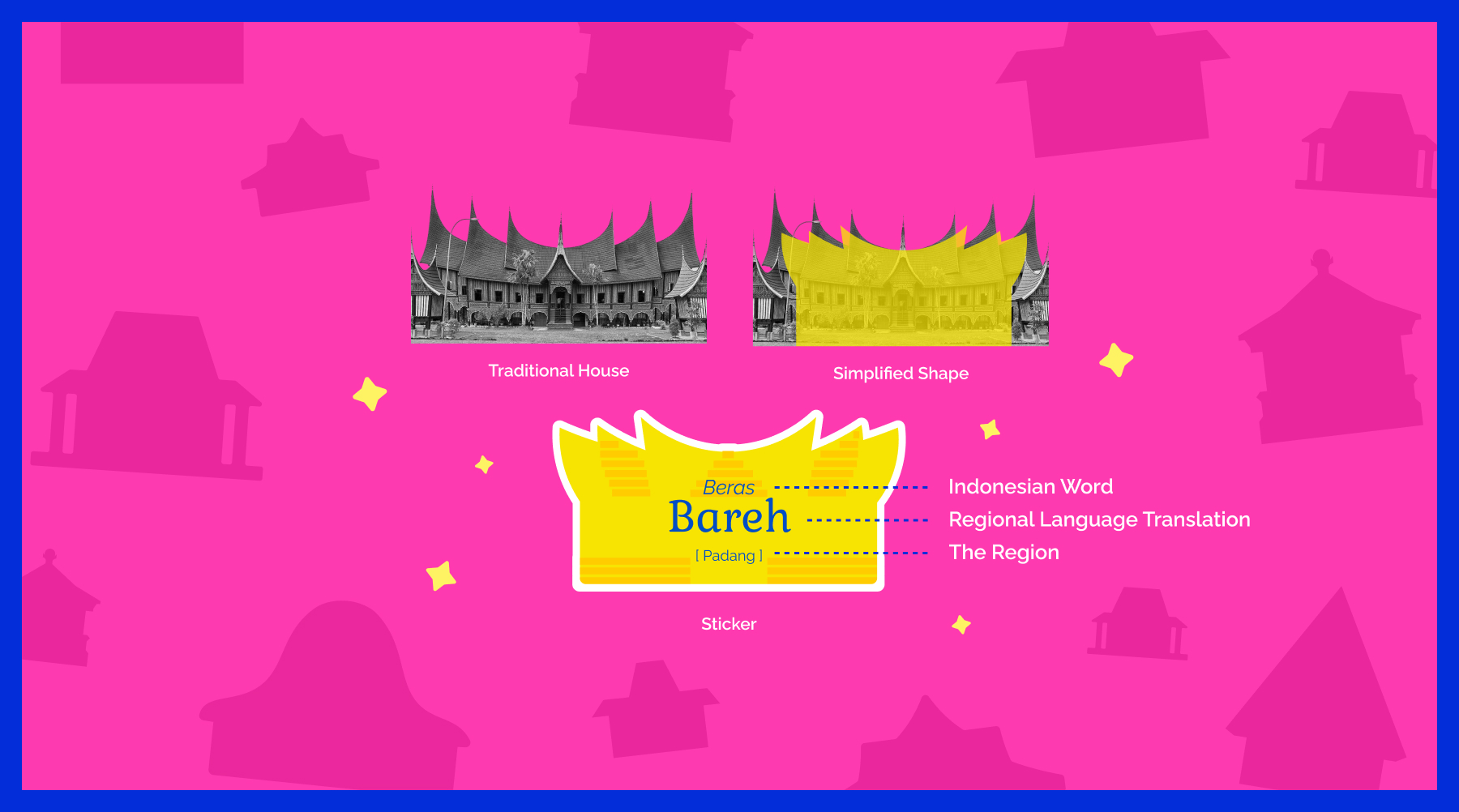
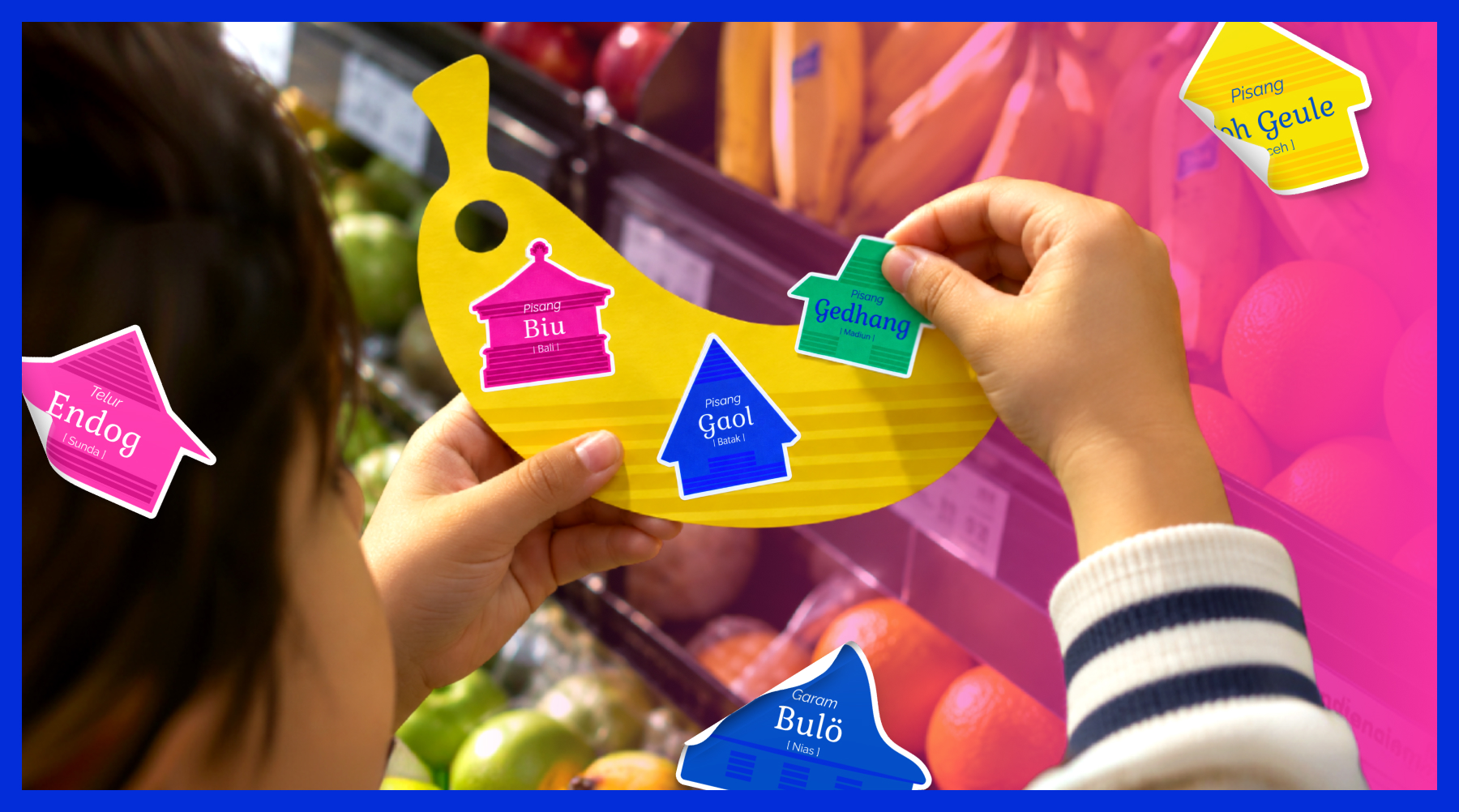
In collaboration with supermarkets, collectible vocabulary stickers shaped like traditional Indonesian houses are placed on selected everyday products throughout the store. As children search for the stickers, they are introduced to local language vocabulary associated with familiar objects. The collected stickers can be built into a mini dictionary, transforming the shopping journey into an interactive learning experience.
By embedding language learning into daily activities, KATA DARI RUMAH creates opportunities for intergenerational knowledge sharing and cultural recall. The project demonstrates how ordinary commercial spaces can become platforms for preserving linguistic heritage and fostering cultural continuity. Through small moments of participation and conversation, children are encouraged to reconnect with their local languages and carry fragments of their cultural heritage into the future.
Objectives :
The objective of KATA DARI RUMAH is to create accessible and engaging learning opportunities that encourage children to reconnect with their heritage language through everyday interactions and activities. Rather than focusing solely on language acquisition, the project aims to encourage children to develop a greater curiosity and appreciation for the languages and cultural heritage connected to them. By making local language more approachable and relevant to their everyday experiences, KATA DARI RUMAH seeks to create a learning experience that children can engage with naturally.
KATA DARI RUMAH also aims to encourage children to become more actively involved in discovering and understanding local language. The project seeks to support a learning experience where children can encounter new vocabulary, explore its meaning, and develop familiarity with the language through participation. Through this approach, language learning can become more engaging and memorable, while allowing children to build a personal connection with the words and cultural meanings they encounter.
Another objective of KATA DARI RUMAH is to encourage knowledge sharing between children and the people around them. The project aims to involve not only parents and family members, but also friends and the wider community in encouraging children to engage with local language. By creating opportunities for conversation and shared learning, the project seeks to make language preservation a collective experience rather than a responsibility placed solely on the family. These interactions can also provide opportunities for different generations to exchange knowledge and recall cultural meanings that may otherwise become less familiar to children.
Furthermore, KATA DARI RUMAH aims to extend opportunities for cultural learning beyond formal education. The project seeks to demonstrate how everyday experiences can support informal learning and encourage children to engage with their heritage in ways that feel accessible and relevant to their lives. KATA DARI RUMAH aims to strengthen children’s connection with their linguistic and cultural heritage while encouraging local languages to remain part of everyday communication. Through greater curiosity, participation, and intergenerational knowledge sharing, the project seeks to contribute to cultural continuity and help local languages remain living forms of communication for future generations.
Conceptual Framework :
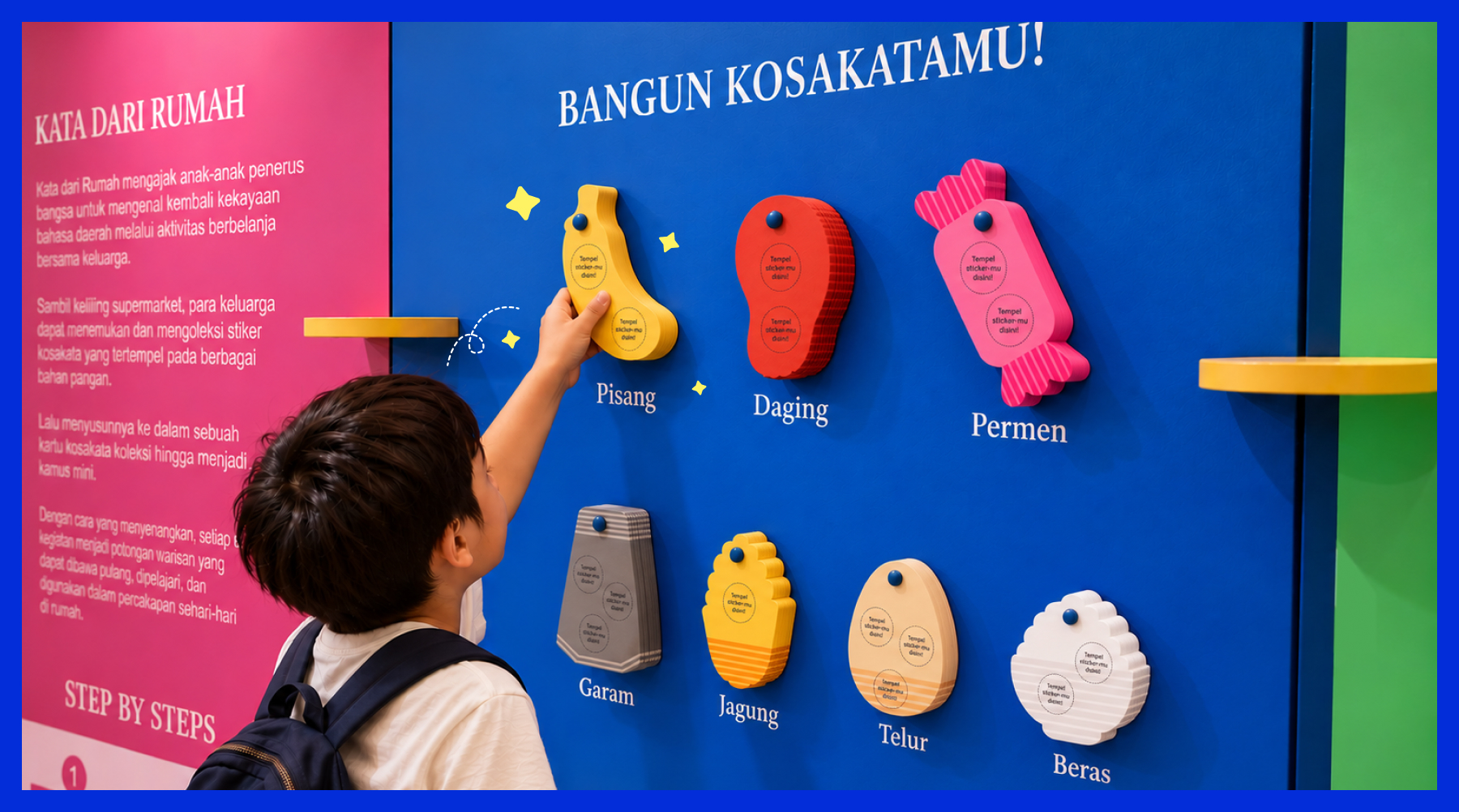
The project builds on children’s natural tendency to learn through play and exploration. Through a playful learning experience, children can search for stickers featuring regional word translations, placed on everyday goods. They can then peel, stick, and build the stickers to create their own mini dictionary.
The supermarket serves as a familiar environment where children can encounter these words while exploring everyday products. By turning grocery shopping into interactive learning, the project introduces language through play and everyday experiences. The collected stickers also encourage children to engage with the vocabulary beyond the store by building their own mini dictionary. Through this approach, the project aims to increase children’s curiosity, exposure and understanding of their linguistic heritage.
Process / Methodology :
The design process of KATA DARI RUMAH (WORDS FROM HOME) uses a Human-Centered Design approach adapted from IDEO’s seven phases of design thinking (IDEO, n.d.).
1. Frame the Question
Identifying decreasing familiarity towards Indonesia local languages among younger generations and exploring how they could encounter them through everyday experiences.
2. Gather Inspiration
Research, observation, and interviews were conducted to gather information about local languages and children’s understanding towards their linguistic heritage.
3. Synthesize for Action
Previous research found that parents play an important role in regional-language maintenance (Handini, 2022). These findings led to the decision to use the home and family environment as the context for introducing regional language.
4. Generate Ideas
The team explored different ways to make language-learning playful by including the use of familiar objects and supermarket environments as ways to introduce regional words. This led to the concept of Kata dari Rumah (Words from Home) as something close to everyday life.
5. Make Ideas Tangible
The concept was developed through local language stickers shaped as the designated Indonesian traditional houses, complete with 3D POP media supporting the campaign.
Techniques and Materials :
Result / Conclusion :
KATA DARI RUMAH (WORDS FROM HOME) shows that preserving regional languages can begin through everyday experiences rather than separate educational spaces. By re-introducing linguistic heritage to children through familiar objects and daily activities, the project creates opportunities for children to encounter and learn the language in their daily lives.
The final design applies this idea through familiar supermarket objects and interactions that introduce Indonesia regional languages in an approachable way. Stickers shaped as Indonesian traditional houses with designated regional language translations were placed on the designated selected items. Children are encouraged to Peel It, Stick It, and Build It into their own mini dictionary. By placing this activity in an environment that children already recognize, learning becomes part of an everyday experience rather than a formal lesson, improving chances for children to naturally build their knowledge. KATA DARI RUMAH aims to make regional languages more familiar to children and encourage its continued use and recognition across generations.
References :
Brown, T., & Katz, B. (2009). Change by design: How design thinking transforms organizations and inspires innovation. Harper Business.
Handini, K. (2022). Peran orang tua, teman, dan media sosial dalam sikap pemertahanan bahasa daerah. Ranah: Jurnal Kajian Bahasa, 11(1). https://doi.org/10.26499/rnh.v11i1.4366
IDEO. (n.d.). Human-centered design. https://www.ideo.com/
Kementerian Pendidikan Dasar dan Menengah. (2026, February 19). Kolaborasi revitalisasi bahasa daerah, jaring praktik baik bersama pemda, guru, dan pemuda. https://www.kemendikdasmen.go.id/siaran-pers/14764-kolaborasi-revitalisasi-bahasa-daerah-jaring-praktik-baik-bersama-pemda-guru-dan-pemuda
Sahril. (2018). Pergeseran bahasa daerah pada anak-anak di Kuala Tanjung Sumatra Utara. Ranah: Jurnal Kajian Bahasa, 7(2), 210–220. https://doi.org/10.26499/rnh.v7i2.571
Share :
Facebook
Twitter
LinkedIn
WhatsApp
Email
Print