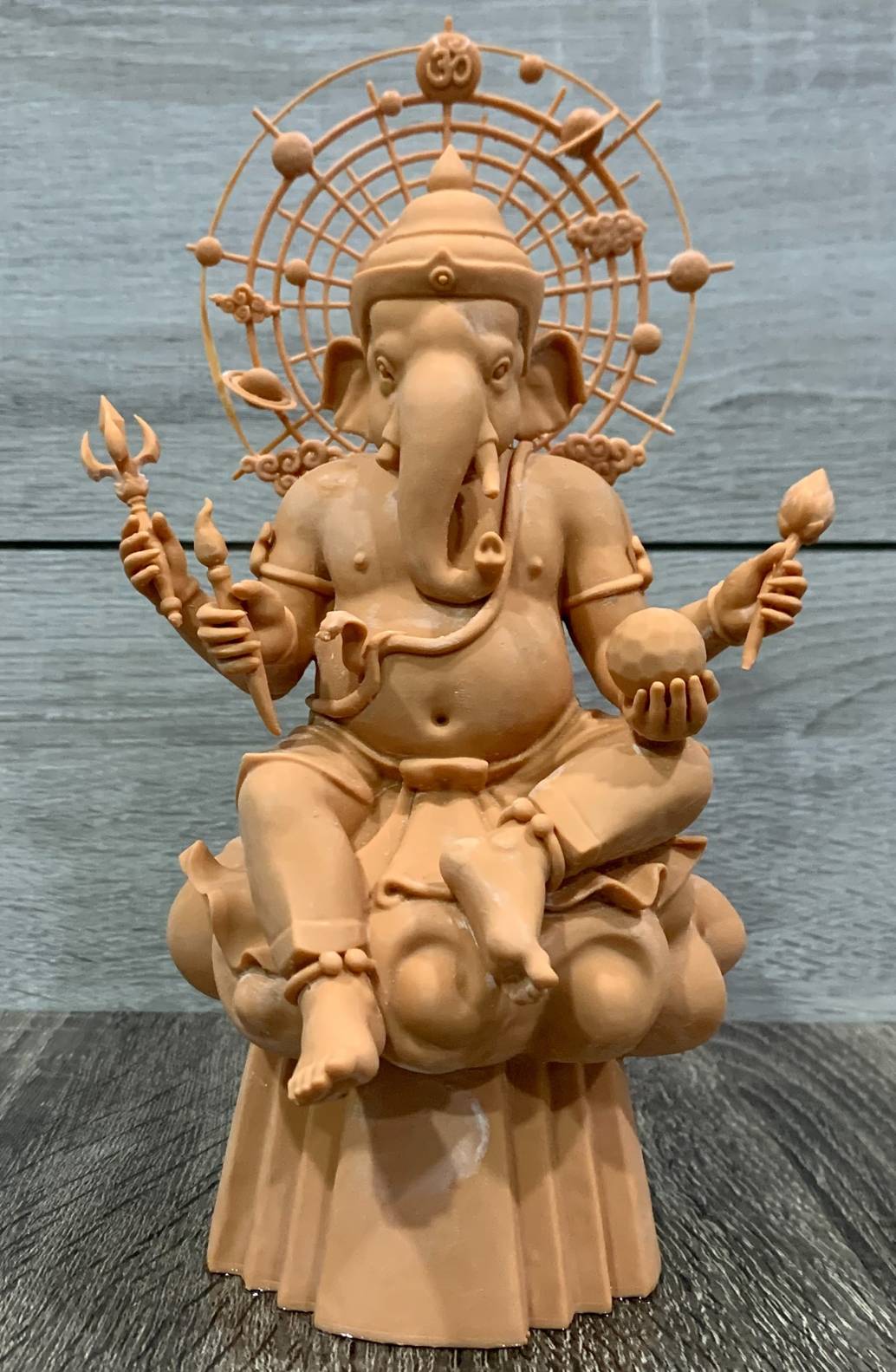
The Design Project of Ganesha in the Cosmic Art Posture.
College of Design, Rangsit University, Thailand
Anupong Suttaluk, Ekachai Somboon, Nipon Samanmit, Suriya Srisuphap, Wasant Yod-im, and Asst. Prof. Poraphon Chinwannachot
Abstract :
This research aims to develop a design for Ganesha in the Cosmic Art Posture as a spiritual focal point and landmark for the College of Design, Rangsit University. The research employs qualitative and creative research approaches. Data were collected through theoretical and documentary studies, analysis of artistic and cultural concepts, interviews, opinion surveys, observations, and consultations with relevant experts. The research resulted in a contemporary Ganesha sculpture design that connects cultural meaning, spirituality, artistic creativity, and institutional identity. The proposed design is intended to function as a shared spiritual focal point and landmark for students, faculty, staff, alumni, and visitors. It may also contribute to a sense of unity, pride, creative inspiration, and engagement within the College of Design. The project demonstrates the potential of contemporary sculptural design to reinterpret cultural and spiritual symbolism while creating a meaningful landmark that reflects the identity and creative environment of an educational institution.
Objectives :
This research aims to achieve the following objectives:
- To study and analyze artistic, cultural, and symbolic concepts related to Ganesha in the Cosmic Art Posture as a representation of wisdom, creativity, success, and the removal of obstacles.
- To develop a contemporary Ganesha sculpture design that reflects the identity and creative environment of the College of Design.
- To develop a design approach that strengthens spiritual connection, institutional identity, and creative engagement within the College of Design.
Conceptual Framework :
The conceptual framework of this research is developed through the integration of art, culture, spirituality, institutional identity, and contemporary sculptural design. Ganesha is positioned as the central symbolic element, representing wisdom, creativity, success, and the removal of obstacles, which corresponds with the educational mission and creative environment of the College of Design, Rangsit
University.
The concept of “Cosmic Art” serves as the primary creative direction, representing the relationship between the power of the universe and the limitless potential of artistic and design expression. This concept is translated into sculptural form through the study and interpretation of symbolic elements associated with Ganesha, combined with principles of visual composition, form, proportion, balance, rhythm, surface, light and shadow, color, material, and spatial relationships.
The framework further emphasizes the integration of traditional Thai artistic and cultural references with contemporary artistic approaches to establish a distinctive visual identity while maintaining cultural significance. Material selection and creative techniques are considered in relation to aesthetic expression, durability, environmental conditions, and the intended installation context.
The conceptual framework therefore guides the creative process from cultural and theoretical investigation, conceptual development, sketch design, prototype construction, evaluation, and refinement toward a final sculptural representation. The resulting artwork is intended to function simultaneously as a spiritual focal point, a contemporary artistic landmark, and a symbolic representation of the identity, creativity, and collective pride of the College of Design.
Process / Methodology :
Structural Framework Construction
A structural framework is constructed to support the main body of the sculpture. The framework establishes the overall height, proportions, balance, and stability of the figure before the modeling process begins.
Hand Modeling and Form Development
Modeling materials are gradually applied to develop the major volumes and anatomical forms of Ganesha. The body, head, arms, hands, legs, and other structural elements are carefully shaped. The forms are refined to achieve visual balance, movement, rhythm, and harmony.
Digital 3D Modeling and 3D Printing
Selected complex components are digitally modeled and prepared for 3D printing. The digital models are processed using slicing software and produced through additive manufacturing. The printed components are subsequently assembled with the main sculpture and manually refined to achieve consistency with the overall design.
Painting and Color Application
A primer is applied to prepare the surface before painting. Layers of color are then gradually applied to emphasize the form and symbolic elements of Ganesha. Tonal variation, highlights, shadows, and surface effects are used to create visual depth and enhance the three-dimensional qualities of the sculpture.
Techniques and Materials :
Result / Conclusion :
The research resulted in the development of a prototype design for Ganesha in the Cosmic Art Posture as a spiritual focal point and landmark for the College of Design, Rangsit University. The design integrates Ganesha’s symbolic associations with wisdom, creativity, success, and the removal of obstacles with cosmic power and limitless artistic potential. Visual elements, symbolic forms, proportion, balance, surface, light and shadow, materials, and spatial relationships were considered to create a contemporary sculptural identity. The research process combined qualitative and creative approaches through theoretical study, cultural and artistic analysis, interviews, opinion surveys, observation, and prototype development.
References :
คชาชีวะ, จ. (1984). คติความเชื่อและรูปแบบของพระพิฆเนศวร์ที่พบในประเทศไทย [วิทยานิพนธ์ปริญญามหาบัณฑิต, มหาวิทยาลัยศิลปากร]. Silpakorn University Research and Information Services.
เสาธง, น. (2009). ลัทธิพิธีบูชาพระพิฆเนศ: กรณีศึกษาเทวสถานพระพิฆเณศวร (สนามบินน้ำ) ถนนสนามบินน้ำ จังหวัดนนทบุรี [สารนิพนธ์ปริญญาศิลปศาสตรบัณฑิต, มหาวิทยาลัยศิลปากร]. Silpakorn University Research and Information Services.
หินไชยศรี, ศ., & หินไชยศรี, ไ. (2019). พระพิฆเนศ: แนวคิด พัฒนาการ และวิวัฒนาการการผสมผสานทางความเชื่อในสังคมไทย. วารสาร มจร บาฬีศึกษาพุทธโฆสปริทรรศน์, 5(1), 103–116.
พสุนนท์, ป., & วิริยวุฒิไกร, ก. (2011). ปัจจัยและพฤติกรรมการบูชาพระพิฆเนศวรของนักศึกษา มหาวิทยาลัยศิลปากร วิทยาเขตสารสนเทศเพชรบุรี. วารสารศรีนครินทรวิโรฒวิจัยและพัฒนา สาขามนุษยศาสตร์และสังคมศาสตร์, 3(6), 27–38.
Boner, A. (1962). Principles of composition in Hindu sculpture: Cave temple period. Brill.
Farag, M. M. (2020). Materials and processes of contemporary sculpture. Cambridge Scholars Publishing.
Getty, A., & Foucher, A. (1971). Gaṇeśa: A monograph on the elephant-faced god. Munshiram Manoharlal.
Krauss, R. E. (1985). The originality of the avant-garde and other modernist myths. MIT Press.
Low, S. (2023). Why public space matters. Oxford University Press.
Roux, N. (2026). Public art and place-making. In Remaking the urban: Heritage and transformation in Nelson Mandela Bay (pp. 131–166). Manchester University Press.
Sthapati, V. G. (2002). Indian sculpture & iconography: Forms & measurements (S. Ananth, Trans.). Sri Aurobindo Society in association with Mapin Publishing.
Share :
Facebook
Twitter
LinkedIn
WhatsApp
Email
Print