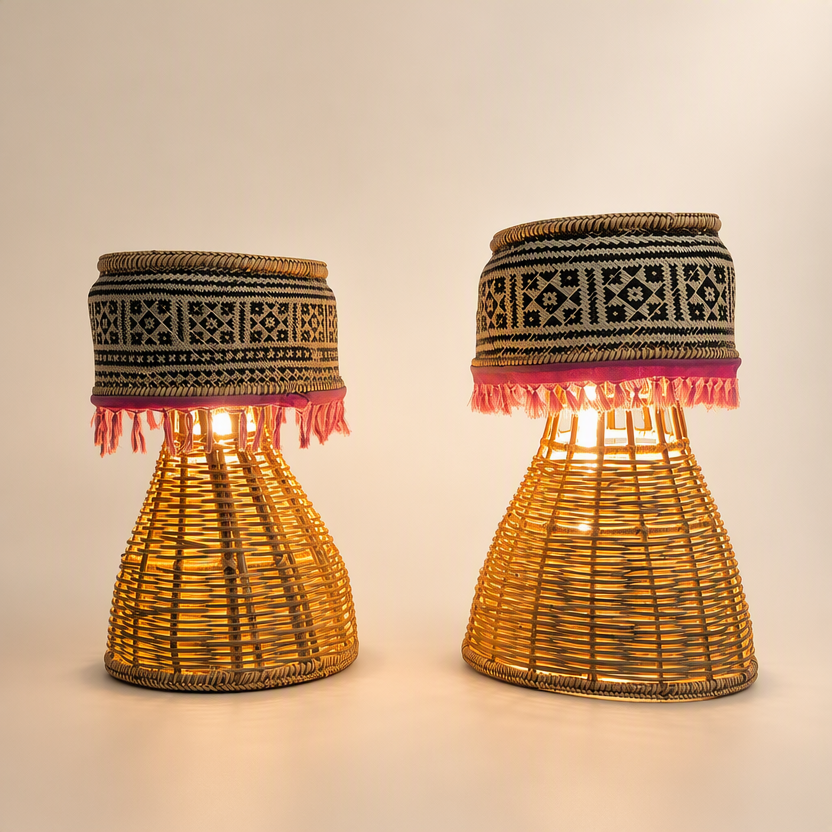
WAII-WAII-LAMP
Faculty of Fine and Applied Arts, Programme in Creative Industrial Crafts Design, Thammasat University, Thailand
Kittipong Keativipak
Abstract :
The design is a decorative lamp using woven bamboo as the primary production material. In the weaving process, Sang bamboo — which can be sourced locally from the community — is used, split into thin strips (called “tok”), and then dyed with natural dyes for weaving into various beautiful products. Bamboo cores and rattan are also used for the internal structural framework. The base is developed using rattan core (the inner strand of rattan), while the upper portion is woven from bamboo strips to create various patterns.
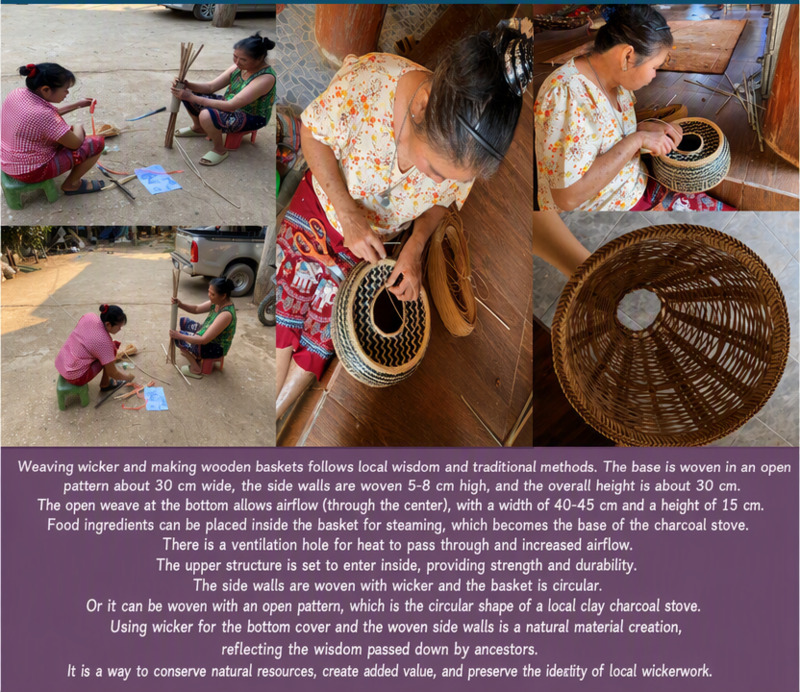
In the weaving production process for the decorative lamp — which is larger than a traditional sticky rice basket (kong khao) — an internal mold is required to serve as a form base, ensuring the woven piece takes shape correctly, has adequate strength, and maintains consistent size and proportions. The weaving is first done to create a flat, horizontal pattern, after which the mold is placed on top so the weaving can continue around it until the final product takes shape. The pattern used for designing the upper part of the lamp is the lotus flower pattern, also known as the “royal lotus” pattern.
This decorative lamp, woven from bamboo skin and rattan, represents the development of a home décor product built on a rattan-strand structural frame combined with curved bamboo-skin weaving. It can be priced for sale at 1,000–1,200 baht per piece.
Objectives :
To enhance the competitiveness of businesses in the creative industry, enabling them to apply creativity, innovation, and technology in developing creative products.
Conceptual Framework :
The concept for designing and developing new product forms within the community aims to create a new type of product that is distinctive and different, while using the same traditional weaving processes and techniques that the community already practices. The design pattern must use the lotus flower weaving pattern or another pattern that represents the community’s unique identity, using rattan as the structural material and bamboo skin for the weaving, since these are materials that the community can source locally on its own.
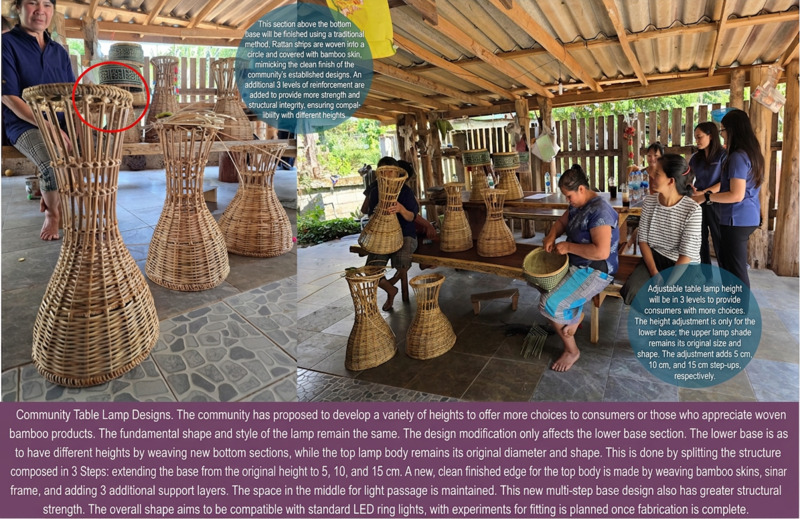
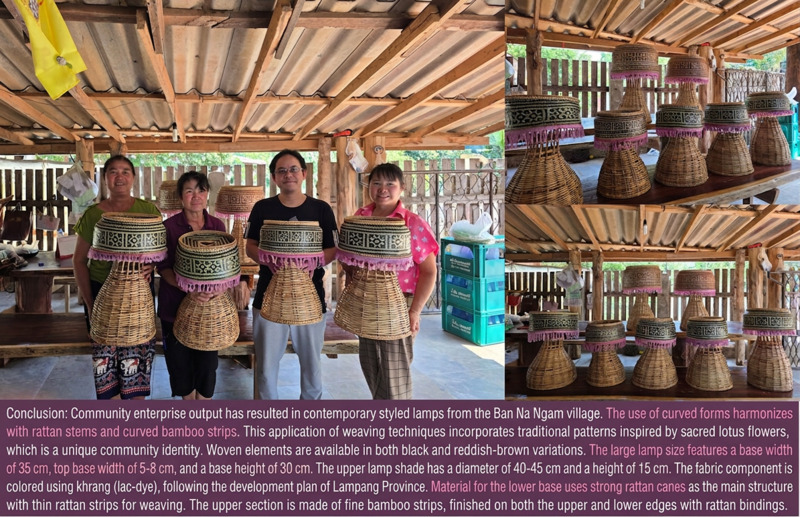
A prototype was trial-produced with production planning for the lamp’s form and dimensions: the lower base is 30 cm wide, the upper part of the base is 5–8 cm wide, with a height of 30 cm. The upper lampshade section has a width (diameter) of 40–45 cm and a height of 15 cm.
In production, rattan strands (whole/core rattan) were used to build both the lower and upper structural frameworks. For the lower section, split rattan strips were woven to form the base of the lamp, while still leaving gaps to allow light to pass through. Additional vertical structural elements were incorporated to increase strength and enhance the aesthetic appeal. The upper section was woven using bamboo skin, forming the lotus flower pattern (also known as the “royal lotus” pattern) — a local pattern of the Mueang May people — using natural brown or black dye to create the pattern’s lines through the weaving. Rattan was used to finish and bind the edges along the bottom and the entire top circular rim, securing the edges of the piece for a neat, beautiful appearance and preventing the woven structure from fraying or coming apart.
Process / Methodology :
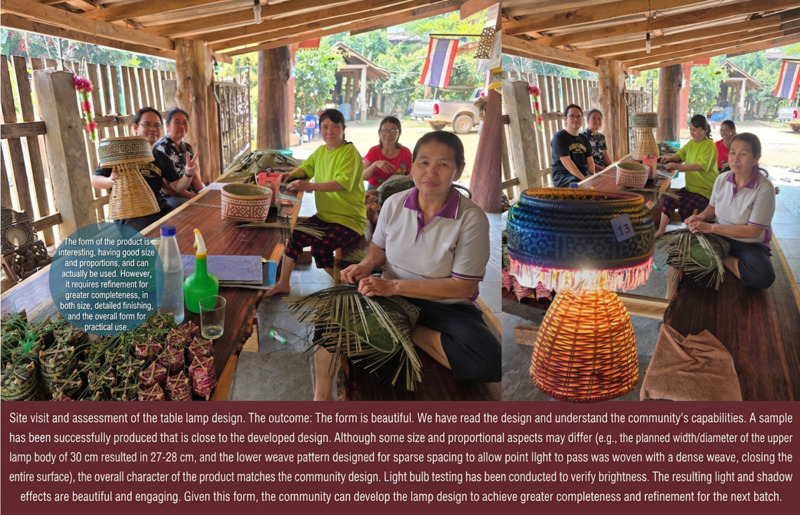
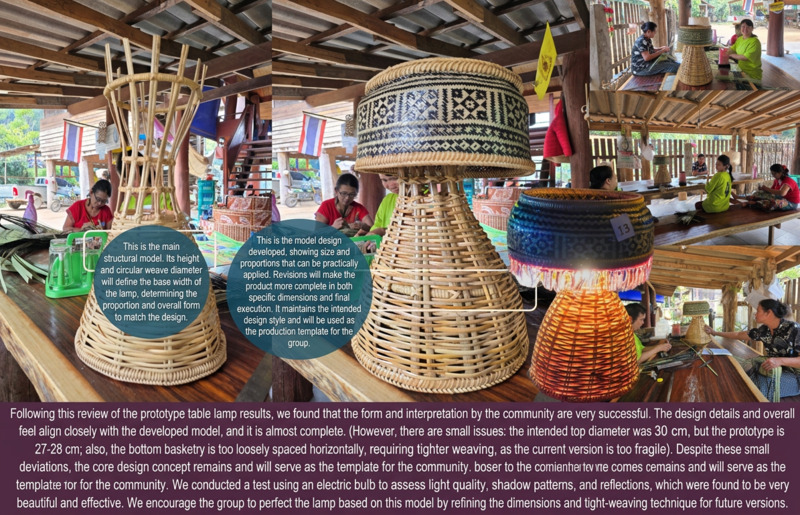
1.The creative design produced is a decorative lamp that applies bamboo and rattan materials. The Chae Hom bamboo weaving community was able to trial-produce the prototype without any issues, successfully building the prototype structure immediately after discussion and explanation of the design.
2.The main materials used in creating the prototype are bamboo and rattan. The bamboo is split into strips and then woven for the upper section, forming the lotus flower pattern. Two types of rattan are used: rattan core (whole/large rattan), used for the structural framework, and rattan strips, used for weaving the lower base of the lamp.
3.For the lamp’s lower base, rattan core is used to build the structure, with vertical placement points designed and positioned, then adjusted to leave open gaps — these areas are left unwoven so that light can pass through the base. The remaining areas, where no gaps are left, are fully woven closed all around using rattan strips.
4.The entire internal structure uses rattan core, formed into circular shapes in sequential layers, then further reinforced with additional vertical rattan core pieces to create the desired lamp structure.
5.For the bamboo weaving on the upper section, the weaving is done in the style of a large tray or basket made of bamboo skin. An internal mold is used as a form base to shape the weaving, ensuring it comes out strong, tightly woven, and consistent in size and proportion. The weaving is first done to create a flat, horizontal pattern, after which the mold is placed on top so the weaving can continue until it forms a beautiful lamp.
6.The pattern used in the weaving is the lotus flower pattern, or “royal lotus” pattern — a local pattern of the Mueang May people, passed down as traditional wisdom from generation to generation.
Techniques and Materials :
Bamboo woven and Fabric
Result / Conclusion :
The decorative lamp has a contemporary style, with curved contours designed to align with the beautiful natural curves of the rattan core and bamboo skin. The bamboo-skin weaving technique is used to form the lotus flower pattern, a design that represents the community’s unique identity. Weaving is done in both black and red color variations on the upper section.
The dimensions of the woven lamp are as follows: the lower base has a width (diameter) of 35 cm; the upper part of the base is 5–8 cm wide with a height of 30 cm; the upper lampshade section has a width (diameter) of 40–45 cm and a height of 15–20 cm. The decorative fabric used is lac-dyed cloth (fabric dyed with natural lac dye). For the lower base, rattan core forms the structural frame, woven with rattan strips or bamboo strands. The upper section is woven with bamboo skin, and the top and bottom edges are finished and bound together with rattan.
Rattan core is used to build both the lower and upper structures. For the lower section, rattan strips or bamboo strands are woven to form the lamp’s base, while leaving gaps to allow light to pass through, with added vertical structural elements for extra strength and beauty. The upper section is woven with bamboo skin in the lotus flower pattern (or “royal lotus” pattern) — a local pattern of the Mueang May people — using natural brown or black coloring to form the pattern’s lines. Rattan is used to bind the bottom edge and the entire top circular rim, keeping the edges of the piece neat and preventing the woven structure from fraying.
The rattan strands at the bottom are arranged with appropriate spacing so that the light placed inside can shine through the gaps between the rattan pieces. To join the upper lamp section with the lower base, small rattan strands are threaded from the top down and bound together with the base structure to hold everything firmly in place, allowing the piece to be strong enough to be picked up and carried. To finish the woven edge at the top, rattan core is bent into a circular shape matching the size of the lamp at each point, then placed on top; rattan strips are then wound around the edge for a decorative finish, wrapping from the woven section around the rattan core edging on both the top and bottom of the lamp. The base structure incorporates both rattan core and bamboo for reinforcement, making the base sturdy, strong, and suitable for practical use.
The light bulb is installed by hanging it from the top (using a long LED tube-style bulb, hung vertically in line with the lamp’s shape), with the wire wound up and over the top, then threaded down and out through the base of the lamp.
References :
–
Share :
Facebook
Twitter
LinkedIn
WhatsApp
Email
Print