
Echoes of Thin Shell: Reinterpreting Architectural Memory through Parametric Synthesis
Faculty of Architecture, Rangsit University, Thailand
Asst. Prof. Apiwat Pattanasirimongkol
Abstract :
“Khurusamanakarn” is a reinforced-concrete thin-shell structure in the form of a hyperbolic paraboloid, located at Rajamangala University of Technology Isan and standing for more than 66 years. Its remarkable architectural form, together with spaces for meetings, performances, and student activities, has allowed the building to accumulate experiences and meanings that have been passed from one generation to the next. Just as knowledge and experience are transmitted from earlier generations for later generations to reinterpret and develop, architecture from the past can likewise convey its concepts, formal principles, structural logic, and construction processes for contemporary reinterpretation.
This project asks how parametric design can serve as a medium for transmitting and reinterpreting such architectural memory. Rather than preserving the original form as a fixed image, the project transforms the memory of “form” into a set of geometric and spatial rules for exploring alternative architectural configurations.
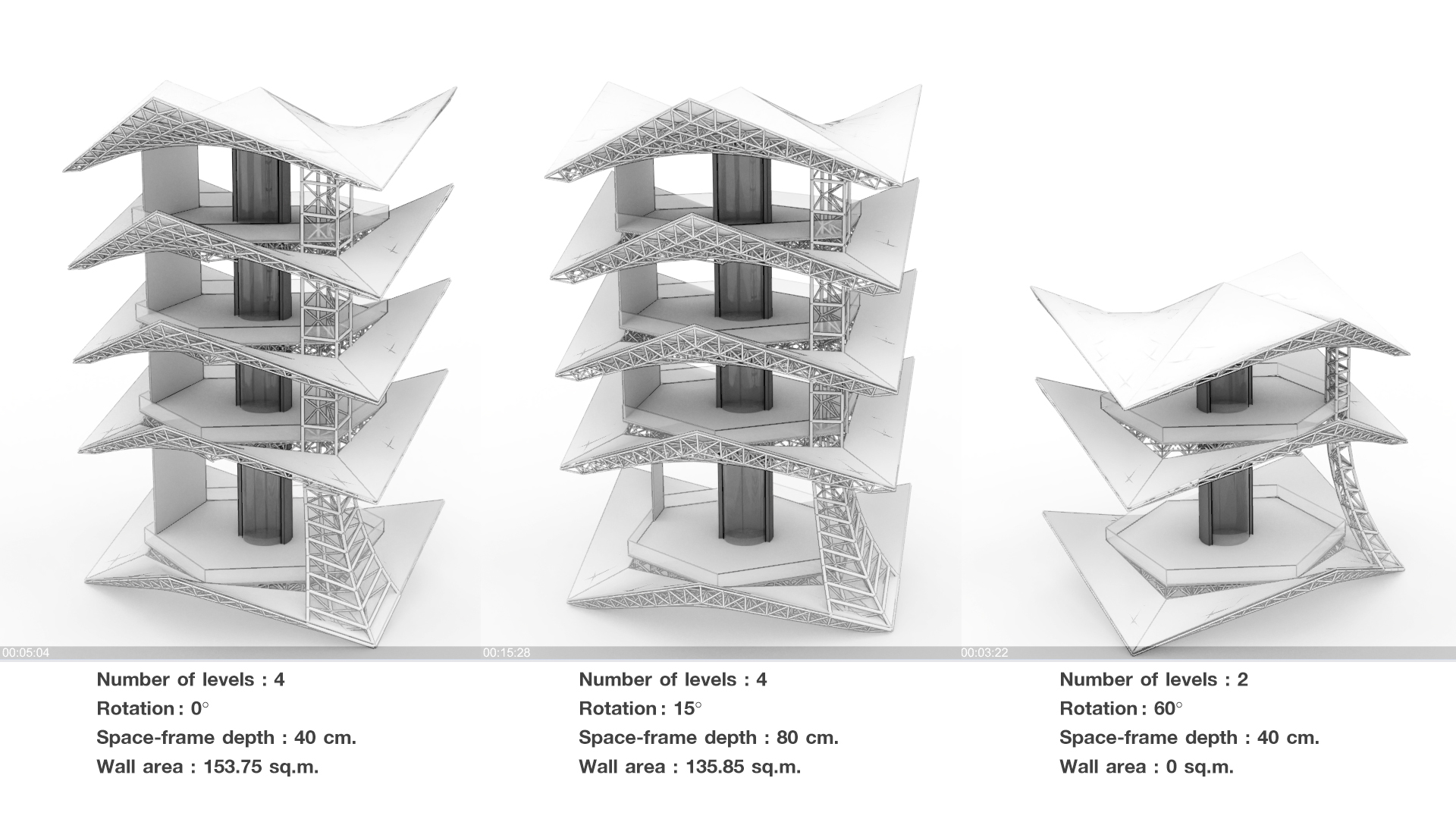
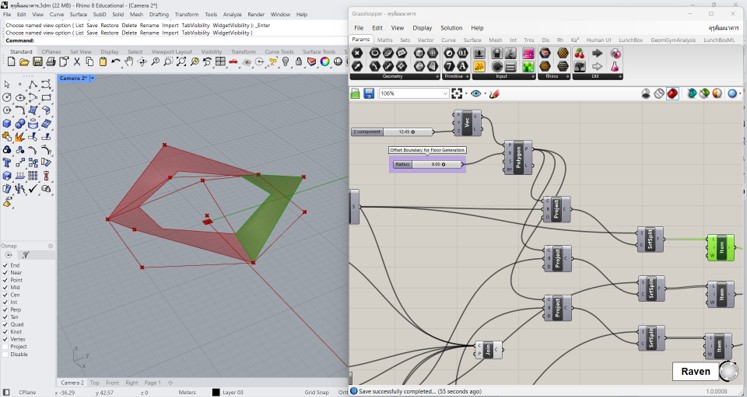
“Echoes of Thin Shell” is a parametric definition developed from the architectural memory of Khurusamanakarn. It extracts key characteristics of the original building, including its hexagonal geometry, hyperbolic paraboloid form, structural logic, and spatial openness, and translates them into adjustable parameters through Grasshopper in conjunction with Rhinoceros. These parameters include the width of the hexagon, with the height of the hyperbolic paraboloid adjusting proportionally; the number of stacked levels and the height between them; building rotation; the depth of the space-frame system and member sizes; and the proportion of enclosed wall area.
Three representative variations were compared qualitatively in terms of formal composition, spatial enclosure, and structural configuration. The comparison demonstrates how parameter adjustments generate distinct configurations while retaining the essential hexagonal and hyperbolic paraboloid geometry. The translation is documented through a table of inherited characteristics and a parameter hierarchy. The proposed space-frame reinterpretation remains conceptual and requires further structural and environmental evaluation.
“Echoes of Thin Shell” therefore presents a reusable form-generating system through which architectural memory can be reinterpreted rather than replicated.
Objectives :
This creative work aims to investigate how parametric design can serve as a medium for transmitting, reinterpreting, and transforming architectural memory from the past into a flexible design system applicable to contemporary contexts, using “Khurusamanakarn” as the primary architectural precedent for the study.
Khurusamanakarn is characterized by its hexagonal geometry, reinforced-concrete thin-shell structure in the form of a hyperbolic paraboloid, spatial openness, and environmental responsiveness through natural ventilation. Rather than replicating or preserving the original form as a fixed image, this work seeks to identify the underlying logic of the precedent and translate that logic into a set of rules, relationships, and adaptable variables.
The main objectives are as follows:
- To analyze the formal, structural, spatial, and environmental characteristics of Khurusamanakarn in order to identify the elements that constitute its architectural identity.
- To translate these elements into a parametric definition developed using Grasshopper in conjunction with Rhinoceros.
- To experiment with adjustable variables, including the size of the hexagon, number of levels, spacing between levels, building rotation, space-frame depth, member size, and proportion of wall area, in order to explore new architectural configurations that can respond to different contexts, spatial conditions, and functional requirements.
The overarching goal is to demonstrate that architectural memory can be transmitted not only through the preservation of original form, but also through the continuation of its underlying logic, rules, and design system, allowing it to be reinterpreted and further developed over time.
Conceptual Framework :
Architectural memory is not limited to the preservation of an original form; it can also be transmitted through a design system that allows reinterpretation and further development. “Echoes of Thin Shell” adopts this idea as the conceptual framework for studying Khurusamanakarn, viewing the building’s key characteristics—including its hexagonal geometry, hyperbolic paraboloid surface, structural logic, and passive design principles—as components of architectural memory. These characteristics are then translated into rules, relationships, and variables within a parametric definition, allowing the resulting forms to adapt to different contexts and contemporary needs while maintaining a recognizable connection to the original architectural precedent.
Process / Methodology :
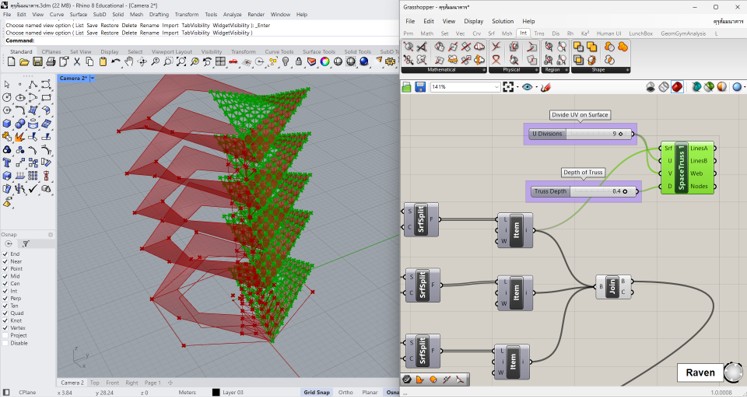
The process began with a study of Khurusamanakarn through historical data, photographs, and architectural documentation in order to analyze its key characteristics in terms of form, structure, spatial organization, and environmental responsiveness. These characteristics were then translated into rules, relationships, and variables for developing a parametric definition using Grasshopper in conjunction with Rhinoceros.
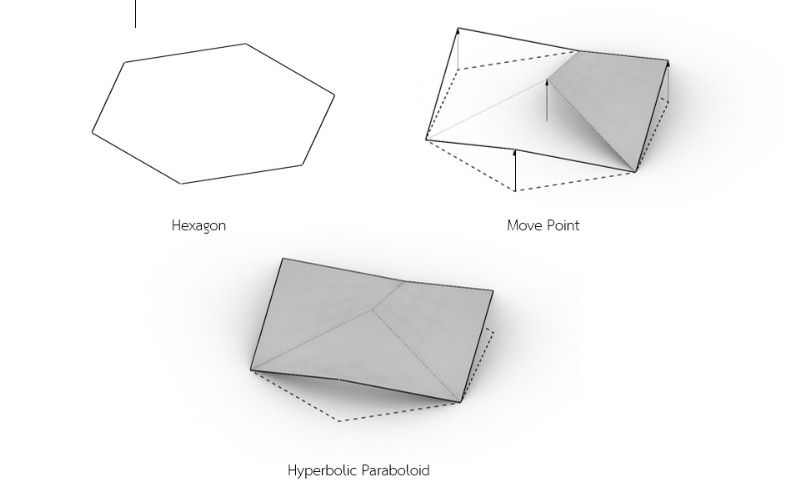
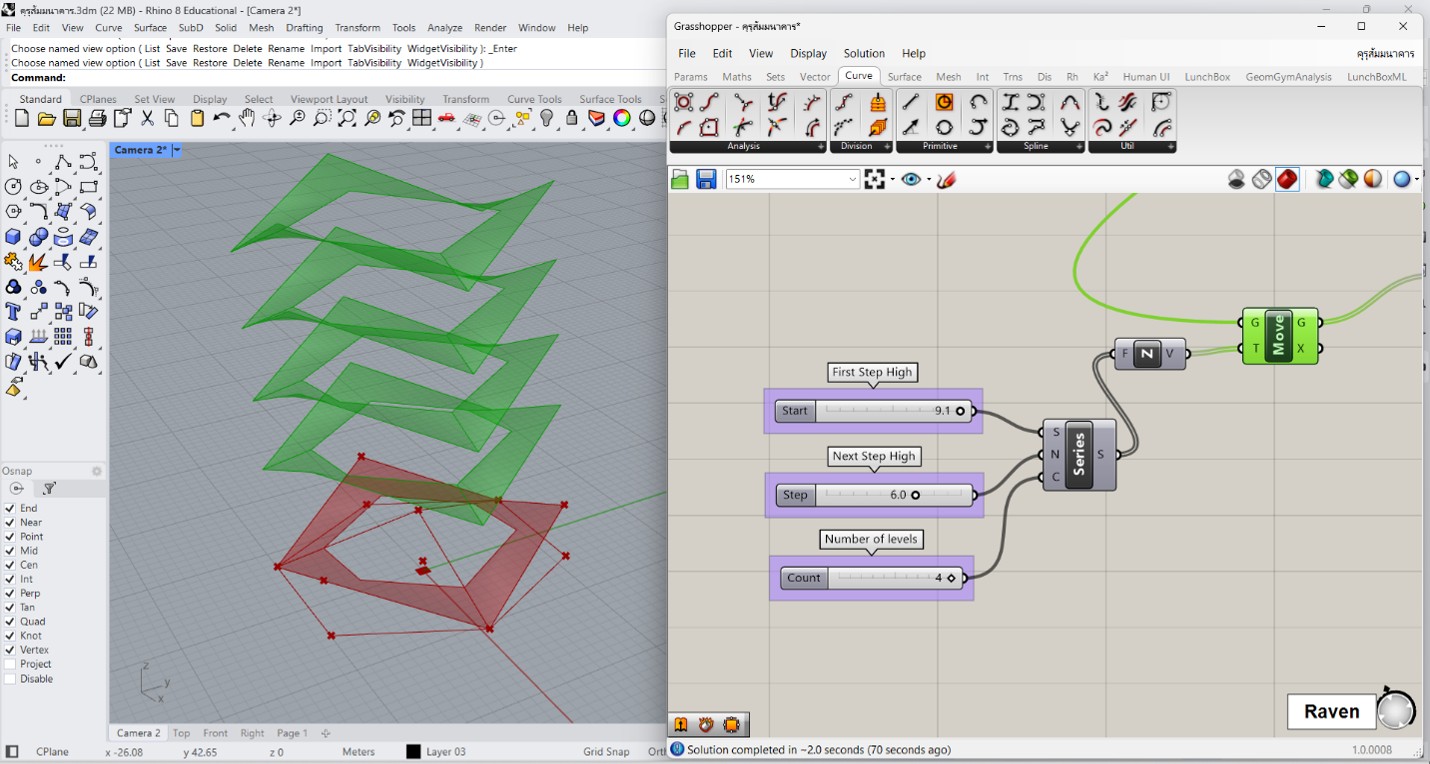
The system began with a hexagonal geometry and the definition of high and low points to generate a hyperbolic paraboloid surface. It was then extended through additional parameters, including overall size and proportion, number of levels, spacing between levels, rotation and orientation, space-frame depth, member size, and wall-area proportion.
The final stage involved adjusting these parameters to generate a range of architectural configurations and examining how far the system could be transformed while maintaining a recognizable connection to the architectural identity of Khurusamanakarn.
Techniques and Materials :
Result / Conclusion :
The result of “Echoes of Thin Shell” is a parametric definition developed not as a proposal for a single architectural form, but as a system capable of generating multiple architectural configurations while maintaining a recognizable relationship with the key characteristics of Khurusamanakarn.
The system allows the adjustment of variables including overall size, hyperbolic paraboloid proportions, number of levels, spacing between levels, building rotation, structural depth, member size, and wall-area proportion. These parameters enable the system to respond to different spatial conditions, functional programs, materials, and design requirements.
At this stage, the design remains at a preliminary level and is intended for further development, particularly in relation to the refinement of structural components and the evaluation of suitable structural systems. The exploration of vertically stacked hyperbolic paraboloid forms also reveals rhythmic layering, projecting edges, and tiered spatial arrangements that create a visual association with certain characteristics of traditional Asian architecture.
The results demonstrate that architectural memory does not need to be preserved solely through physical conservation or the replication of an original form. It can also be transmitted through rules, relationships, and computational processes.
The key conclusion is that parametric design can serve as a contemporary medium of postmemory, allowing architectural values from the past to remain active and open to reinterpretation.
“Echoes of Thin Shell” therefore proposes a shift in how architecture is remembered: from architecture as an “object” to architecture as a “form-generating system” that can be adapted, transformed, and further developed over time.
References :
ASA CREW. (2017, July–August). คุรุสัมมนาคาร มหาวิทยาลัยเทคโนโลยีราชมงคลอีสาน จังหวัดนครราชสีมา. ASA CREW, 5(5), 24–25.
Bruno, L., Gabriele, S., Grande, E., Imbimbo, M., Laccone, F., Marmo, F., Mele, E., Raffaele, L., Tomei, V., & Venuti, F. (2023). Exploring new frontiers in gridshell design: The FreeGrid benchmark. Structures, 58, 105678. https://doi.org/10.1016/j.istruc.2023.105678
Díaz Valdés, M., & Geremia, L. C. (2026). Geometric and sustainable analysis of the hyperbolic paraboloid of Félix Candela’s concrete shell structures. Journal of Construction Engineering Innovations and Research, 3(1). https://doi.org/10.37155/3060-8716-3-1-2
FOTO-MOMO. (2020, May 24). Kurusammanakarn. https://foto-momo.com/kurusammanakarn/
Kookalani, S., & Htayaung, H. (2023). GFRP elastic gridshell structures: A review of methods, research, applications, opportunities, and challenges. Journal of Civil Engineering and Materials Application, 7(2), 71–94. https://doi.org/10.22034/jcema.2023.401834.1111
พระวงค์, ส. (2551). คุรุสัมมนาคาร. วารสารอาษา, 06:51–07:51.
Share :
Facebook
Twitter
LinkedIn
WhatsApp
Email
Print