
Mk 1 guitar
College of Design, Rangsit University, Thailand
Kate Siribhakdi
Abstract :
The guitar is a foundational musical instrument that has significantly influenced contemporary music and culture. While major Asian nations such as China, Japan, and Indonesia dominate large-scale guitar production, the manufacturing industry in Thailand remains largely confined to small-scale luthiers. Consequently, there has been limited exploration into novel structural forms, acoustic characteristics, and the integration of regional materials.
To address these gaps, this study investigates core principles of guitar design and handcrafted manufacturing techniques through practical application. The primary objective is to analyze the relationship between material selection, structural design, and acoustic character to establish a distinctive tonal signature. Specifically, the research aims to optimize acoustic and tonal performance by achieving a full, warm low-end response while maintaining the treble clarity required for high-mix articulation. Additionally, playability is evaluated and enhanced through ergonomic modifications to body shape and neck profile.
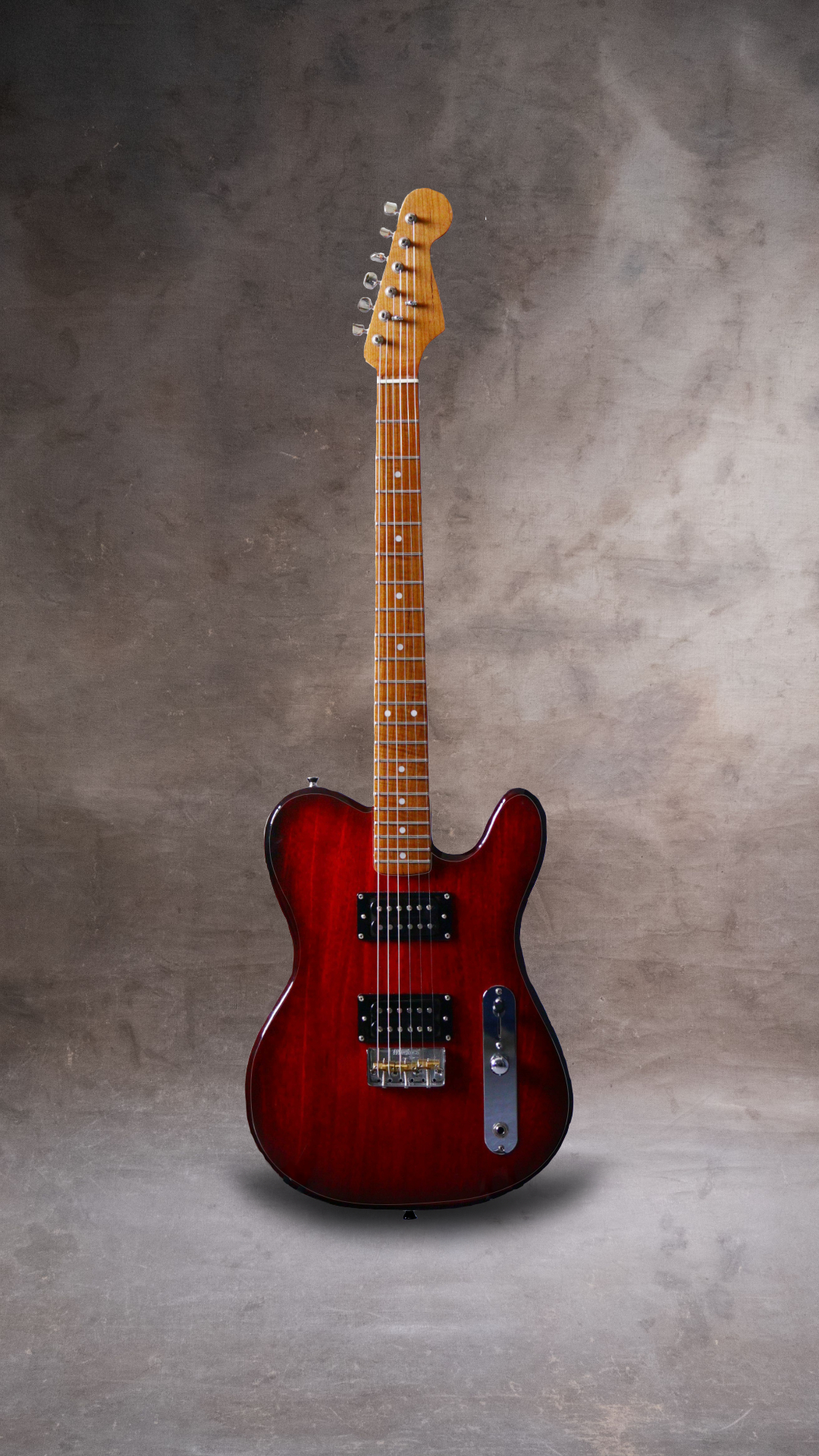
The resulting prototype—featuring a roasted maple neck combined with a Rengas wood body—demonstrates a warm, punchy, and well-rounded tonal profile comparable to traditional mahogany bodies, such as those found in Gibson and PRS instruments, while retaining sufficient treble response to cut through complex sound mixes. Economically, Rengas wood presents a cost-effective alternative to imported mahogany, though it requires specialized surface preparation, such as pore-filling prior to sanding, to achieve a high-quality finish. Furthermore, environmental factors such as high humidity induced slight warping during wood preparation, highlighting the critical role of material conditioning in maintaining cosmetic and structural integrity.
Objectives :
The primary objective of this project is to investigate the viability of utilizing regional timber in handcrafted electric guitar manufacturing to achieve optimized acoustic performance, enhanced playability, and cost-efficiency.
The specific objectives are as follows:
- To investigate fundamental principles of guitar design and handcrafted lutherie techniques through autonomous research, structural prototyping, and practical fabrication.
- To analyze the relationship between material properties, body geometry, and acoustic characteristics by pairing a roasted maple neck with a Rengas wood body to establish a distinctive tonal signature.
- To optimize tonal balance and acoustic response, specifically targeting a full, warm low-end output comparable to traditional mahogany instruments while preserving high-frequency treble clarity for high-mix articulation.
- To enhance instrument ergonomics and overall playability through targeted modifications to body contouring, weight balance, and neck profile ergonomics.
- To evaluate the manufacturing, economic, and conditioning feasibility of local materials, identifying necessary surface preparation techniques (such as pore-filling) and environmental stability factors (such as humidity resistance during wood conditioning).
Conceptual Framework :
The guitar represents one of the foundational stringed instruments in modern music history, undergoing significant technological evolution since the commercial introduction of the solid-body electric guitar by George Beauchamp and Adolph Rickenbacker in 1931. While contemporary global guitar manufacturing is heavily dominated by large-scale industrial producers in countries such as China, Japan, and Indonesia, the domestic luthier industry in Thailand remains restricted to small-scale artisan production. Consequently, there exists a research and design gap regarding the exploration of alternative structural forms, acoustic properties, and local material integration within the region.
The acoustic resonance and primary frequency response of an electric guitar body are fundamentally governed by the physical properties of its tonewoods, particularly density and cellular stiffness. Low-Density Materials: Softer, lower-density timbers exhibit higher elasticity, selectively dampening lower frequencies while allowing high-frequency overtones to decay at a slower rate, yielding a brighter, thinner sound profile. High-Density Materials: Denser hardwoods possess higher mass-to-volume ratios, promoting sustain and lower-frequency resonance, which generates a fuller, darker, and warmer acoustic foundation.
To modernize the traditional single-cutaway Telecaster silhouette, the structural frame incorporates targeted geometric refinements designed to lower mechanical strain on the performer.
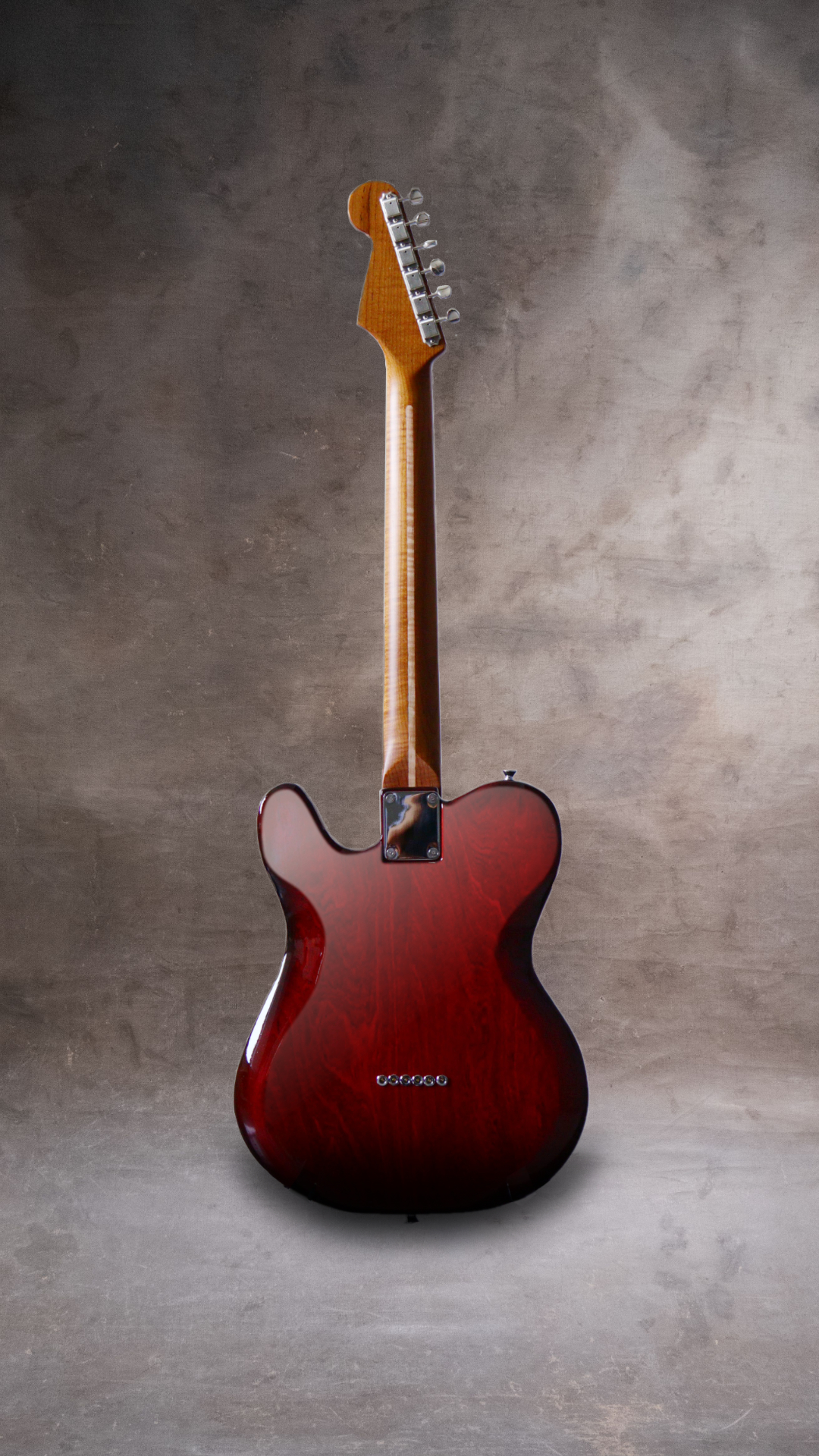
Double Posterior Relief (Belly Cut): A smooth transition into a large-radius fillet along the rear upper bout reduces contact pressure against the performer’s ribcage, legs, enhancing weight distribution and stability in both seated and standing playing positions.
Anterior Edge Chamfering: A prominent chamfered bevel along the front perimeter attenuates the sharp edge profile typical of classic designs, providing forearm relief while visually defining the instrument’s structural contours.
Process / Methodology :
| Selecting tone wood and combining different wood densities play a crucial role in a guitar’s acoustic character. Softer, lower-density woods tend to emphasize higher frequencies to produce a thinner, brighter sound, whereas denser hardwoods favor lower frequencies to generate a thicker, darker, and warmer tone. Rengas wood (Borneo rosewood), native to India and Southeast Asia, has a density of approximately 640-960 kg/m3. It is denser and harder than Mahogany (450-850 kg/m3), which is traditionally used in Gibson guitars for a warmer sound.
By use Density differential calculation: Created compare anaslysis Acoustic density ratio across major guitar brands
The timber is planed and glued together to form the main body block. Guitar templates were designed in CAD software and 3D-printed to ensure precise dimensions. The body shape is a modified Telecaster design altered for better overall balance, featuring a rounder, slightly smaller lower bout for enhanced playing comfort. Custom MDF templates were then prepared for routing the various components of the instrument. These MDF templates served as guides to route the outer body outline, neck pocket, and neck plate recess. The front pocket accommodates the guitar neck, while the rear recess allows the neck plate to sit completely flush with the body for a smooth feel on the back. A 3/8 inch chamfer was routed along the front edge to reduce sidewall thickness and create a distinct framed border, and a ½ inch fillet was routed on the back to make the body more comfortable to hold. The waist sides were cut symmetrically and hand-sanded to transition smoothly into the routed chamfers. Using the premade MDF templates, the control and pickup cavities were routed, followed by drilling the string-through and neck-pocket holes. The entire surface was then sanded smooth to prepare for the finish. A red wood stain was applied to the body, followed by airbrushing a black gradient around the perimeter to create a sunburst effect. Multiple coats of 2K high-gloss lacquer were sprayed, cured, wet-sanded, and buffed to a mirror finish. Roasted maple wood neck with stinless steel fret was assemblied with bolt to seciure tightness. This create more sustain in guitar. Beside that, Roasted maple wood neck produce snappy and clear bringt tone will balance. Humbucker pickups and electric wiring inside control cavity were installed. Then guitar setup such as string action height, guitar nut adjustment. |
Techniques and Materials :
Result / Conclusion :
the guitar featuring a roasted maple neck combined with a Rengas wood body—demonstrates a warm, punchy, and well-rounded tonal profile comparable to traditional mahogany bodies, such as those found in Gibson and PRS instruments, while retaining sufficient treble response to cut through complex sound mixes. Economically, Rengas wood presents a cost-effective alternative to imported mahogany, though it requires specialized surface preparation, such as pore-filling prior to sanding, to achieve a high-quality finish. Furthermore, environmental factors such as high humidity induced slight warping during wood preparation, highlighting the critical role of material conditioning in maintaining cosmetic and structural integrity.
References :
- Wegst, U. G. K. (2006). “Wood for sound.” American Journal of Botany, 93(10), 1439-1448.
- Ahvenainen, P. (2019). “Anatomy and mechanical properties of woods used in electric guitars.
- Vieilledent, G., Fischer, F. J., Chave, J., Guibal, D., Langbour, P., & Gérard, J. (2018). New formula and conversion factor to compute basic wood density of tree species using a global wood technology database. American Journal of Botany, 105(10), 1654–1661. org
Share :
Facebook
Twitter
LinkedIn
WhatsApp
Email
Print