Reinterpretation of old and new in storytelling for digital natives through Stage, Style, and Scenery Design of the University Orientation Event
Mahidol University International College
Asst. Prof. Dr. Dynaya Bhutipunthu, and Yuttana Suntivong

Abstract :
The objective of this project is to reinterpret the famous stories from the past, films focused, transforming them into a new one that suits to be reviewed by the new generation, digital natives, who do not have personal recollection or first-hand experience of these famous films, “Postmemory” (Hirsch, M., 2019). The listing covers 1990s films about Sci-Fi, Space, Mothership, Galaxy, and Quests, such as “Men in Black” (1997), “Galaxy Quest” (1999), “Top Gun” (1986), and “Guardian of the Universe” (1990). Integrating Neuro Design key practices (Bridger, D., 2017) and Experiential Design layout (Dalsgaard, P., 2008) (Lai, M., 2023), the investigators integrate sensory experiences with new storytelling through stage, style, and scenery design for this year’s Mahidol University Orientation event organized by the Mahidol Foundation on July 31, 2026 under the theme “All On Board: Launch Into the Future” (We Mahidol Channel, 2026). The process of the study includes
1.) The review of related literature: Neuro Design, Experiential Design with sensory focus, Digital Native’s preferences, and Principles of Storytelling.
2.) A series of discussions with all parties involved to gain insights for the identification of the direction for the stage, style, and scenery design inside the event’s venue, Prince Mahidol Hall (PMH), Mahidol University, Salaya campus.
3.) The Design Process for the arrangement of all performance sequences.
4.) The Pre and post-production of key visuals, motion graphics, and projection mapping works with the integration of generative AI tools.
5.) The Revision and Finalization of the final works.
6.) The Conclusion and Suggestions. The satisfaction survey was distributed and collected from approximately 6,000 participants, and the results indicated positive feedback throughout the onstage performances.
Objectives :
The objective of this project is to reinterpret the famous stories from the past, 1990s films, as a “Postmemory” medium, then transform them into storytelling for digital native’s audiences through the stage, style, and scenery design of the University Orientation event, the Mahidol University Orientation 2026 event organized by the Mahidol Foundation on July 31, 2026. The event is held annually at the beginning of the academic year, aiming to celebrate a new chapter of freshmen’s pathways to academic achievement with a warm welcome gesture, with approximately 6,000-6,500 participants attending.
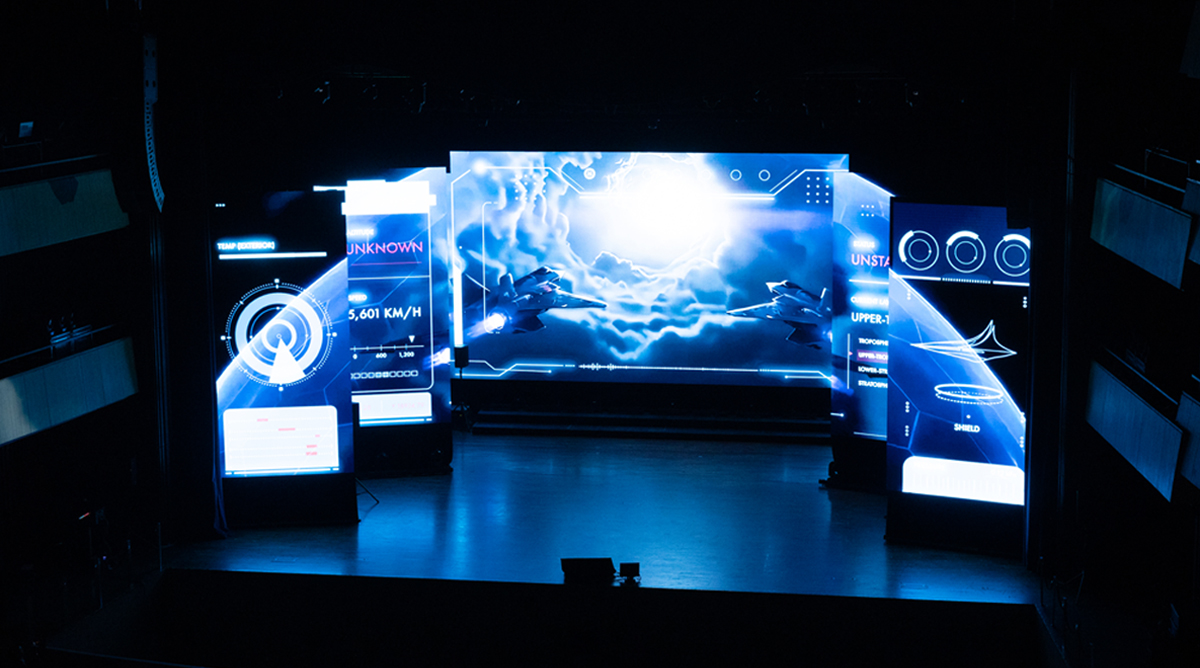
The investigators directed the design of the stage, style, and scenery for the four performance sequences: 1. University’s brief history review, 2. Executives and the president’s opening sequence, 3. MU Choir performances, and 4. Live concert sessions under this year’s event’s theme, “All On Board: Launch Into the Future,” especially in the President’s opening sequence. With the venue arrangements, a series of motion graphics were displayed through six LED screens positioned on stage, four with the dimension of 6 x 2.5 meters (15 square meter) and one with the 6 x 12 meters (72 square meter) dimension, five projectors with high brightness installed, four on the left and the right of the hall’s balconies and one projecting on the roof of the hall for projection mapping displays, also lighting design.
Conceptual Framework :
The study framework includes the review and summary of storylines from the five selected 1990s films about Sci-Fi, Space, Mothership, Galaxy, and Quests as a “Postmemory” medium, namely, “Men in Black” (1997), “Galaxy Quest” (1999), “Top Gun” (1986), “Guardian of the Universe” (1990), and The Matrix (1999). Then the linkage between the storylines to a new storytelling, thematic, (Sandler, H., L., 2025) of the event focusing on the quest through the university’s seven core values are identified replying to the digital natives’ preferences, learning habits, (Piersiala, L., 2023). Neuro Design, Sensory and Experiential Design are also integrated in the creation process. Followed by the design direction of the motion graphics for projection mappings and the revisions and finalization of works. Then the execution of all sequences is implemented through the event’s stage, style, and scenery design.
The review of related literature covers: 1.1) Postmemory, particularly the work of Marianne Hirsch (Hirsch, M., 2019). 1.2) Neuro Design: The investigators apply five key principles of Neuro Design through the design creation process (Bridger, D., 2017). 1.3) The implementation of Sensory Experiential Design (XGD): The investigators plan and organize the use of new technologies in designing graphics in the environment through dynamic experiences (SEGD, 2024) with the use of generative AI. 1.4) The Universal Principles of Storytelling for Designers by Lyle Sandler: four key practices of storytelling are applied to the working process by the investigators (Sandler, H. L., 2025). 1.5) Digital Native’s preferences and learning habits that are keen on fast, bite-sized content, constant mobile connectivity, and instant feedback are also considered (Piersiala, L., 2023).
The investigators conducted a series of discussions with all parties involved, stakeholders in the management and organization of the event; the discussions were set to gain consensus and insights to identify the design directions and implementations of the thematic and execution of the stage, style, and scenery design inside the event venue. Five main groups of stakeholders include
1.) The decision-making group (executives)
2.) The main audiences (digital natives)
3.) The working staff, 4.) The equipment sponsors.
5.) The venue operator staff.
Process / Methodology :
The investigators engaged in the creation process of the event’s stage, style, and scenery design by replying to the Design Process set by the Professional Association for Design (AIGA) (AIGA, 2021), which covers a structured five-step framework: 1.) Define, 2.) Research, 3.) Idea, 4.) Development, and 5.) Implementation (2021). In Define, the thematic, storytelling, and execution of the event were defined by the “Postmemory” medium (Hirsch, M., 2019), selected 1990s films. In Research, the research was done through a review of literature: Principles of Storytelling, Neuro Design, Experiential Design, and Digital Native’s learning habits, and a series of discussions from parties involved, stakeholders. In Idea, the creation of the work’s idea was the reinterpretation of the Postmemory medium, transforming into a new story that suits the focused audiences, digital natives, through the implementation of Principles of Storytelling, Neuro and Experiential Design key practices.
In Development, the investigators evoked the audience’s emotions by creating the framework for the design of key visual and projection mapping displays using external stimuli as the focus. In Implementation, the investigators applied the thematic of the event, retelling the new story of the audience’s quests through years of studying at the university. Using the university’s core values, seven of them, as a quest to straighten the students’ pathways to their academic successes. The investigators directed the stage, style, and scenery design of the four performance sequences: 1.) University’s brief history review, 2.) Executives and the president’s opening sequence, 3.) MU Choir performances, and 4.) Live concert sessions, reflecting the event’s theme, “All On Board: Launch Into the Future.” The link to “Behind the First Step: A Journey to the Future,” the event’s creation process, can be viewed at: https://youtu.be/ka71pw63sLU?si=H97XUJxurDSb8sul (We Mahidol Channel, 2026).
Techniques and Materials :
In the Executives and the president’s opening sequence, the technique covers the production of all key visuals and animation used for projection. While developing the key visuals for each environment along the ascent through seven atmospheric stages before reaching space, the investigators and the working staff exchanged experiences continuously. The investigators described the images and feelings they remembered from films of that period. And the working staff described the images they know from present-day media and how to create images with tools including Generative AI. Then each side brought, what was tested, the draft storyboards and clips, to test on the screen displays and work on the revision, real-time, several rounds of adjustment in lighting, perspective, scale, and composition are implemented, through the final work execution. In one exchange, the investigators described the black-suited agents of “Men in Black” and the aircraft scenes of “Top Gun”, also what those scenes were meant to make an audience feel: a team beginning a mission, and a pilot taking command in the cockpit. The working staff turned these descriptions into prompts and reference images, and tested them with the tools until the cockpit and ascent scenes carried a similar feeling in a present-day look.
For the University’s brief history reviews, all archived photos and stories were reviewed and selected to create a series of photomontages for the three periods of University’s history development to be used in the projection mapping in the event’s hall. For MU Choir performances and Live concert sessions, the investigators directed the storyboard and the creation process of a series of motion graphics to be displayed through six LED screens positioned on stage, four with the dimension of 6 x 2.5 meters (15 square meter) and one with the 6 x 12 meters (72 square meter) dimension, five projectors with high brightness installed, four on the left and the right of the hall’s balconies and one projecting on the roof of the hall for projection mapping displays, also lighting design.
Result / Conclusion :
In conclusion, the implementation of Postmemory medium, 1990s films focused, Principle of Storytelling with sensory and emotional driven for digital natives, Neuro and Experiential Design for the identification of the event’s theme and the creation process of stage, style, and scenery design, which is the objective of this study, can help improve the communication of the theme and the main content, information. The result from the feedback survey of the event’s participants not only reflects the understanding of the theme and the emphasis content, but also the positive connotation of the overall event and performance sequences, provoking emotional involvements. For suggestion of future study, the integration of a series of interactive mediums through onsite activities, inside the venue during the performances, through the design of the event’s stage, style, and scenery, should expand more to respond to the inclusive digital native groups as well and the use of different Postmemory medium and vary the individual experiences.
References :
AIGA (The Professional Association for Design). (2021). The Design Process from Unit 3A Curriculum, AIGA Minnesota Innovative grant funded project. Academic and Design Education. Retrieved 12 October 2025 from: https://www.aiga.org/sites/default/ files/ 2021-03/1A_IntroductionToGraphicDesign.pdf.
Bridger, D. (2017). Neuro Design; Neuromarketing insights to boost engagement and profitability. Kogan Page Limited; New York.
Dalsgaard, P. (2008). Experiential Design: Findings from Designing Engaging Interactive Environments. 10.5772/5937. Accessed 14 September 2026 from: https://www.researchgate.net/publication/221786507_Experiential_Design_Findings_from_Designing_Engaging_Interactive_Environments.
Frontmatter. (2025). Designing For Feeling: The Ultimate Guide to Experiential Design. Accessed 14 September 2026 from: https://www.frontmatter.io/blog/designing-for-feeling -the-ultimate-guide-to-experiential-design.
Hirsch, Marianne. (2019). Connective Arts of Postmemory. Analecta Política. 9. 171-176. 10.18566/apolit.v9n16.a09.
Lai, Michael. (2023). Experience design’s transformation towards experience-driven transformation: a practical perspective. 10.21606/iasdr.2023.366. Accessed 14 September 2026 from:
https://www.researchgate.net/publication/374552590_Experience_design’s_transformation_towards_experience-driven_transformation_a_practical_perspective.
Mahidol University. (2026). Mahidol University Core Values. Retrieved 14 September 2026 from: https://mahidol.ac.th/th/mahidol-core-values/.
Mahidol University. (2026). Mahidol University Strategic Planning 2024-2027. Retrieved 14 September 2026 from: chrome-extension://efaidnbmnnnibpcajpcglclefindmkaj/https://op.mahidol.ac.th/pl/wp-content/uploads/2024/07/MAHIDOL-UNIVERSITY-STRATEGIC-PLAN-2024-2027.pdf.
Piersiala, L. (2023). Digital natives and their learning habits in acquiring knowledge. European Conference on Knowledge Management. 24. 1069-1073. 10.34190/eckm. 24.2.1611. Accessed 15 September 2026 from: https://www.researchgate.net/publication/373691827_Digital_natives_and_their_learning_habits_in_acquiring_knowledge.
Sandler, H., L. (2025). Universal Principles of Storytelling for Designers: 100 Key Concepts for Bringing Good Ideas to Life. Rockport Publishers; Massachusetts, USA; ISBN-13 978-0760392461.
SEGD. (2024). Experiential Design Presentation. Accessed 14 September 2026 from: https://media.segd.org/s3fs-public/SEGD_What_Is_XGD_LowRes.pdf.
We Mahidol Channel. (2026). Behind the First Step A Journey to the Future เบื้องหลังงานปฐมนิเทศ ม.มหิดล. Retrieved 14 September 2026 from: https://youtu.be/ka71pw63sLU?si=H97XUJxurDSb8sul.
We Mahidol Channel. (2026). Your Mission Starts Now! Retrieved 14 September 2026 from: https://youtu.be/zTyp7ByhTc0?si=f3wINamwZwsMzHHU.
Share :
Facebook
Twitter
LinkedIn
WhatsApp
Email
Print