The Past is Present: Postmemory of Who We Are Through Paper Lithography Photomontage
International College, Mahidol University, Thailand
Asst. Prof. Dr. Dynaya Bhutipunthu , and Assoc. Prof. Dale Konstanz
Abstract :
Referring to Marianne Hirsch’s term of “Postmemory” in Connective Arts of Postmemory (Marianne, H., 2019), which by now, has entered various disciplines, the investigators focused on this concept in the context of Visual Arts for this study. Leading to the project’s objective, which is to search for the appropriate Printmaking technique to be used for the creation process of a series of design compositions that represent the concept the most. The process of the study covers 1.) Review related literatures. 2.) Conduct series of interviews with the investigators’ parents and living relatives based on the “Key Ideas of Postmemory” and “Primary Mediums of Transmission” (2019). 3.) Create collections of information, rearrange, and categorize them by replying to the top three most memorable places, events, and situations that not only influenced them, but also have passed on from their early generations. Scoping the focus down to the first and second generations of the investigators, who are the third generation. 4.) Identify information and stories, retell, and transform them into a series of key visuals which are photographic. 5.) Use Printmaking technique, paper lithography, to mimic the concept of how the stories have created impressions, pressing ink on paper, through generations. 6.) Reflect the identified stories multiple times during the printmaking process to prepare for final outcomes. 7.) Create digitally a series of photomontage compositions with the collections of key graphic elements and typographic letterings chosen from the stories’ timelines of when they happened. 8.) Document the creation process. 9.) Draw the conclusion and suggestions for further revisions and development.
Objectives :
The project investigates an appropriate printmaking technique for translating a series of digital design compositions into physical artworks that most effectively communicate the concept of Postmemory. Based on the theoretical framework of Marianne Hirsch and the project’s emphasis on family narratives, photographs, archival materials, and imaginative reconstruction, the selected technique should not only reproduce photographic and graphic information but also embody the processes of transmission, transformation, fragmentation, and reinterpretation that characterize inherited memory.
Several mediums were considered, including screen printing, relief printing, intaglio, monotype, and lithography. Each technique offers different visual and material qualities; however, paper lithography is particularly relevant to the project because it allows photographic images, archival documents, typography, and digitally created compositions to be transferred and transformed through a reproducible process. The technique also permits variations in ink density, texture, grain, and tonal clarity, producing images that are neither completely photographic nor entirely abstract.
This quality is conceptually significant to Postmemory. The family histories investigated in the project are not directly experienced by the researchers; instead, they are encountered through photographs, stories, documents, objects, and other traces of the past. Similarly, the lithographic process transforms an original image into a new physical impression. During photocopying, transfer, inking, washing, and printing, the original visual information is altered while remaining recognizable. This process parallels the way memories are transmitted across generations: preserved, interpreted, fragmented, and reconstructed rather than reproduced exactly.
The technique also supports the integration of multiple visual sources within a single composition. Personal photographs can be layered with archival imagery, historical typography, maps, documents, and contemporary digital elements, allowing different periods and narratives to coexist. The resulting prints can therefore function as material representations of both documented history and imaginative reconstruction.
Through experimentation with paper, ink density, layering, scale, transparency, and repeated impressions, the researchers can identify the printmaking qualities that most effectively express absence, emotional transmission, memory, and intergenerational influence. The selection of paper lithography consequently becomes not merely a technical decision, but an integral conceptual component of the project.
Conceptual Framework :
The process framework begins with 1.) a review of related literature on Postmemory, particularly the work of Marianne Hirsch, which provides the theoretical foundation for examining how experiences of previous generations are transmitted to those who did not directly experience them.
The framework focuses on four Key Ideas of Postmemory:
- Absence of Direct Experience — The subsequent generation does not personally experience or remember the original events.
- Emotional Transmission — Photographs, stories, behaviors, and family narratives can transmit the emotional impact of past experiences, creating a strong connection to events that were not personally lived.
- Imaginative Reconstruction — Because direct recall is impossible, gaps in historical knowledge are negotiated through imagination, interpretation, research, and artistic expression.
- Intergenerational Influence — The experiences and histories of previous generations can become deeply intertwined with the subsequent generation’s identity and understanding of family history.
The framework also identifies three Primary Mediums of Transmission:
- Family Narratives — Interviews with older family members provide access to memories, stories, and interpretations that may not exist in written records.
- Photographs and Archival Materials — Visual and material traces of people, places, and events from previous generations serve as sources for investigation, interpretation, and artistic transformation.
- Art and Literature — Artistic and literary practices provide means of representing, interpreting, and reimagining inherited histories.
Together, these key ideas and primary mediums guide the researchers in collecting, examining, interpreting, and transforming family narratives and archival materials into artistic expressions of postmemory. The framework emphasizes that inherited histories are not simply recovered as fixed facts, but are continually reconstructed through memory, evidence, imagination, and creative practice.
Process / Methodology :
The investigators conducted interviews with parents and living relatives, drawing on the concepts of Postmemory and Primary Mediums of Transmission. Through oral histories, family records, photographs, and archival materials, they reconstructed intergenerational histories of migration, displacement, settlement, and cultural inheritance.
For one investigator, the family history traces migration from Germany and Ireland to the United States during the nineteenth and early twentieth centuries, followed by settlement in the western United States and later Wisconsin. For the second investigator, family histories extend from Mawlamyine and Guangzhou to Lamphun, Thailand, and from Portugal and Sukhothai to Ayutthaya, Thonburi, and eventually Nonthaburi. These histories demonstrate how family identity is shaped through successive movements across geographic and historical contexts.
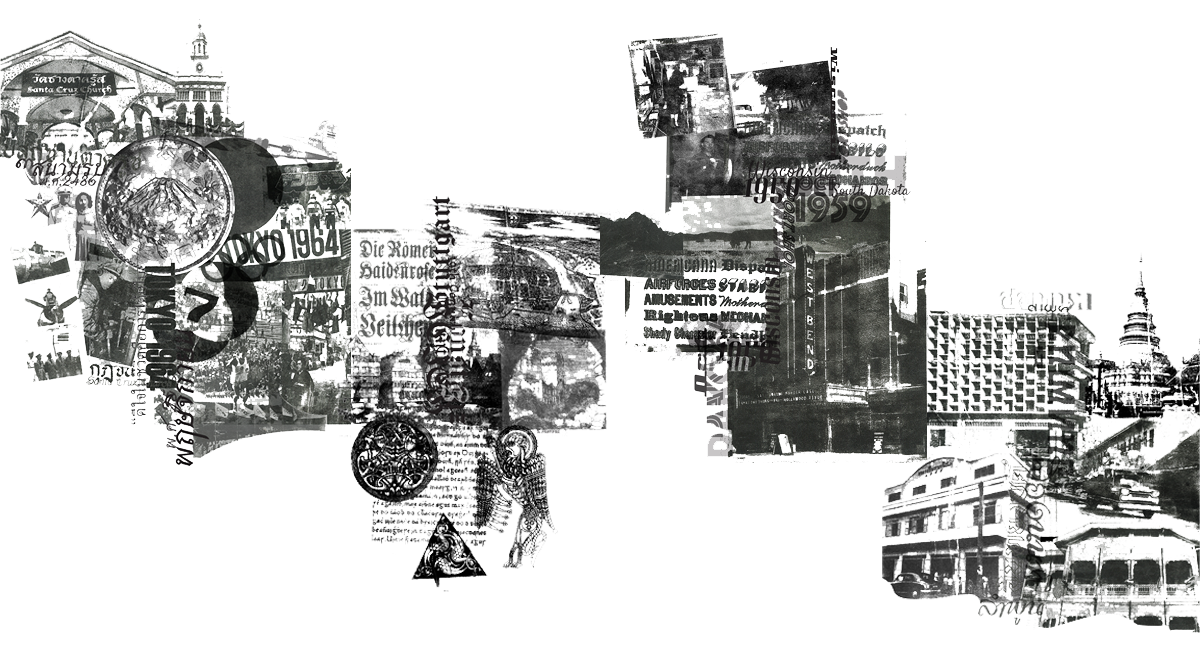
The investigators organized and categorized the collected information around three memorable places, events, and situations, transforming selected stories into a series of key photographic visuals. Personal photographs, family documents, objects, places, historical imagery, and typography were combined to represent experiences inherited rather than directly lived. Selected materials included marriage certificates, family homes and businesses, military records, significant temples and communities, Nonthaburi City Hall, and photographs documenting the parents’ experiences in Tokyo in 1964, including their work translating Japanese television programs. Historical and period-specific typography was incorporated into the compositions to reinforce the cultural and temporal contexts of each story.
The project uses paper lithography as both a printmaking technique and a metaphor for intergenerational transmission. Photocopied photographs, archival imagery, graphic elements, and historical typography are transferred onto lithographic plates using water and gum arabic. Ink is then applied, washed, and printed onto dampened paper through a press. Variations in ink density, grain, texture, absorption, and fragmentation produce images that are materially imperfect and layered.
These qualities connect the physical process of printmaking with the processes of memory and postmemory: stories and images are repeatedly transferred across generations, retaining traces of their origins while becoming transformed through time, interpretation, and transmission.
Techniques and Materials :
Both investigators while working on the paper lithography technique, reflecting the selected stories multiple times through the grouping, composition arrangements, and the action of pressing through the printing press machine. The process again is the representation of the reflections of “Postmemory” through “Primary Mediums of Transmission” (Hirsch, M., 2019). Family narratives, photographs, and records remind the investigators again of what was embedded in them through their ancestors’ stories and have transformed to the investigators’ times. Each investigator draws the connections linking the past to the present and all the process is documented. The participation of family members through series of interviews and discussions about their stories that have passed through from generations to the present time, is essential for the investigators not only for the development of the work’s content, but also as co-creator of the works sharing all emotions attached to the used medium with the investigators. This is replying to the Participatory Design approach to the design process (Armstrong, H., Zvezdana, S., 2011), allowing the selected group of audiences to be part of the creation process (2023).
The collections of key visuals and typographic letterings chosen from the selected stories and the stories’ timelines, the investigators compose a series of digital montage compositions applying and implementing the five key principles of Neuro Design introduced by Darren Bridger (Bridger, D., 2017) into the creation of all design four photomontage compositions. The five key principles cover; 1.) Processing Fluency and 2.) First Impressions, both principles are integrated in the composition through the arrangement of hierarchy of photos and typography and emphasis areas. 3.) Visual Saliency, the interesting content from the “Primary Mediums of Transmission,” stories, photos and typography used in the compositions, 4.) Nonconscious Emotional Drivers happen when the audiences are automatically driven emotionally by the design works accomplished by Visual Saliency (No.3 above). And 5.) Behavioral Economics, the Nonconscious Emotional Drivers (No.4 above), assist in the awareness of the changing of audiences’ behaviors (2017).
Result / Conclusion :
The project investigates the construction and transmission of familial memory through personal archives, oral histories, migration narratives, and material processes of image reproduction. By combining photographs that predate the creators’ lived experiences with family documents, historical imagery, and typographic references, the work situates individual memory within broader histories of migration, displacement, and cultural inheritance. Interviews with older family members demonstrate that family history is not a fixed or complete record, but is continually reconstructed through recollection, documentation, interpretation, and gaps in available evidence.
The paper lithography process reinforces these ideas through its reproductive and transformative qualities. Grain, tonal variation, fragmented details, and tactile surfaces produced through photocopying, inking, washing, and printing create a visual language that parallels the instability of remembered and inherited histories. The resulting images function not simply as representations of the past, but as material sites where personal memory, archival evidence, and imagined histories converge.
Future development could strengthen the relationship between archival research and the physical language of the prints. Additional family photographs, handwritten documents, letters, maps, immigration records, and other primary sources could expand the archival dimension while maintaining visible distinctions between documented history and reconstructed memory.
The project could also further explore relationships between the German, Irish, and Asian family histories through typography, geographic references, and archival imagery used as recurring visual elements. Experimentation with scale, transparency, layering, cropping, and repeated printing could intensify the sense of temporal fragmentation and emphasize the incompleteness of inherited memory. Variations in paper, ink density, and printing pressure could become deliberate material strategies for communicating clarity, absence, loss, and recovery.
Further oral-history interviews could introduce multiple perspectives on shared family events, revealing how memories shift across generations and how narratives are shaped through selective remembrance. These developments would strengthen the project’s engagement with postmemory by placing the tension between historical evidence, personal interpretation, and material transformation at the center of the work.
References :
- Armstrong, H. and Stojmirovic, Z. (2011). Participate: Designing with User-Generated Content, A Designer’s Guide to Co-Creation: Princeton Architectural Press, New York.
- Bridger, D. (2017). Neuro Design; Neuromarketing insights to boost engagement and profitability. Kogan Page Limited; New York.
- Brown, S. (2018). Paper lithography: A printmaker’s guide. Bloomsbury Publishing: London.
- Hirsch, M. (2019). Connective Arts of Postmemory. Analecta Política. 9. 171-176. 10.18566/apolit.v9n16.a09.
- Hirsch, M. (2008). The Generation of Postmemory: Poetics Today, 29 (1): 103-128. Accessed 18 September 2026 from: https://doi.org/10.1215/03335372-2007-019.
- Kim, J. (2021). The memory struggle: Archives of postmemory in contemporary Korean photography. Trans-Humanities Journal, 14(1), 63-89. https://www.researchgate.net/publication/350012732_The_memory_struggle_archives_of_postmemory_in_contemporary_Korean_photography.
Share :
Facebook
Twitter
LinkedIn
WhatsApp
Email
Print